
























When Lilith tells the other girls a folktale about a snake-woman, she briefly becomes someone they want to listen to. At Priscilla’s tea party in Alyce Tzue and John Ripa’s animated Steps, that attention threatens the hostess’s control. Priscilla tricks Lilith and her younger sister Margot into a storm drain and locks them behind its gate. Cinderella, whose father has married the sisters’ dressmaker mother, has already welcomed them into the family. Defending them now would mean risking her place among the popular girls. She stays with the girls.
The sisters’ cheongsams and black hair already distinguish them within Alouette’s predominantly white society, dressed in the pastel extravagance of rococo fashion. Their mother, Li Mei, must accommodate the local taste for voluminous European dresses in her work.
Priscilla polices the same hierarchy through friendship: Lilith may attend, but she cannot displace the girl whose appearance defines the accepted ideal. Cinderella’s silence helps enforce the distinction. Her kindness at home offers the sisters little protection when its public expression would cost her something. Nobody has to announce a doctrine of racial superiority for these girls to learn whose comfort takes precedence.
Lilith’s subsequent goth makeover makes that social calculation visible on her body. Black and purple, heavy boots, skull embroidery, and an asymmetrical haircut replace the hope of blending in. Olivia Rodrigo’s “Brutal” supplies an efficient soundtrack for the conversion of humiliation into attitude. The sequence understands how defiance can offer control over an unwanted distinction: Lilith will decide what makes people stare.
Yet her clothes remain addressed to the society she rejects, particularly to Cinderella. Ali Wong gives her sarcasm the practiced ease of a defense rehearsed until it becomes conversational habit. Her resentment can be funny without becoming evidence that the original rejection was deserved.
The Fairy Godmother then supplies a substantial complication to this account of belonging. Cinderella’s charmed existence has literally been managed by a supernatural benefactor, whose plans include marriage to the Prince. What looks like effortless goodness moving toward its natural reward has enjoyed considerable assistance.
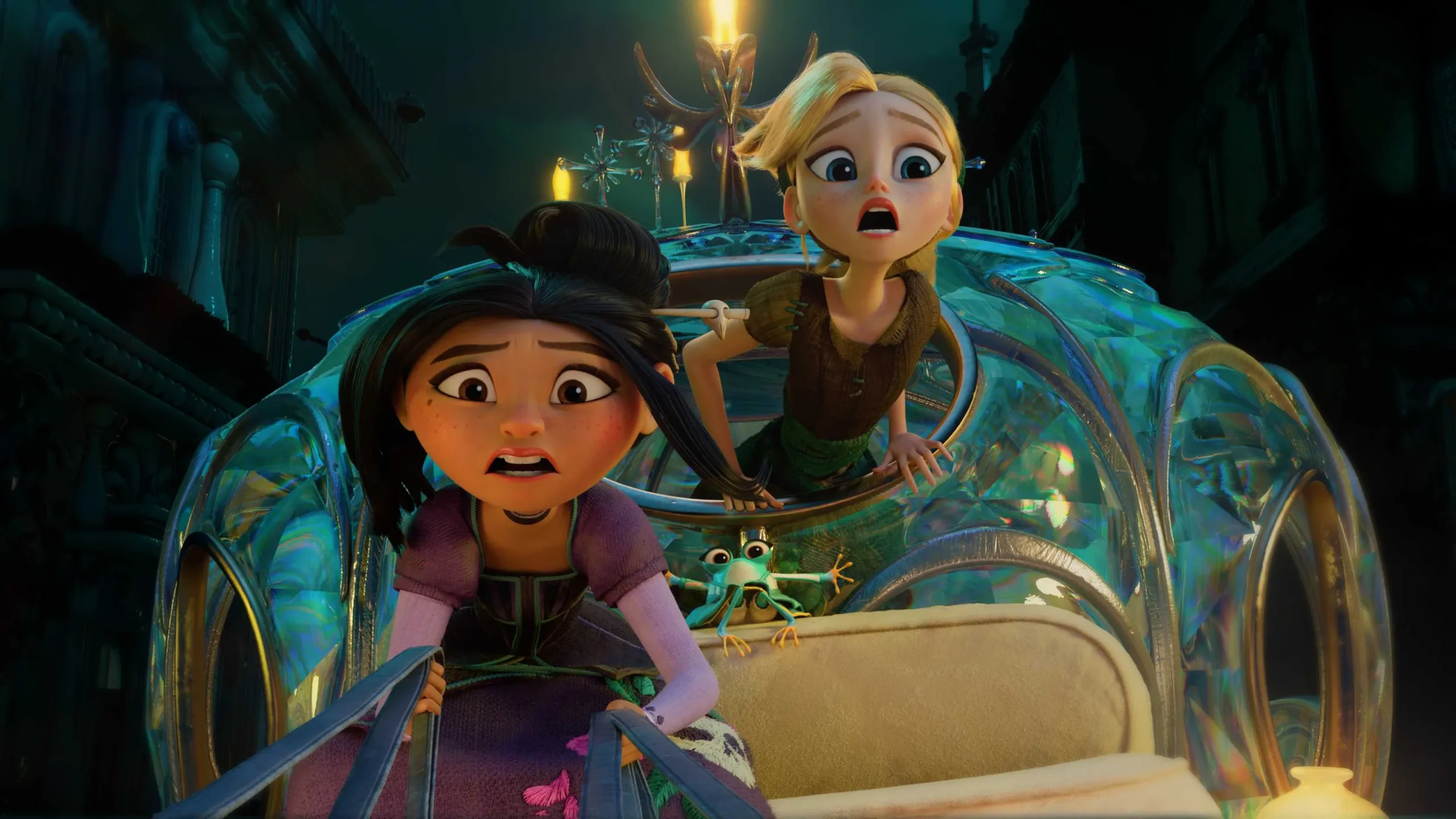
Lilith’s discovery gives her jealousy a material foundation, though stealing the wand is a reckless attempt to correct the imbalance. When Priscilla gains control of it, Margot becomes a frog and Cinderella’s intended romance goes disastrously wrong. The sisters must get the glass slipper back onto Cinderella’s foot before the following midnight. Personal resentment has acquired consequences for the kingdom.
Cinderella becomes interesting once the protections surrounding her cease to resemble the normal condition of life. Perspiration and body odor arrive as bewildering discoveries; danger proves harder to recognize without a magical arrangement smoothing the way. These jokes give privilege an accessible physical vocabulary. The film is sharper still in its treatment of her cleaning.

Here, domestic labor is a compulsive refuge, accompanied by relentless cheerfulness and animal companionship that asks less of her than human intimacy. Amanda Seyfried’s brightness suits a girl who keeps performing contentment. Cinderella’s optimism contains anxiety, and the familiar princess manner becomes an imperfect method of managing it.
That emotional complication sustains the sisters’ relationship through the film’s busiest stretches. Cinderella’s pain does not cancel her conduct at the party, while Lilith’s exclusion cannot make every expression of her anger fair. Their growing cooperation asks both to revise an understanding of the other that has become convenient.
Wong’s defensive humor and Seyfried’s determined sweetness give their exchanges distinct emotional habits to work against. Sisterhood gains weight through the difficulty of that adjustment. The film allows affection to return between girls whose grievances have real causes, avoiding the easier solution of revealing that nobody had anything to answer for.
Its adventure is less patient with the implications. Roderick, Priscilla’s ferocious butler, pursues the sisters; goat-riding biker trolls supply another burst of comic aggression; the gentle troll inventor Gef introduces a romantic possibility for Lilith. Each encounter is readily legible, but the succession increasingly treats movement through the world as sufficient development within it.
The mechanical spider-house offers a pleasingly odd invention without giving the surrounding fantasy much cultural texture. Alouette’s clothing tells us how its inhabitants police belonging. The later attractions largely tell us where the next interruption will occur. Lilith’s explanatory narration compounds the problem by making her perspective emphatic before the action begins repeatedly carrying it elsewhere.
Margot bears the clearest cost of this narrowed attention. Stephanie Hsu’s cheerful younger sister shares an early dance with Lilith, then spends much of the film in amphibian form while Lilith and Cinderella receive the sustained work of estrangement and repair. A talking frog can participate in an adventure, but the transformation also makes it easier to accommodate Margot as comic company.
The revision of the wicked stepsisters’ reputation grants one sister a complicated inner life and gives the other an enduring change of species. Concentrating on a central pair is a defensible choice; presenting that concentration through Margot’s prolonged displacement leaves the family repair unevenly distributed.
The royal romance imposes another restriction, one the film’s jokes cannot quite loosen. Daniel Radcliffe’s Prince uses a slipper to identify his beloved because he is face-blind, an amusing explanation for the fairy tale’s peculiar method of courtship. The joke repairs the mechanism while leaving its authority intact. The Fairy Godmother has written Cinderella’s story in magic, and departure from it threatens disaster.
Gef’s arrival offers Lilith a romantic prospect of her own, but the larger pressure comes from the rescue mission: restoring the favored girl’s intended match becomes everyone’s urgent responsibility. The sisters have room to reconsider their relationship while running toward the palace. Imagining a happy future that does not depend on this particular royal marriage receives far less space within the clock’s demands.
Steps premieres globally on Netflix on November 20, 2026. Directed by Alyce Tzue and John Ripa, the animated musical comedy subverts the classic Cinderella story by following her misunderstood stepsister, Lilith, who teams up with Cinderella after accidentally turning her other sibling into a frog.
Where to Watch Steps (2026) Online
Full Credits
Title: Steps
Distributor: Netflix
Release date: November 20, 2026
Rating: PG
Running time: 1 hour 38 minutes (98 minutes)
Director: Alyce Tzue, John Ripa
Writers: Ava Tramer, James Madejski, Jen Chuck, Dana Schwartz, Felicia Ho
Producers and Executive Producers: Amy Poehler, Jane Hartwell, Kim Lessing
Cast: Ali Wong, Amanda Seyfried, Stephanie Hsu, Nikki Glaser, Daniel Radcliffe, Young Mazino, Peter Dinklage, Bette Midler
Director of Photography (Cinematographer): Alice Brooks
Editors: Edie Ichioka
Composer: Kris Bowers
The Review
Steps
Steps finds real feeling in the distance between welcoming someone at home and defending her in public. Wong and Seyfried give the sisters’ reconciliation humor and emotional friction, while preferential magic makes unequal opportunity tangible. The succession of chases, Margot’s sidelining, and the dependence on a royal match restrict the film’s cultural imagination. Its affection for these girls is persuasive; its willingness to imagine different terms for their happiness is less secure.
PROS
- Perceptive treatment of exclusion and social conformity.
- Sisterly reconciliation preserves responsibility on both sides.
- Wong and Seyfried bring distinct emotional habits to their roles.
CONS
- Successive action encounters crowd the relationship development.
- Margot receives little of the central emotional work.
- The rescue plot remains constrained by Cinderella’s royal match.