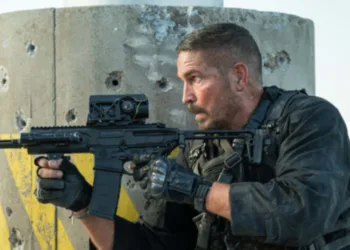


















The soldiers have permission to shoot the man they believe is Matias. They have located their target, watched the encampment, and secured authorization. In The Awakening, the operation proceeds through the proper channels right up to the point at which the jungle starts taking people. Men are pulled into trees and dragged into darkness. The sequence leaves an uncomfortable gap between the precision of the decision and the ignorance surrounding it. Nobody seems to have consulted the place where all this is happening (an administrative oversight, apparently).
Earlier, members of the unit hear whispers and hesitate to mention them for fear of ridicule. This small failure interests me as much as the catastrophic one that follows the shot. Information has already encountered an obstacle inside the group: admitting to an experience outside its accepted categories could damage a soldier’s standing. Their discipline helps them operate together, yet it also discourages them from sharing something they need to understand. Before anything tears the unit apart physically, embarrassment has begun withholding evidence.
The Colombian jungle is also occupied by another expedition, separated from these commandos by roughly five centuries. Spanish conquistadors enter sacred territory associated with Mobuya, a supernatural guardian whose violence reaches across both periods. Cutting between the armed groups makes their equipment seem temporary and their assumptions remarkably durable. Each arrives with a purpose that appears sufficient to justify its presence. The land has an existing claim on itself, one neither expedition has incorporated into its plans.
I want to call the ensuing horror historical justice. But that would let me enjoy the punishment without doing much thinking about the people receiving it. The contemporary soldiers have been sent to eliminate a target; that does not give them the same motives or responsibilities as the conquistadors. The film’s parallel is strongest as a challenge to their assumed authority. As a moral account of individual guilt, it is thinner. Sharing an invasive posture does not settle what each person deserves, and the soldiers’ limited individual development leaves that question largely with their uniforms.
Rojas, the sniper played by Claudio Cataño, becomes useful here. Pushed toward command as the military hierarchy deteriorates, he must assume responsibility at the moment its familiar supports become unreliable. His increasing strain gives the collapse a human point of contact. Having someone to lead is suddenly a burden quite different from having orders to follow. Yet the film gives this pressure too little room among its attacks and historical returns. We can grasp the predicament of command without acquiring an equally strong attachment to the man carrying it.
The survivors’ retreat into a cave should concentrate that pressure. They have four hours until their scheduled extraction, an admirably plain deadline in a film busy with centuries of unfinished business. Outside, danger can come from directions they cannot monitor. Inside, shelter restricts their possibilities. The change of space gives survival a new shape, but the intercutting repeatedly loosens the hold of the immediate situation. The past explains the territory while the present waits to become urgent again.

Those returns have a legitimate purpose. Without the conquistadors, Mobuya could function as another hidden jungle killer, detached from the history of intrusion that gives this story its particular anger. The difficulty lies in what the historical passages contribute after that connection is established.
They keep renewing our understanding of the premise without consistently changing what we anticipate for the trapped soldiers. I found myself intellectually defending the cuts while feeling the suspense drain through them. The historical argument needs duration; the cave ordeal needs accumulating pressure. The film struggles to make the time spent on one serve the other.
Jaime Osorio Márquez’s material shares its origins with the series Thousand Fangs, and Federico Durán and José Luis Rugeles helped reconstruct the feature after his death. That history makes the 96-minute film’s compression understandable, though it cannot settle how well the reconstruction works.
The attacks themselves produce a related tension between meaningful disorientation and simple repetition. When soldiers vanish into burrows or disappear beyond the vegetation, the surroundings refuse to become a readable battlefield. Their weapons offer force without a reliable direction for it.
That is an effective physical expression of the film’s territorial argument: occupying ground has failed to make it comprehensible. But repeated shots of men firing into darkness eventually give us the same information again. Confusion needs to change the danger, or the characters’ response to it, if it is going to keep frightening us. Here, the gunfire can continue after the scene has stopped developing.
The later visibility of the creatures changes the problem. Practical effects and prosthetics give the threat a bodily presence, and physical confrontation supplies an immediate outlet for the soldiers’ panic. There is no inherent failure in letting a monster be seen. What weakens this shift is the uncertain relationship between these assailable bodies and the territorial power the earlier sequences encouraged us to imagine. An unseen attacker could belong anywhere in the surrounding space; a visible creature establishes a position and a possible means of resistance. The action becomes easier to recognize just as the horror loses some of its reach, narrowing the struggle toward soldiers confronting bodies they can aim at.
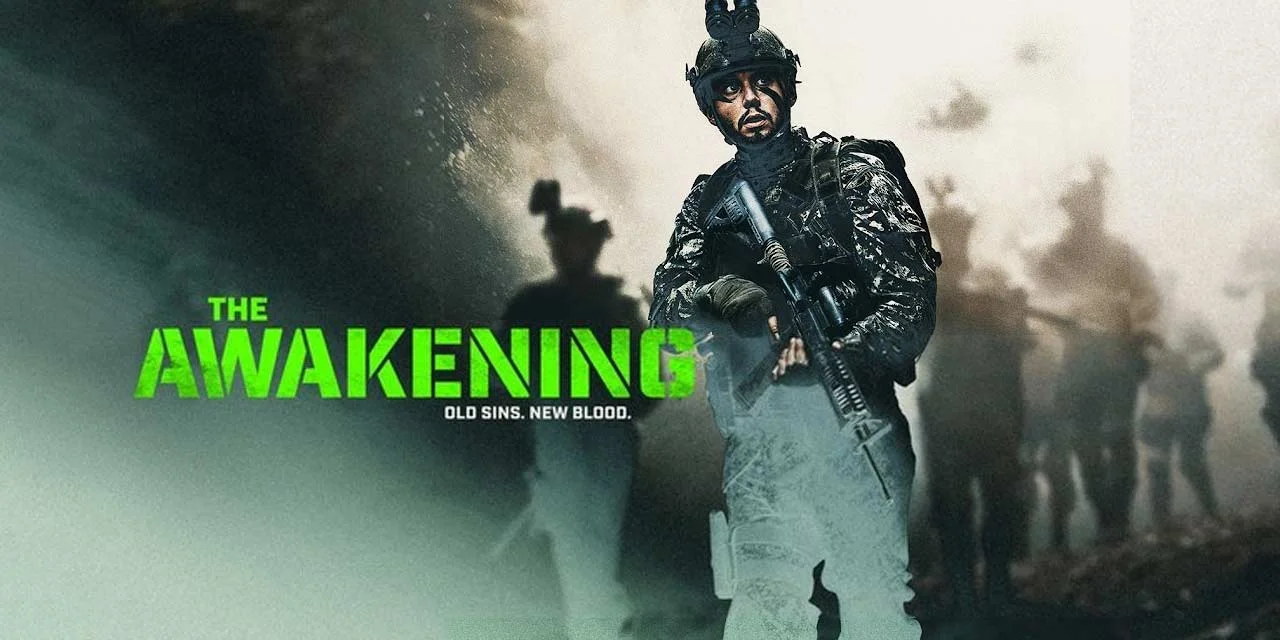
The Awakening was released on digital streaming platforms on November 10, 2026, via Well Go USA Entertainment. Directed by Federico Durán, Jaime Osorio, and José Luis Rugeles, the action-horror film follows an elite military unit on a mission in the South American jungle that encounters a deadly, primeval force also faced by Spanish conquistadors five hundred years prior.
Full Credits
Title: The Awakening
Distributor: Well Go USA Entertainment
Release date: November 10, 2026
Running time: 1 hour 36 minutes (96 minutes)
Director: Federico Durán, Jaime Osorio, José Luis Rugeles
Writers: Federico Durán, Guillermo Escalona, Jaime Osorio
Producers and Executive Producers: Federico Durán, Paul Drago, Luis F. Peraza, Gabriela Remirez De Estenoz
Cast: Salvador Bridges, Alejandro Buitrago, Claudio Cataño, Federico Durán, Jaime Osorio, José Luis Rugeles
The Review
The Awakening
The Awakening has an arresting idea: armed men mistake authorization for understanding, and the territory refuses their claim. Its whispers and disappearances make that mistake frightening. I wish the historical parallels sustained the same pressure. Instead, repeated returns to the conquistadors weaken the cave ordeal, while thin characterization leaves the moral reckoning attached to uniforms. The visible creatures offer something to shoot at, shrinking a threat that was stronger when nobody could locate it. An intellectually charged horror film with an unreliable pulse.
PROS
- Historical parallels challenge the soldiers’ assumed authority.
- Unreported whispers expose discipline’s blind spots.
- Unseen attacks make the jungle frighteningly unreadable.
CONS
- Historical intercutting repeatedly drains the cave suspense.
- Thin characterization limits attachment and moral complexity.
- Repetitive gunfire stalls the attacks’ development.
- Visible creatures narrow the earlier threat’s reach.