















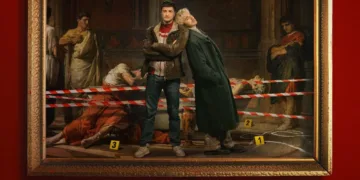















When Elena’s mother pulls an earphone from her right ear, the hospital suddenly grows louder. Masaki Nishiyama makes us hear the interruption from inside the girl’s retreat: muffled surroundings acquire an abrupt, intrusive clarity. The gesture needs no sinister intention to feel uncomfortable. Someone else has decided how much of the world she should admit. Before the supernatural pursuit takes shape in The Invisible Half, this small intervention establishes a question that will become increasingly difficult for Elena to answer. How can she protect herself without surrendering contact with other people?
Nishiyama approaches that question through the uneven distribution of sensory information. An early image briefly connects our view to the reflection in Elena’s eye; later, shots of her looking give us the effort of observation without always supplying its object. Faint sources of light struggle against heavy shadows, and the subdued colour drains warmth from her surroundings. These compositions give her apprehension a spatial logic. There is room for something beyond what she can establish, and the audience must wait inside that uncertainty with her. The darkness makes her caution reasonable before anyone around her understands it.
Elena Takahashi, played by Lisa Siera, has a Japanese mother and a British father. Racist bullying has already preceded a hospital stay and another school transfer. At the new school, she encounters Nyan Ito (Runa Hirasawa), whose constant attention to her phone and refusal to remove her earphones invite further ridicule. Nyan appears to have withdrawn from the classroom. As the haunting moves toward Elena, that behavior acquires a terrible practical explanation: a bandaged figure can be perceived through a smartphone, its movements heard through earphones. What classmates dismiss as antisocial behavior is a means of keeping watch.
The creature walks. Nishiyama understands the possibilities of that unhurried approach, allowing anticipation to develop through the distance it steadily consumes. A low-battery warning then threatens the instrument by which Elena measures that distance. The danger has not necessarily changed its speed; her ability to locate it is failing. Passages aligned with her friend Akari deny us the same visual access, making absence itself difficult to interpret. Footprints in sand establish that the unseen body still occupies physical space. We can lose sight of it without gaining any reason to feel safe.
Technology-mediated terror has a substantial history in Japanese horror, but the comparison with Ringu helps specify Nishiyama’s departure. Here the device provides evidence of an approaching threat. Looking away carries its own danger. For once, checking a phone during a crisis is sensible. The resulting dependency also makes a simple warning about adolescent screen use inadequate: Elena’s defensive habits begin to reproduce Nyan’s isolation, yet asking her to abandon them would mean asking her to relinquish protection. The film gives an apparently familiar social complaint an uncomfortable condition. We know what the withdrawn girl is watching for.
Siera makes that vigilance visible even without the creature. Her guarded posture and hesitant speech suggest someone accustomed to having ordinary encounters turn against her; the strain persists when she is alone. She carries the damage forward rather than switching it on for scenes of overt harassment. Miyu Okuno’s Akari offers a different quality of attention. Their first-day contact and gradual friendship allow Elena’s guardedness to ease, giving Siera room to register the difference between being observed and being welcomed. The bond develops gently enough that the later demands of constant monitoring feel like a threat to something already established.

Akari’s admiration for Elena’s supposedly exotic appearance keeps that welcome from becoming morally spotless. The remark is friendly, and its friendliness still singles Elena out. Okuno’s sincerity permits both qualities to remain present without reducing Akari to a disguised antagonist. This is a useful complication in a film whose bullies are often blunt instruments. Affection can carry assumptions that its recipient must absorb. Alongside the camera’s alignment with Elena, the comment asks us to consider the burden of being visible to others through a characteristic they have already decided defines us.
The treatment of racial identity is less developed elsewhere. Elena’s fractured memories and difficulty retaining childhood English suggest a personal history that cannot be contained by her classmates’ hostility. Yet the repeated school humiliations occupy space that might have given those dislocations greater dramatic consequence. Her conspicuousness among her peers and the invisibility of her pursuer form an expressive relationship, but that relationship does not fully explain why the haunting attaches itself to her. The film’s images make private persecution tangible; the supernatural causality provides a less secure account of how that persecution connects to this particular girl’s identity.
Repetition also weakens techniques that initially have force. The hospital’s change in auditory perspective makes a precise intrusion felt, while later stretches of muffled conversation prolong the experience after its implications are clear. The early school drama has a similar unevenness. Time spent establishing Akari’s friendship gives the pursuit emotional stakes; further demonstrations of familiar cruelty produce diminishing returns. This is distinct from the monster’s slow gait. Its approach changes the immediate danger with every step. Another rehearsal of Elena’s exclusion can leave her dramatic position much where it was.
The late confrontation inside the school gives those positions movement again. Darkness and the building’s layout become practical problems for Elena and Akari to negotiate together, and their improvised responses draw the friendship into the action. The uncertain origin and transfer of the haunting still limit how confidently we can anticipate its rules.
Within the confrontation, though, the unequal access to danger has a clear consequence: companionship requires acting alongside someone whose perception cannot simply be shared. Akari must help Elena contend with a threat she cannot monitor in the same way. Elena must divide her attention between the screen that warns her and the friend helping her survive.
The Invisible Half was released theatrically in Japan on July 31, 2026, before making its North American VOD and digital debut through Cleopatra Entertainment on November 10, 2026. Written and directed by Masaki Nishiyama, the Japanese psychological horror film centers on a high school student who realizes she is being stalked by a terrifying, invisible monster that can only be seen through the screen of her smartphone and heard through her earphones.
Where to Watch The Invisible Half (2026) Online



Full Credits
Title: The Invisible Half (Toumei na Hanhon / 透明な半分)
Distributor: Cleopatra Entertainment, Geek Pictures Inc., EST N8
Release date: July 31, 2026 (Japan Theatrical), November 10, 2026 (North America VOD/Digital)
Running time: 1 hour 46 minutes (106 minutes)
Director: Masaki Nishiyama
Writers: Masaki Nishiyama
Producers and Executive Producers: Atsushi Sakamoto, Ryu Suzuki, Yuki Sakamoto
Cast: Lisa Siera, Miyu Okuno, Runa Hirasawa
Director of Photography (Cinematographer): Shuhei Yamamoto
Editors: Masaki Nishiyama
The Review
The Invisible Half
The Invisible Half turns restricted sight and sound into an uneasy question of trust. Nishiyama’s shadows and battery-dependent suspense make Elena’s vigilance feel necessary, while Lisa Siera and Miyu Okuno give its social cost emotional weight. Repeated school humiliations and muffled dialogue wear down the tension, and the haunting’s connection to racial identity remains insufficiently developed. Yet its most effective horror comes from a precise dilemma: protecting yourself can require habits that make other people leave you alone.
PROS
- Subjective framing and shadow make Elena’s fear tangible.
- Phone-dependent visibility produces sustained suspense.
- Siera and Okuno ground the central friendship.
- The school confrontation makes cooperation essential.
CONS
- Repeated bullying scenes stall development.
- Muffled dialogue becomes overused.
- Unclear haunting logic weakens its identity allegory.







