


























Lucien gives the family dog an RPG battle system and a role in helping its humans through life’s decisions. The joke depends on a change of scale: a format associated with quests and conflict becomes a way to remember the place an animal held in a household. That household belongs to Ellie and Lucien, an elderly couple in Bordeaux whose 57 years together provide the material for Mydear.exe. Their shared interest in games gives Lucien a language for making Ellie a gift.
He puts that language to affectionate use. His work as a bicycle postman becomes a simple side-on cycling challenge, turning a remembered occupation into something Ellie can play. Her interest in photography finds a different expression in coloring by numbers. There is a slight distance between taking a photograph and filling in designated colors, but the activity preserves a patient attention to images. These games have modest demands, often involving only one or two inputs. Their interest lies in the particular lives attached to familiar actions, with each shift of genre introducing another household preoccupation.
The cultural exchange happens at this small scale. A couple in Bordeaux takes forms recognizable to players far outside its home and fills them with memories those players must learn. The dog has a family role before it has a genre role; understanding that connection gives the RPG conceit its charm. Ellie and Lucien’s age also changes the meaning of the collection. Games remain a shared pleasure through which they can address each other after decades together. Lucien makes something for a person whose tastes he knows, using the same medium that already belongs to their relationship.
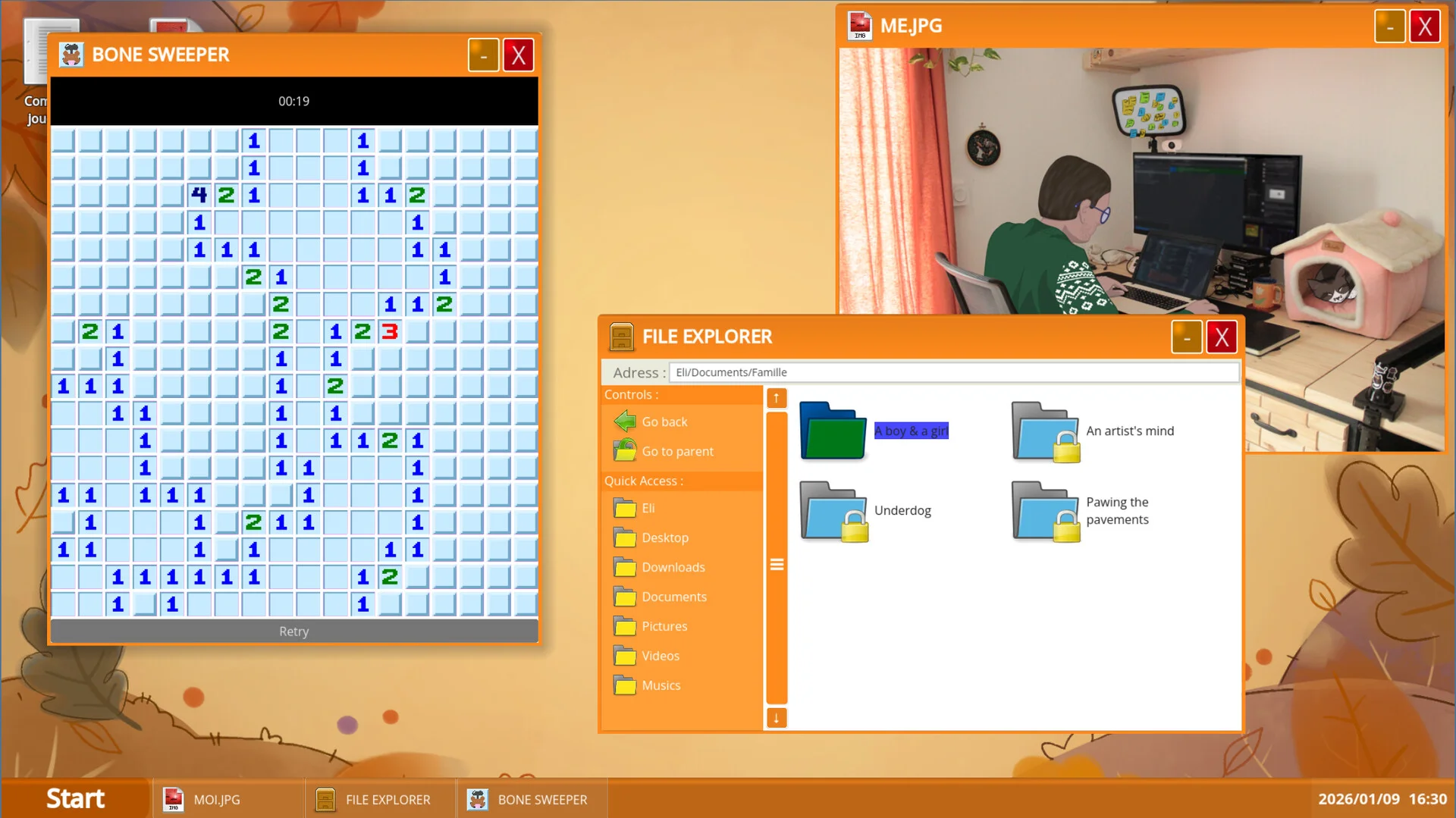
The old family computer accommodates this exchange between private knowledge and recognizable conventions. Playing as Ellie, you open folders containing photographs, letters, documents, and Lucien’s games. The Family folder sits inside Documents, giving personal history an ordinary place within a file system. Their story reaches back to Lucien’s early postal work, when he delivered a package containing a hat for Ellie’s mother and, by his account, fell in love immediately. Such details give the archive something specific to preserve. A delivery becomes part of a courtship, then material for a game made many years later.
Passwords make attention to this material useful. Information discovered in one folder can unlock another, and pictures need to be examined together to assemble a solution. The bookmark system supports that process by letting you bring relevant images back into view. It is a sensible accommodation for a game whose puzzles ask you to retain details from its keepsakes. The clues stay within the files, keeping the work of deduction close to the people being remembered. A photograph can hold your interest as a fragment of their life and still require another look because something in it will let you continue.
That participation has a clear limit. Required minigames and password gates organize a linear progression, so the desktop offers local investigation within a set route. Anyone expecting the freedom of an open computer simulation should adjust those expectations. The structure is closer to a visual novel that distributes its reading across files and small activities. Its two-to-three-hour scale suits that arrangement: the changes between browsing, observation, and simple play give the recollection different rhythms without demanding that every activity sustain a separate game.

The hardware interface can introduce a less useful kind of interruption. Mouse and keyboard are the natural fit for repeated pointing and password entry. Handheld play is possible, but analog-stick cursor movement makes selecting things fiddlier.
On the ROG Xbox Ally X, bringing up the Windows keyboard can obscure the game screen, complicating the repeated act of entering passwords. That particular problem should not be extended to every handheld; Steam Deck play accommodates the game with some cursor awkwardness. Still, a design built around looking from a clue to an entry field benefits from having both comfortably available.
Ellie and Lucien’s spoken recollections give the files a human register that the interface alone could not supply. Their comments and soft chuckles accompany a history of dating, careers, marriage, and thoughts of a family. The warmth comes through the conversational manner of remembering, which allows these records to feel familiar to somebody before they become familiar to us.
The surrounding sound places that intimacy in an ordinary present. Browsing has no continuous musical accompaniment, leaving room for birds, distant traffic, and the computer’s own noises; occasional tunes belong to the minigames.
Familiar reboot sounds and the response of a locked button make the machine audible as an object Ellie is using. Photographs and letters belong to earlier periods, while the sounds around the screen continue in the time of her looking. The family archive occupies part of a room, with birds and traffic still audible beyond it.
The Review
Mydear.exe
Mydear.exe turns familiar game genres into the private language of a Bordeaux couple. Lucien's gift gives postal work, photography, and a beloved pet their own playable forms, while password puzzles make attention to keepsakes useful. Warm voices and everyday sounds give the archive human presence. Handheld pointing and text entry can interrupt that intimacy, but the modest activities suit a story built around shared pleasures and remembered details. Its affection comes from knowing what matters to these two people.
PROS
- Familiar genres personalized through the couple's work, hobbies, and pets.
- Password puzzles reward attention to photographs and documents.
- Warm voice acting gives stored memories human presence.
- Ambient sounds place the archive within an ordinary lived environment.
CONS
- Analog-stick cursor control makes handheld pointing fiddly.
- The Windows keyboard can obscure password entry on the ROG Xbox Ally X.