


















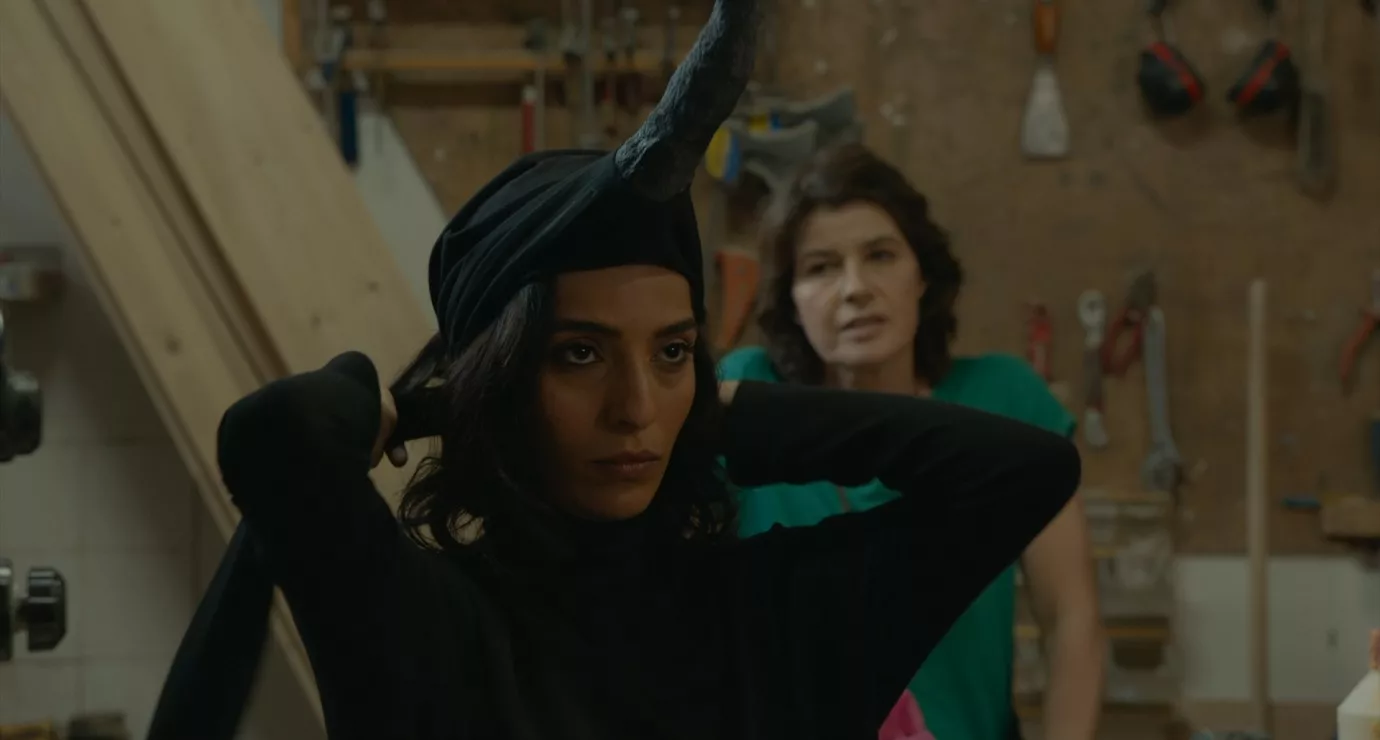

Shikun is Israeli director Amos Gitai’s daring and demanding new film, a loose interpretation of absurdist playwright Eugène Ionesco’s “Rhinoceros”. This Kafkaesque drama unfolds across multiple locations in Be’er Sheva—primarily inside a towering apartment block known locally as “The Quarter Kilometer Building”.
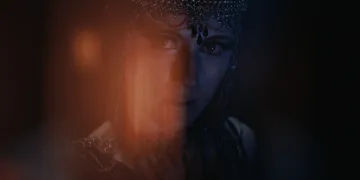
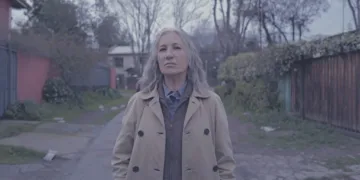
We follow an assortment of disconnected characters as they deliver intense monologues directly to the camera. The narrative through-line comes via French-Swiss actress Irène Jacob, who serves as a kind of one-woman Greek chorus. She floats spectrally through proceedings, periodically commenting in an abstract way on the unfolding sociopolitical implications.
Tonally and stylistically, Shikun is about as far from a mainstream crowd-pleaser as it’s possible to get. This is complex, overtly theatrical art cinema that makes few concessions to casual viewers. The film operates via layers of opaque symbolism and allusion, tackling big themes like authoritarianism and political repression. Gitai originally conceived the project as a response to wide-scale protests against Benjamin Netanyahu’s government in Israel. However, in light of recent events, Shikun may resonate more deeply and take on added dimensions.
Surrealism and a palpable sense of unrest fuel the mood, but linear storytelling this ain’t. You’ll have to actively work for whatever rewards it offers. Approach with patience and an open mind.
Wandering Through a Maze of Metaphors
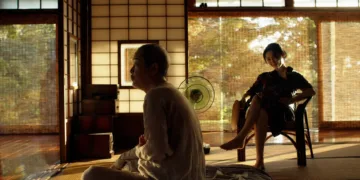
Shikun unfolds primarily across two locations that shape its symbolic backdrop—the aforementioned “Quarter Kilometer Building”, a Brutalist slab of Israeli public housing, as well as a semi-abandoned bus station. This is where we meet our ensemble, a diverse mix of Israelis from all walks of life.

We have longtime residents rubbing shoulders with recent immigrants and asylum seekers. There are Holocaust survivors, Russian Jews, Arab-Israelis, and Orthodox Jews. The lone recurring character is Irène Jacob’s unnamed narrator, our guide through the maze. But rather than a traditional plot, we get fragments and vignettes as she passes the baton to various players.
The scenes unfold in long, elaborate tracking shots—the camera gliding through corridors, down stairwells, in and out of rooms. We get snatches of conversations about arranged marriages, the insensitive siting of a new synagogue, teaching Hebrew to new arrivals. At one point, a marching band bizarrely plays “Amazing Grace” in an underground parking garage.
Other moments hint at rising authoritarianism and occupation in the West Bank. Some references allude to the recent brutal violence, while others point back to Israel’s militaristic history. But any semblance of a coherent storyline proves elusive.
Shikun weaves connections between architecture and oppression, between Israel’s utopian early days and its divided, disenchanted present. Lofty ideals have crumbled into disrepair, both literally and symbolically. Whether through long monologues or heated exchanges, the characters wrestle with their nation’s soul, raging against internal and external threats.
The puzzle pieces are all here, but Gitai intentionally scatters them across a surreal dreamscape rather than neatly connecting the dots. Unpacking it requires some heavy lifting.
Decoding the Dream Language
As an adaptation of absurdist literature, it’s no surprise Shikun embraces surrealism, abstraction, and subjectivity over convention. This is the language of fever dreams rather than orderly narratives. Layers of symbols stand in for linear plot points.

Most potent is the metaphorical use of rhinoceroses, borrowed from the original Ionesco play. As increasing numbers of people “transform” in the story, they come to symbolize the perils of groupthink and blind allegiance to tyranny, be it fascism in WWII or today’s rising tides of Israeli nationalism.
When an Arab woman dons handcrafted rhino horns, the “otherness” connotations prove troubling. And while direct references to the occupation of Palestine are scarce, an atmosphere of authoritarian oppression permeates throughout, represented by the Brutalist architecture itself.
So through avant-garde dialogue and vivid imagery, Shikun externalizes an inner turmoil aroundrecent violence and its aftermath. How does a society reconcile learned prejudices with empathy? What does justice look like moving forward?
By presenting a fractured hall of mirrors held up to his country’s soul, Gitai challenges viewers to extract their own meanings from the deliberate disorder. And while the overarching execution often frustrates, moments of raw emotional truth occasionally shine through.
There are nods to political issues like the unconstitutional expansion of executive power, but the broadly absurdist brush paints a wider societal portrait than any specific movement alone. It’s less an activist rallying cry than an anguished howl into the void, processing wave after wave of ideological crisis through art rather than advocacy.
An Art House Endurance Test
There’s no question Shikun is a demanding viewing experience, even by the standards of highbrow world cinema. Gitai’s approach is avant-garde in the extreme – a hypnotic barrage of unrelenting theatricality and heady abstraction.
The exaggerated acting styles seem lifted straight from the stage. Characters launch into soliloquies and monologues, loudly emoting right at the camera. The script itself is poetic and literarily dense, assuming a culturally literate audience intimately familiar with Israel’s sociopolitical landscape.
Visually, Gitai favors elaborate long takes with the camera gliding slowly over, around, and through the Brutalist architecture. The combination of fixed frames and restless mobility creates a disconnect – we feel trapped yet disoriented.
Occasionally these technical showpieces pay off. One 20-minute unbroken shot follows various characters scattered across multiple rooms and stories, the camera returning periodically to Jacob’s narrator for context. The coordination involved is remarkable, and the score complements the hypnotic mood.
But too often, Shikun privileges artsy technique over resonance. Instead of enhancing the underlying emotion, the non-stop theatrical affectations distance us. It’s all so exaggerated that the line between urgent political allegory and pretentious naval-gazing grows thin.
Part Brecht, part Godard, Shikun is an art house endurance test demanding our attention while rarely earning it. For all its visual audacity and creative fearlessness, Gitai’s misfired polemical experiment lacks a vital grounding heart.
Emotion vs. Abstraction: A Heartbreaking Imbalance
There’s no doubt Shikun is a visually stunning yet mentally taxing piece of cinema. As an immersive mood piece, it often astonishes through technically complex sequencing and vivid performances. But as a cohesive storytelling vehicle, it’s found wanting.

Following the plot proves nearly impossible, even for those well-versed in Israeli culture and politics. The onslaught of oblique symbols and breathless intellectual references assumes a depth of pre-existing knowledge that’s alienating in its specificity. Perhaps if you’re an archivist of Gitai’s filmography some threads resonate more deeply, but as a standalone work, Shikun bewilders more than it illuminates.
Which isn’t to say it’s devoid of resonance. Despite the arm’s length intellectualization, glimpses of emotional truth occasionally pierce through when the text is allowed space to breathe. Hearing words written by children condemned to concentration camps or a soldier’s future hypothetical remorse creates tiny windows into the characters’ inner being.
But these moments fade quickly as Gitai’s relentless showmanship takes over. And when making grand political statements, the speeches come across as ironic detachment rather than conviction. References to Gaza, while potentially profound, feel conveniently tacked on in hindsight rather than baked into the original conception.
Perhaps that’s the limitation of approaching authoritarianism through avant-garde absurdism rather than humanism or documentary realism. Unlike the direct empathy of something like Waltz With Bashir, Shikun intellectualizes oppression as an abstract academic exercise. The rational overwhelms the instinctual, leaving us to marvel at the artifice rather than lose ourselves in the message.
So while I’ll gladly celebrate Gitai’s bold experimentation and visual craft, as a politically galvanizing conversation starter, Shikun rings hollow. The head receives nourishment aplenty, but the heart goes hungry, and a film without heart is a meal without substance.
An Admirable Misfire for the Art House Crowd
As an avid cinephile, I admire Gitai’s bold swing-for-the-fences ambition even as Shikun ultimately misses the mark for me. It brings an assured technical command and thoughtful conceptual framework rooted in a clearly deep passion for his country’s soul. But the experience itself proves isolating when emotional connection should be paramount.
I suspect the film will hold great appeal within certain rarefied circles – devotees of avant-garde cinema who prioritize audacity and abstraction over accessibility. There is pleasure in untangling the intricate craftwork and allowing Gitai’s visual poetry to wash over you. Yet that pleasure is often cerebral rather than visceral.
Casual moviegoers are advised to steer clear. But adventurous arthouse crowds who relate to provocative filmmakers like Alejandro Jodorowsky, Leos Carax, or Carlos Reygadas may lose themselves in Shikun’s elaborate formalism and brash political commentary. Just prepare for an austere, demanding work that intentionally defies easy interpretation.
Amos Gitai has forged a defiantly singular artistic voice over decades spent examining Israel’s sociopolitical identity. While Shikun doesn’t fully deliver on its lofty ambitions, I’ll eagerly await his next act. Perhaps in a less indulgent work more grounded in emotional accessibility, his vital perspective could create something truly remarkable. Until then, Shikun stands as a pivotal transition point – the bold experiments of a restless auteur searching earnestly for the right form to match the message.
The Review
Shikun
A technically impressive but emotionally remote piece of avant-garde agitprop. Shikun's layers of opaque symbolism showcase Amos Gitai's bold artistic voice, but the film's cerebral approach distances more than it connects.
PROS
- Visually stunning cinematography and elaborate long takes
- Ambitious and creative interpretation of the source material
- Great performances, especially by Irène Jacob
- Evocative score heightens the poetic mood
- Thought-provoking themes and sociopolitical commentary
CONS
- Very demanding, avant-garde style with little mainstream appeal
- The abstract symbolism is often impenetrable
- Prioritizes artsy technique over emotional engagement
- Scattered narrative hard to invested in
- Politically muddled and heavy-handed at times