





















![Kingdom Hearts Collection [I-III] Review](https://gazettely.com/wp-content/uploads/2026/10/Kingdom-Hearts-Collection-I-III-1-360x180.webp "Kingdom Hearts Collection [I-III] Review: KHII Holds Steady as Newer Entries Fluctuate 37")



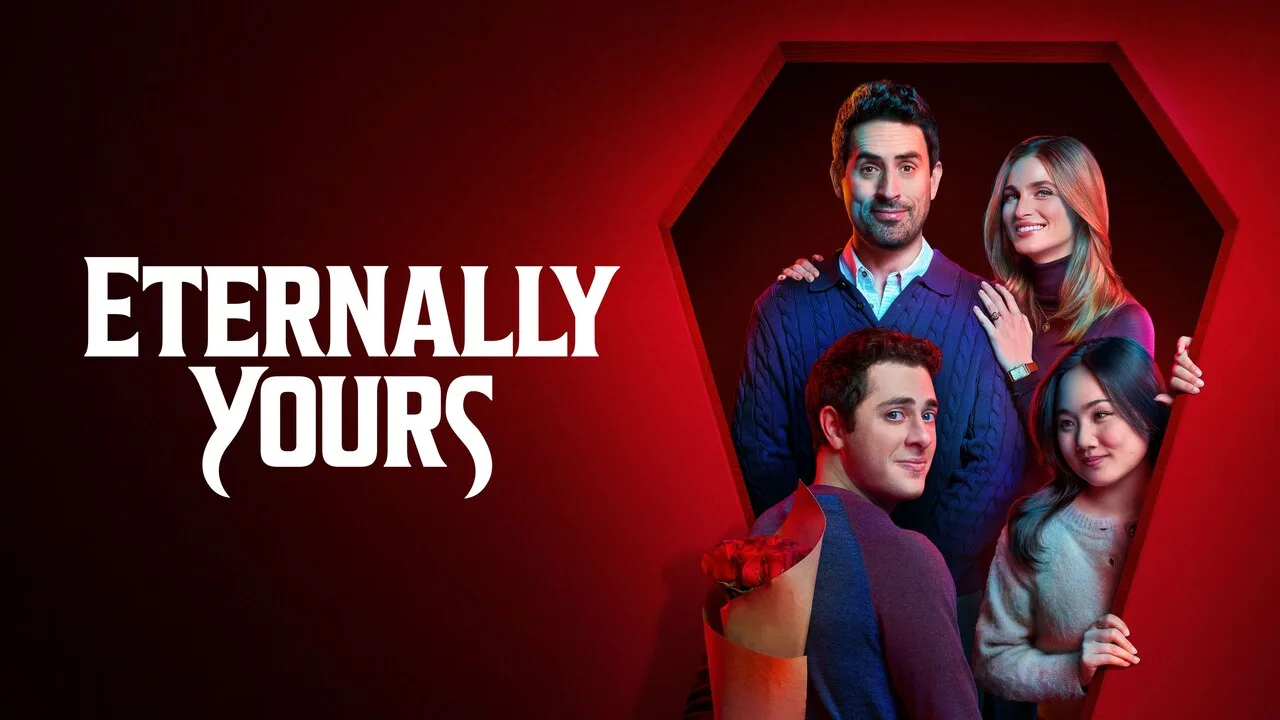

Liz has had five hundred years to reconsider her husband’s throat-clearing. What once seemed endearing now irritates her, which gives Eternally Yours a domestic problem small enough to recognize and a duration large enough to make it absurd. Charles has scarcely needed to change for Liz’s response to him to change completely. Their romantic beginning in 1526, when he turns her into a vampire, survives as an awkward piece of evidence against their present unhappiness: they really did want this.
The Council of Elders makes that evidence difficult to assess. Vampire divorce is forbidden, with staking available to anyone determined to challenge the policy (customer retention taken seriously). Charles and Liz’s continued marriage tells us little about their continued willingness to be married. Even Charles’s contemplation of death as an escape has a miserable logic. I initially read their predicament as affection exhausted by time. The prohibition introduces another possibility: they have spent centuries being denied the opportunity to choose each other again.
Joe Port and Joe Wiseman’s CBS comedy locates this arrangement in a Seattle household, but the pilot sometimes seems impatient with the domestic behavior that gives it substance. Jesse, another vampire in the coven, explains the divorce restriction to people who already know it. An institution that could acquire comic weight through its interference arrives as information the audience must receive. Charles’s irritation and Liz’s changed response to his habits let us infer a history. The dialogue about vampire regulations keeps stopping to certify it.
Yet my suspicion that the family’s warmth is simply a pleasant covering for captivity runs into Liz.
Her adopted daughter Emma is secretly dating Max, a human investigator for the Social Security Administration. Liz’s response to him shifts from potential predation to maternal pleasure in his university achievements, and she supports him against Charles’s disapproval. Allegra Edwards makes use of an amusing continuity between these responses: Liz can assess a young man as food and as a suitable boyfriend with comparable seriousness. The shift gives her an attachment that the divorce prohibition cannot explain. She recognizes something of her early relationship with Charles in Emma’s romance, even while living with its exhausted later version.
That recognition complicates the pilot’s cynicism. Liz can remember the excitement of choosing Charles without pretending their present life is satisfactory. Edwards and Ed Weeks give the bickering enough residual attraction to keep the original romance from looking like a mistake everyone has finally understood. Emma and Max’s earnestness, carried by Helen J. Shen and Jaren Lewison, then occupies an uncomfortable position beside them. Their happiness offers Liz a recollection of possibility; for the audience, Charles and Liz offer an example of what can happen to possibility when it becomes permanent.
Jesse’s marriage supplies a harsher version of the same problem. He remains physically youthful while his human wife, Phyllis, ages. The apparent reversal of their ages has comic usefulness, but his method of keeping her ignorant is the consequential detail. Whenever she discovers his vampire identity, he erases her memory. These interventions damage brain cells. Continuity here requires one partner to lose the knowledge that might alter the relationship.
Phyllis cannot even accumulate an informed grievance.
Parker Young and Rose Abdoo give the pairing comic energy, but the mechanism keeps interrupting the relationship’s capacity to generate its own conflict. Discovery should allow Phyllis to reassess the man she married. Jesse’s power removes that reassessment and restores the arrangement he prefers. A comedy can make such conduct funny without endorsing it; the difficulty is that the joke also confiscates its own consequences. Each erasure makes his convenience available again while taking something from her. The pilot demonstrates that imbalance, although one episode cannot establish how thoroughly the series will explore it.
Max’s employment offers a better way to make an immortal life collide with an ordinary system. Jesse has collected Social Security benefits for suspiciously long, bringing Max to the household on official business. Bureaucracy notices what Phyllis has repeatedly been prevented from retaining. The coincidence that assigns this investigation to Emma’s boyfriend is convenient, but the underlying collision has a comic logic: a benefits record can preserve an inconvenient history even when a husband can delete it from memory.
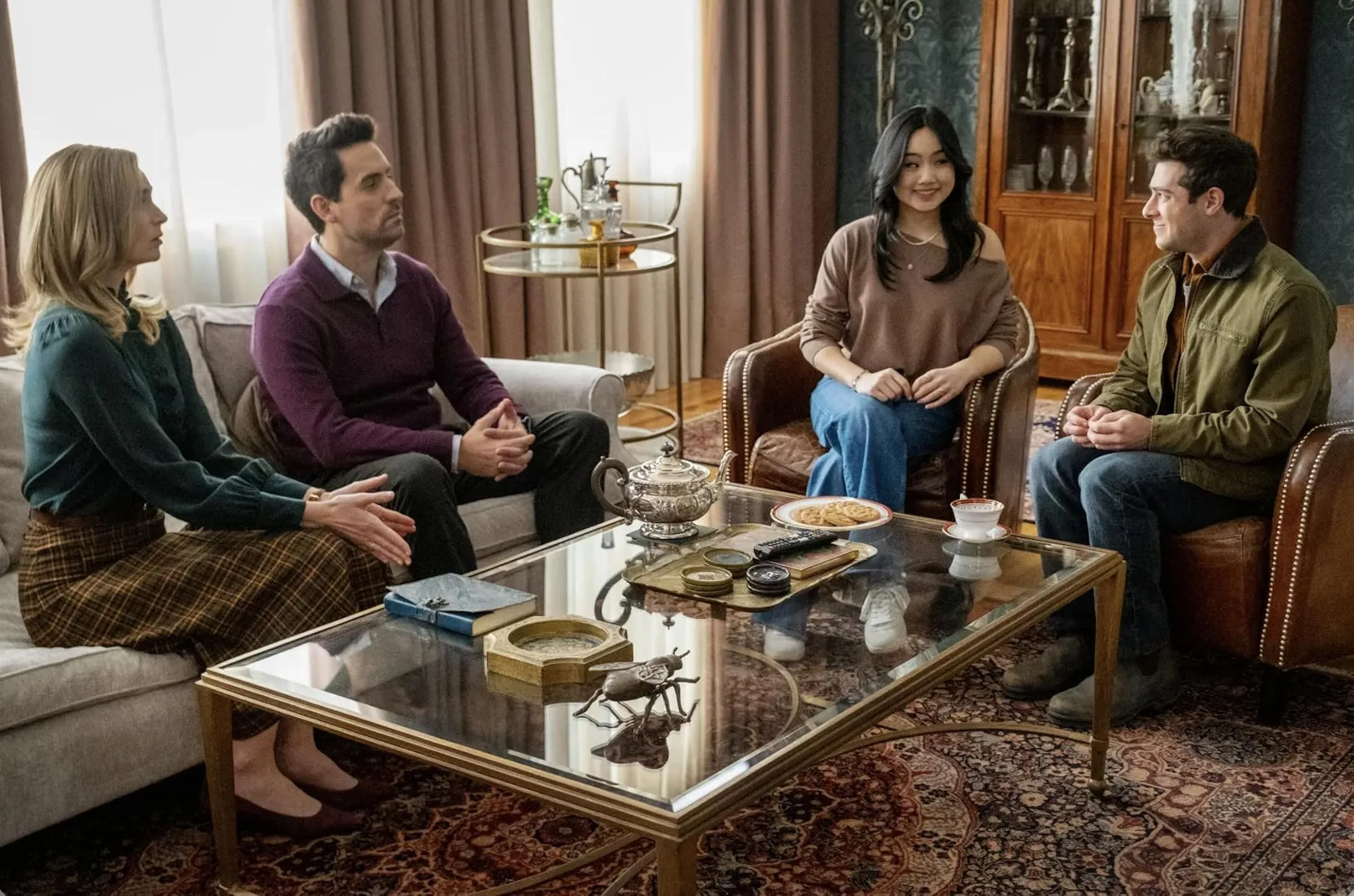
The episode then moves rapidly through exposure into another condition altogether. Max discovers the coven’s identity, suffers a fatal accident, and is turned into a vampire to save him. His narration initially gives us a human route into the household; the closing transformation places him inside its predicament. The concern is the limited time the pilot gives Emma and Max’s relationship before changing the terms on which we understand it. Their secrecy, the parental confrontation, and his conversion compete for space with explanations of the world he has entered.
Charles once turned Liz so that their love could continue. Max’s rescue gives the younger romance a related prospect under different circumstances. His girlfriend’s parents now represent a span of experience he can share, rather than an eccentricity he must accept from outside. Emma has chosen a human partner beyond the vampire relationships she knows, only to end the episode with someone who must learn to live within her family’s condition.
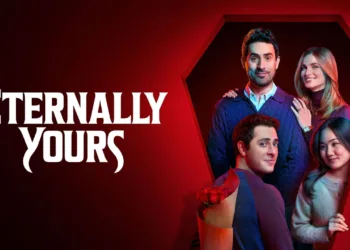
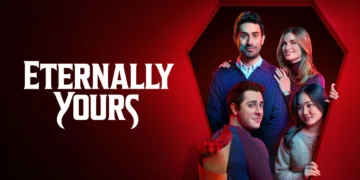
Eternally Yours is a supernatural family sitcom that premiered on CBS on October 8, 2026. Created by Joe Port and Joe Wiseman, the series follows Charles and Liz, a married vampire couple in present-day Seattle whose five-century relationship has settled into a routine, until their daughter’s human boyfriend unexpectedly disrupts their household. You can watch new episodes weekly on CBS or stream them live and on-demand via Paramount+.
Where to Watch Eternally Yours Online








Full Credits
Title: Eternally Yours
Distributor: CBS
Release date: October 8, 2026
Rating: TV-PG
Running time: 30 minutes per episode
Director: Trent O’Donnell
Writers: Joe Port, Joe Wiseman
Producers and Executive Producers: Joe Port, Joe Wiseman, Eric Tannenbaum, Kim Tannenbaum, Jason Wang
Cast: Ed Weeks, Allegra Edwards, Helen J. Shen, Jaren Lewison, Parker Young, Rose Abdoo, Tristan Michael Brown, Shylo Molina
Director of Photography (Cinematographer): Dan Zampa
Composer: Jeff Cardoni
The Review
Eternally Yours
Five centuries together would be impressive evidence of devotion if divorce were legal. Eternally Yours finds real comedy in that uncertainty, and Liz’s warmth keeps its family from becoming a purely cynical exercise. The pilot is less assured about letting those relationships develop: explanations interrupt behavior, Phyllis’s erased memories suppress conflict, and Max’s transformation arrives before his romance has much room to breathe. An engaging cast sustains a pilot whose implications are richer than its execution.
PROS
- Ordinary marital irritation gives immortality a recognizable comic scale.
- Edwards and Weeks preserve attraction beneath the bickering.
- Liz’s maternal warmth complicates the family’s darker dynamics.
- - The Social Security investigation gives supernatural longevity a bureaucratic consequence.
CONS
- Expository dialogue interrupts character interaction.
- Memory wipes short-circuit Phyllis’s response to discovery.
- - Rapid premise changes crowd Emma and Max’s developing relationship.