
























![Kingdom Hearts Collection [I-III] Review](https://gazettely.com/wp-content/uploads/2026/10/Kingdom-Hearts-Collection-I-III-1-360x180.webp "Kingdom Hearts Collection [I-III] Review: KHII Holds Steady as Newer Entries Fluctuate 37")



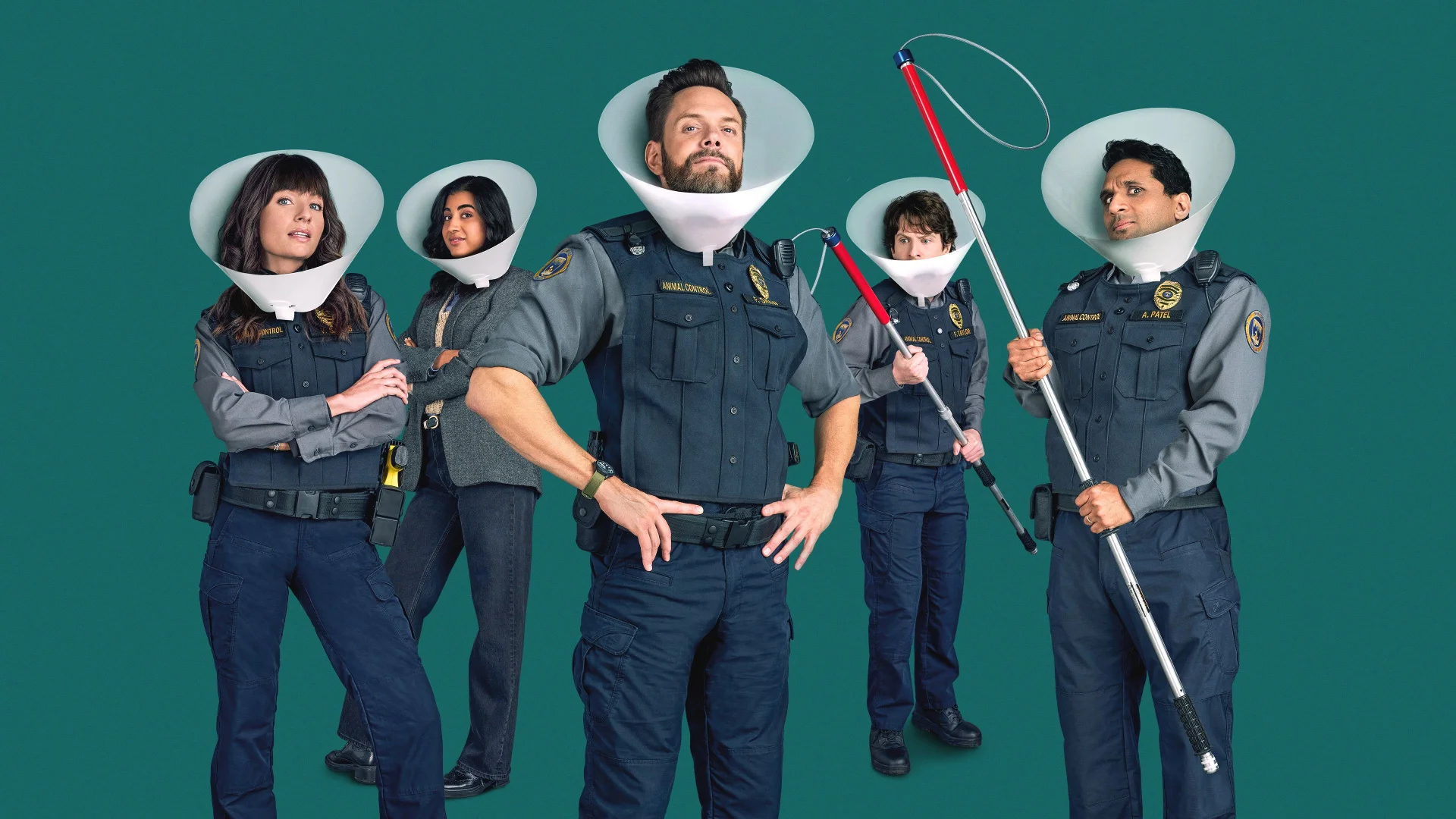

Frank Shaw waits for someone else to suggest retrieving Hopper, then Animal Control cuts to him already halfway to the door. The edit skips the interval in which he might pretend to consider the idea. Joel McHale’s movement supplies the answer before Frank can protect himself with an irritated remark. Having surrendered Hopper to Roman Park on Shred’s advice, he needs very little encouragement to reverse course. I love the economy of that joke: Frank gets to preserve the fiction that he is following somebody else’s lead, while we see how badly he wants to go.
The same episode, “Lost Dogs and Bar Flies,” finds another use for Frank’s unwillingness to explain himself. He hangs his head out of the truck window looking for Hopper; the scene cuts to Roman doing the same while searching for Charise. Repeating the action makes these antagonistic men look briefly alike. Ken Jeong’s exuberance and McHale’s impatience arrive at the same undignified posture, with Michael Rowland’s Shred sitting between them and accepting the inconvenience. His willingness to accommodate both men gives the visual joke a third personality.
Those scenes come in the fourth episode of a season whose opening five installments gradually find firmer comic footing. Fox’s Seattle workplace sitcom has enlarged its precinct through a merger, bringing Templeton and his partner Daisy into the Northwest Division while Emily manages the expanded team. There is useful disruption here, although introducing the newcomers initially pulls attention away from the established group. Episode four’s shared lost-dog call helps restore that collective energy. The officers become funniest when the job forces their separate preoccupations into the same space.
Daisy and Templeton’s arrival also changes how we see an existing partnership. They work comfortably together and spend time together outside their shifts. Frank and Shred have built something considerably less reciprocal, sustained by Shred’s determination to keep offering friendship.
With Shred now occupied by his developing relationship with Emily, Frank can feel the withdrawal of attention he has usually taken for granted. Kyla Pratt gives Daisy an easy presence, and her existing connection with Patel helps her enter the workplace through several relationships. She brings a social life into the precinct rather than functioning solely as Templeton’s companion.
Templeton is harder to settle into the ensemble. Gerry Dee can supply friction, but the writing struggles to reconcile the kindness Daisy describes with his treatment of other colleagues. His attempt to discredit Emily invokes her age and gender; Victoria still has reason to resent his earlier stalking behavior, for which he has never genuinely apologized. These actions make the attempts to soften him feel insufficiently developed. Selective warmth toward a trusted partner is believable. Asking that warmth to carry the audience past his continuing efforts to undermine Emily places too much weight on Daisy’s endorsement.
“Dragons and Dognappers” finds a better use for him by making Frank, newly appointed interim union representative, responsible for defending someone he dislikes. The obligation is built into the job Frank wanted, so the conflict needs little contrivance.
Investigating the dognapping case lets him exercise old detective instincts, while the payoff involving a dog attached to a mannequin’s leg keeps the case agreeably ridiculous. McHale can play professional satisfaction and personal aggravation together. Frank has acquired responsibility without acquiring a sudden enthusiasm for everyone under his protection.
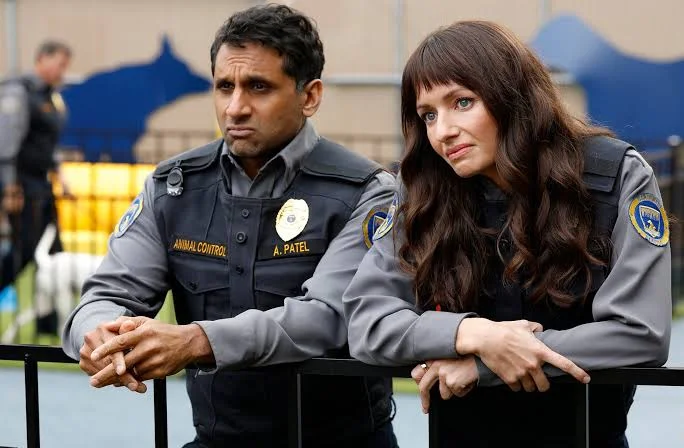
Emily and Shred’s romance creates a different collision between work and private desire. She supervises him, and the risk to her position gives their secrecy a practical basis. Vella Lovell’s tightly wound energy is particularly useful when the show turns embarrassment into physical business.
In “Bagged Birds and Alley Dogs,” Emily’s pant loop catches on a leash hook, while Patel spits tomato juice onto Shred. These mishaps interrupt people already struggling to manage appearances. Rowland keeps Shred’s earnestness active through the awkwardness, making his helpful intentions available for both affection and comedy.
The writing is less satisfying when it skips an uncomfortable encounter. Shred’s breakup with Isabelle reaches us through his later FaceTime debrief with Emily, leaving a significant transition at the level of reported information. We hear the outcome without experiencing the behavior that produced it.
The next episode handles Emily and Shred’s disagreements with greater care, allowing mistakes and apologies to lead into their first date with key lime pie. Their attraction becomes something they must make room for through decisions, giving the relationship activity after its long period of anticipation.
That secrecy also reaches beyond the couple. In episode four, Emily’s golf lie becomes a comic detour around telling Victoria the truth. Grace Palmer’s delivery makes Emily’s attempt to look comfortable especially funny, but Victoria’s eventual hurt concerns friendship: she expected Emily to trust her with the news about Shred. The evasive behavior prepares that emotional turn. Emily has spent energy maintaining a cover story while overlooking what her silence communicates to someone close to her. The episode allows the joke and the grievance to occupy the same interaction.
Patel’s development takes longer to acquire comparable substance. Episode two offers the prospect of a Community Outreach Officer role, yet episode three gives Frank considerably richer activity in his new position. Patel remains caught in the extended house-flip plot.
Bettany’s challenge to his pride and Frank’s decision to rent the property finally move that story in episode four, but the delay has constrained Ravi Patel’s opportunities. “French Bulldogs and White Broncos” then gives him his first outreach fundraiser, with Daisy available as an ally. Emily and Shred’s relationship becomes a supporting complication within his story, a welcome adjustment in how the ensemble’s attention is distributed.
Victoria’s relationships benefit from a more continuous connection between physical behavior and emotional resistance. Episode three leaves her in a sling while she rejects Parker’s help. Her insistence on managing alone has a visible cost, and Palmer and Josh Segarra let disappointment and regret register before she accepts assistance. The scene preserves her independence while showing how defensively she can exercise it. By episode five, that openness is complicated by Frank, whose quick exchanges with Victoria create a shared rhythm Parker struggles to enter.
The horseback encounter makes the complication legible through blocking, the placement and movement of performers within a scene. Victoria looks back toward Frank in the sunset, then Parker runs into the encounter and changes its balance. The direction and editing give us Frank’s disappointment and Victoria’s recognition of his gesture when he gives his horse to Parker. McHale’s restraint matters here: the man who so often makes irritation visible has something less convenient to conceal. His generosity helps Parker participate in an afternoon Frank had reason to enjoy without him.
Animal Control Season 4 premiered on Fox on December 28, 2025. The workplace comedy follows a cynical former cop turned animal control officer and his eccentric colleagues as they wrangle wild beasts and manage their chaotic precinct dynamics.
Where to Watch Animal Control Season 4 Online










Full Credits
Title: Animal Control Season 4
Distributor: Fox, Hulu, Netflix
Release date: December 28, 2025
Rating: TV-14
Running time: 21–22 minutes per episode
Director: Natalia Anderson, Clark Mathis, Brennan Shroff, Jay Chandrasekhar
Writers: Tad Quill, Jim Brandon, Brian Singleton, David Feeney, Jen Jackson, Brad Stevens, Boyd Vico, Sam Shanker, Spencer Taylor
Producers and Executive Producers: Bob Fisher, Rob Greenberg, Dan Sterling, Tad Quill, Jake Fuller, Tony Hernandez, Brooke Posch, Joel McHale
Cast: Joel McHale, Michael Rowland, Vella Lovell, Ravi Patel, Grace Palmer, Gerry Dee, Kyla Pratt, Ken Jeong
Director of Photography (Cinematographer): Matthew Chipera
The Review
Animal Control Season 4
The first five episodes of Animal Control Season 4 find their best laughs in behavior: Frank rushing toward Hopper, Emily maintaining an awkward cover story, and Shred accommodating everyone’s needs. I especially enjoy how the editing lets affection slip past these characters’ defenses. The merger creates useful friction, though Templeton’s attempted softening remains unpersuasive and Patel waits too long for meaningful activity. Episodes four and five bring stronger ensemble connections and emotional turns earned through performance and staging.
PROS
- Precise editing turns character behavior into jokes.
- McHale, Jeong, and Rowland’s contrasting comic responses.
- Romantic secrecy creates believable friendship tension.
- Episodes four and five give the ensemble stronger connections.
CONS
- Templeton’s sympathetic treatment lacks sufficient development.
- Patel’s house-flip storyline delays richer opportunities.
- Shred’s breakup is reported rather than dramatized.







