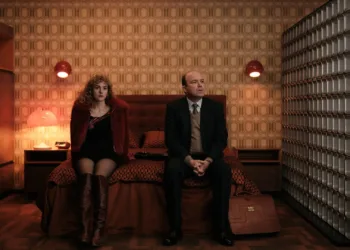






























Melissa and Falk seem faintly troubled by how well they get along. Waiting to finalize their divorce, they laugh, talk easily, and display a familiarity that has survived the decision to separate. Anne Haug and Godehard Giese make their friendliness seem practiced without making it false. Around them, other separating couples offer the hostility one might expect from this particular waiting room. Melissa and Falk wonder if their own arrangement is normal. Apparently, they have found a civilized way to separate and would like someone to check it for defects.
Their doubt interests me as much as their affection. They can agree to end a marriage, yet still feel answerable to an idea of how its ending should look. Calling the relationship a failure would miss the ease between them; calling their separation a mistake would assume that affection creates an obligation to remain married. Meanwhile, the judge has a dreadful cold. Whatever meaning the couple assigns to this occasion, somebody has had to come to work ill.
Fabian Stumm’s third feature, The Ideas, gives this encounter a place among six independent stories set in a wintry Berlin. The characters never assemble into a single plot. Instead, their arrangements keep running into other people’s inconvenient participation. Nadine, played by Marie-Lou Sellem, exchanges sexual messages through false dating profiles while sitting in workplace meetings. At the appointed bar, she watches the men arrive, then deletes the profiles. She has devised a form of dating that gives her exclusive custody of the date.

Sellem’s outward reserve makes the covert messaging funny before the deception becomes uncomfortable. Nadine can observe desire without submitting herself to its scrutiny, granting strangers an intimacy she can withdraw without explanation. When one of the men, played by Hans Löw, approaches her outside, their walk changes the terms. He becomes someone with whom she must spend actual time. Löw’s sympathetic presence complicates her behavior without supplying an excuse for it: the person she has disappointed can still be interested in her. An encounter survives the arrangement intended to prevent it.
The rehearsal episode gives the wish to manage others a noisier setting. Henry, Michael Klammer’s director, tries to make a largely female company realize his intentions, while a punctilious prompter and an increasingly frustrated actress turn execution into an argument. His authority grows comic through its dependence on people who keep answering back. The dispute has a practical object, a scene that must be rehearsed, so its escalating absurdity never needs a separate lecture about artistic ego. Everyone is trying to get the work done. Their definitions of the work are the problem.
Stumm’s own direction allows room for these competing intentions. Michael Bennett’s held medium shots let awkward exchanges occupy shared space, while the displaced compositions deny the performers a comfortably settled position within it. The grey-blue palette gives the separate encounters a common visual climate. With little camera movement across much of the film, speech and reaction carry the changes in pressure; the rehearsal chapter’s greater mobility suits a collective process coming unstuck. The restraint works because a deleted profile, an instruction resisted, or a friendly exchange in a divorce office changes what someone else can do next.
I was ready to read the film as an argument against the names we give relationships. Julia’s reunion with a former student makes me distrust the convenience of that reading.
Julia, played by Maren Eggert, was twenty-two when she had a sexual relationship with the sixteen-year-old boy she supervised. Now an adult, played by Stumm, he has asked to meet her. Their ages and her authority establish an inequality that the passage of time cannot retrospectively remove. The earlier divorce makes a useful distinction here: continuing affection need not validate a marriage, and the existence of intimacy cannot validate the circumstances that produced it. Suspicion of a label becomes evasive if it also dissolves responsibility.
Vivaldi’s “Winter” gives Julia’s approach an unusually forceful musical accompaniment. The camera reveals the waiting man’s guarded expression, then returns to her as the music slows and drops in pitch. Eggert’s composure and Stumm’s restraint make the meeting tense before either face can settle its meaning for us. The score announces emotional magnitude, but the performances keep its ownership uncertain. Her calm tells us little about his experience; his reserve cannot be translated into a tidy statement of what he now wants. The scene earns its weight by making attention difficult. Watching closely does not grant us permission to explain either person away.
This encounter also gives the anthology a connection stronger than shared subject matter. Nadine controls access to an imagined relationship; Melissa and Falk negotiate an ending that confounds expectations; Julia must face someone whose place in her past carries a different burden. These situations require different judgments. Stumm’s willingness to place them beside one another creates friction, rather than a comforting proposition that everyone is simply misunderstood.
There is a cost to leaving each group so soon. Nadine’s walk makes contact possible, but the format cannot test what becomes of that possibility beyond the encounter. The divorce carries greater immediate completeness because the couple has already reached a decision. The episodes do not all offer the same degree of development, even when their premises invite equal curiosity. Nor does this largely white, materially comfortable social world support unlimited claims about human experience. Its precision belongs to a particular set of rooms, freedoms, and expectations.
The last story places two Swedish women visiting Berlin inside a relationship damaged by infidelity. Here, staying together is still a question, and the film’s final embrace cannot answer it on their behalf. After the relative ease of Melissa and Falk’s separation, physical closeness has acquired a less reassuring meaning. Comfort may be offered before trust has been restored, while the person receiving it can still be hurt. Stumm leaves the women holding one another without letting that contact decide how they should live afterward.
The Ideas is scheduled for theatrical release in Germany by Eksystent Filmverleih on January 28, 2027, following its festival circuit appearances. Directed by Fabian Stumm, the drama unfolds across six loosely connected episodes capturing Berlin residents navigating various turning points, transitions, and personal illusions.
Full Credits
Title: The Ideas (Die Ideen)
Distributor: Eksystent Filmverleih
Release date: January 28, 2027 (German theatrical release)
Rating: FSK 12
Running time: 1 hour 50 minutes (110 minutes)
Director: Fabian Stumm
Writers: Fabian Stumm
Producers and Executive Producers: Franziska Gärtner, Nicola Heim, Kaspar Panizza, Nele Schallenberg, Fabian Stumm
Cast: Fabian Stumm, Maren Eggert, Marie-Lou Sellem, Hans Löw, Anneke Kim Sarnau, Romina Küper, Godehard Giese, Angela Winkler
Director of Photography (Cinematographer): Michael Bennett
Editors: Kaspar Panizza
The Review
The Ideas
Stumm makes a persuasive case for listening without surrendering judgment. The friendly divorce and the former student’s reunion demand different moral responses, and the performances preserve that difference. His comedy is sharpest when people discover that everyone else has arrived with instructions, too. Some encounters end before their possibilities develop, and this comfortable Berlin milieu offers a restricted view of experience. Yet the film’s generosity has substance: an embrace can provide comfort while leaving responsibility unresolved.
PROS
- Precise performances sustain humor and moral tension.
- Comedy grows naturally from competing intentions.
- Contrasting encounters resist easy ethical answers.
- Restrained framing gives dialogue and reactions room.
CONS
- Uneven development across the separate encounters.
- Limited social range restricts the anthology’s reach.