




![Kingdom Hearts Collection [I-III] Review](https://gazettely.com/wp-content/uploads/2026/10/Kingdom-Hearts-Collection-I-III-1-360x180.webp "Kingdom Hearts Collection [I-III] Review: KHII Holds Steady as Newer Entries Fluctuate 37")





Saving Sunny gives Aidan Lynch a reason to keep moving through hell, though it offers little emotional reassurance. Their relationship has already become an escalating pursuit of painful sexual experiences when they use the Genesis Configuration during an intimate encounter.
The Cenobites arrive, tear Sunny apart, and take her away. Aidan’s determination to recover her is understandable, but the circumstances leave an uncomfortable question hanging over his rescue: how much of his desperation belongs to love, and how much belongs to the gratification they supply each other? Clive Barker’s Hellraiser: Revival gives that uncertainty room to trouble the apparent simplicity of its objective.
Aidan’s own suffering soon becomes harder to contemplate at a distance. Captured by the Scarlet Church, he is left in a chair with one arm sewn to his chest and the other nailed down. Getting free means confronting the damage holding him there. The scene makes escape feel physically repellent before it can feel hopeful. You want the restraint removed, yet the prospect of removing it produces its own recoil. That small conflict between wanting to act and wanting to look away gives the game an immediate hold on the player, independent of any affection for its protagonist.
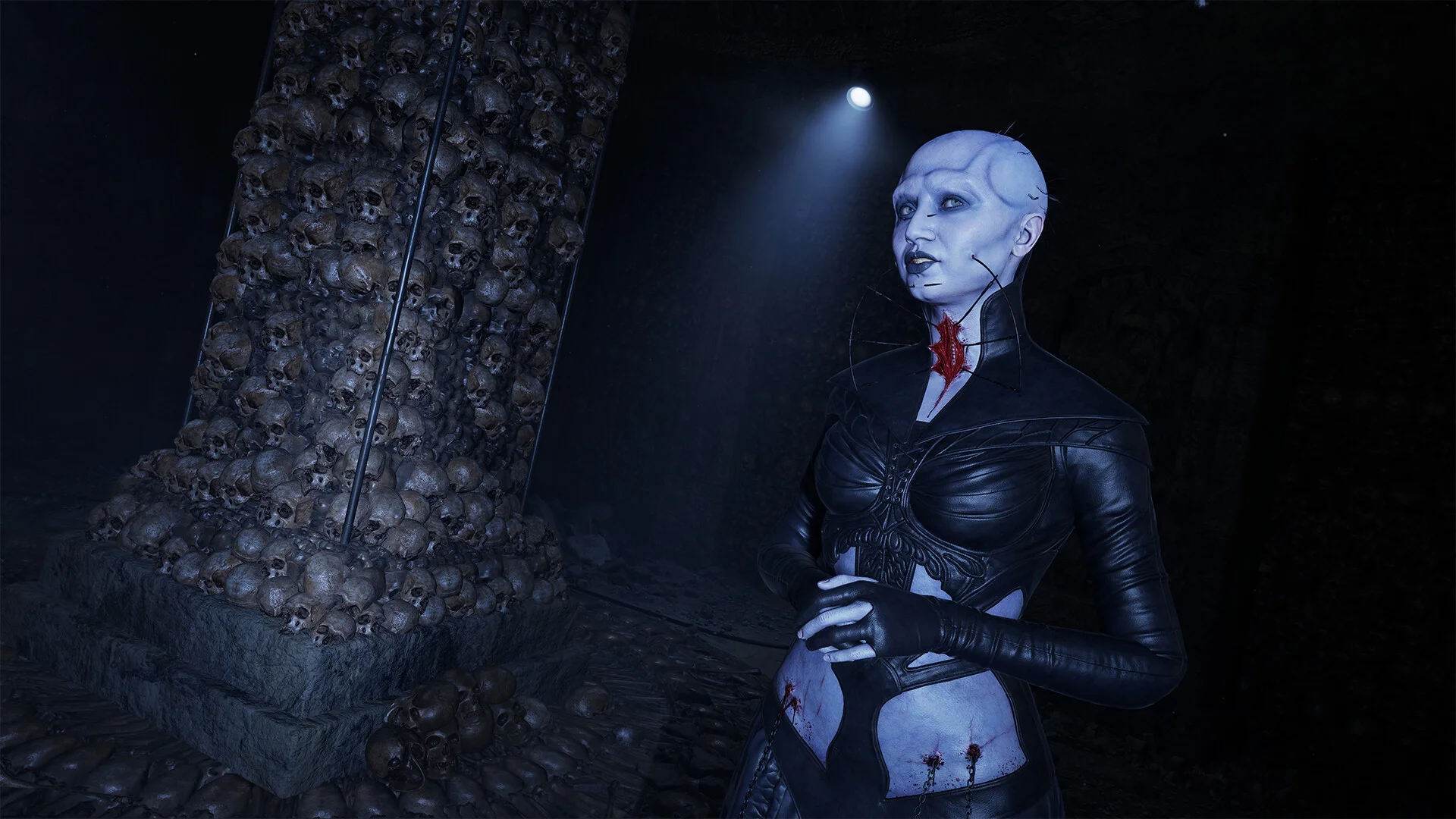
The setting preserves a useful distinction between sexual experimentation and the cult’s violence. Upstairs, the club accommodates people pursuing their desires; below, the Scarlet Church turns bodies into objects of mutilation and sacrifice. That separation matters to the experience of exploring it. Discomfort comes from discovering where pleasure has become coercion, rather than from treating every sexual preference as evidence of depravity. Pinhead supplies a different kind of unease. Doug Bradley’s measured delivery lets sadism arrive with composure, making his presence feel horribly assured beside Aidan’s desperate efforts to recover Sunny.
The Genesis Configuration carries this relationship with pain into the player’s means of survival. Its powers run on Suffering, a resource gathered by dealing and receiving damage. Injury becomes something the game can put to use, an apt connection between its fiction and its actions.
Pulling spikes or saw blades from the surroundings and launching them into enemies offers a nasty satisfaction: the environment that threatens your body becomes material you can turn against somebody else. The relief of gaining power arrives through participation in the same violence that made you recoil earlier.
The box also earns its place outside combat. Changing its shape opens doors, while manipulating platforms, walls, and blocks lets Aidan negotiate the Cenobites’ world. It feels like an object with a continuing relationship to the places around it.
Fire manipulation is especially enjoyable in principle, letting you absorb a flame and send it into a group, but available fire sources confine that pleasure to particular encounters. The ability encourages an appetite for improvisation that the environments only intermittently satisfy. Telekinesis provides the steadier outlet, giving ordinary scraps of the scenery an aggressive possibility.
Conventional weapons struggle to sustain that involvement. Melee hits lack the impact needed to make their brutality convincing, and stiff aiming and movement keep firearms from feeling comfortably responsive. A directional dodge provides a way out of danger, but crowded fights can trap Aidan before he can create enough space.
These encounters produce frustration through the awkwardness of acting on an urgent need. Guns can relieve the vulnerability of earlier passages, which could be a welcome emotional change. Their handling makes that relief less satisfying, leaving the player with greater destructive capacity and a weaker physical connection to using it.
The Labyrinth restores that connection through movement. Confined corridors open onto immense views beneath a lightning-filled sky, and shifting structures make the space difficult to trust. Its scale can invite you to stop and stare even while its traps encourage you to keep going.
Elsewhere, laboratories expose bodies under experimentation, and corpses float through filthy sewers. These locations sustain a curiosity that disgust cannot quite suppress. Revival understands the peculiar appeal of wanting to inspect something dreadful, then feeling uneasy about how readily you accepted the invitation.

That attention becomes urgent when the Chatterer pursues you. Contact means death, and escape can require dodging bladed obstacles or moving blocks with the Configuration while he closes in. Having to solve a spatial problem under those conditions changes the feeling of a familiar interaction.
A block you could calmly reposition elsewhere becomes an obstruction between you and survival. The sequence divides your attention between the task immediately ahead and the creature approaching behind, giving the Labyrinth’s hostility a direct expression in play.
Repeated attempts change that relationship. Some chases are long enough, and their routes unforgiving enough, that a wrong turn leads into another exercise in remembering where to go. The initial scramble can be frightening; learning the required route gradually replaces uncertainty with rehearsal.
Failure starts to mean repeating a known stretch rather than discovering a new danger. Revival’s pursuits have the ingredients for intense panic, but repetition can exhaust their effect. The same moving architecture that first felt impossible to trust becomes a sequence of instructions you are trying to execute correctly.

Exploration has a related problem with familiarity. Several areas send you around a loop to find a key, open a shortcut, and return to the lock encountered earlier. Later spaces arrange branching searches around a central objective. These structures make progression understandable, yet their repetition can turn curiosity into anticipation of the next errand.
Ordinary enemies sometimes offer little interruption: they approach, stop, and begin a slow attack, leaving room for knife strikes followed by retreat. Crowds and restricted supplies can still generate pressure, but predictable individual behavior makes that pressure feel uneven.
Zora’s appearances offer supplies, upgrades, and teasing exchanges that briefly loosen the atmosphere. The inventory then introduces a less welcome pause. Its grid recalls Resident Evil 4’s attaché case, where arranging weapons and ammunition makes limited capacity tangible.
Here, automatic sorting does not reliably solve the space problem. Picking up ammunition can require dropping an item, taking the bullets, reloading, and retrieving what you left behind. Managing supplies could keep you thinking about the danger ahead. This handling sequence leaves you thinking about the space occupied by a box of ammunition while the next strange room waits beyond the menu.
The Review
Clive Barker's Hellraiser Revival
Hellraiser: Revival makes disgust and curiosity difficult to separate. Its bodily horror, unsettling rescue story, and Suffering-powered Configuration give the player an uncomfortable stake in Barker’s world. The Labyrinth can turn a simple puzzle into panic, but repeated chases gradually trade fear for memorization. Weak weapon feedback and cumbersome survival routines interrupt the urge to discover its next grotesque space. There is plenty here worth enduring, particularly for players drawn to horror that makes desire itself feel suspect.
PROS
- Bodily horror creates immediate physical unease.
- Rescue story leaves Aidan’s motives unsettlingly open.
- Configuration powers connect suffering with survival.
- The Labyrinth encourages both dread and curiosity.
CONS
- Stiff gun handling and weak melee impact.
- Lengthy chase retries wear down fear.
- Predictable searches slow discovery.
- Inventory handling creates unnecessary interruptions.