






























Byron Jackson had already tried to make a life in professional football when he began filming his little brother’s attempt. A former Kansas City Chiefs practice-squad player, he understood the distance between a family’s confidence and an NFL career. His recordings, gathered across roughly three decades, supply the extraordinary material of Go Deep: The DeSean Jackson Story. Long before DeSean became a celebrated wide receiver, someone was keeping a record of the expectations surrounding him.
Byron also knew what those expectations could cost. He and their father, Bill, had gone years without speaking, and that history gives his narration a personal stake beyond pride in DeSean’s accomplishments. The brother behind the camera has experienced a different version of the father in front of it. Watching the younger son develop, we have the older son’s experience available as a complication. Bill’s certainty that DeSean will succeed can be reassuring in one exchange and uncomfortable in the next.
Director Mandon Lovett assembles this enormous family archive into a largely chronological account, moving through DeSean’s California childhood, high school, college, and professional career. Chronology is a straightforward tool: placing events in order lets viewers track what changes and what persists.
Here, Bill’s involvement becomes the connecting thread. The early stretch moves too quickly, passing through pieces of family history before we have fully absorbed the relationships. Once those relationships become familiar, the progression acquires an emotional continuity that dates and football milestones could never provide alone.
Bill makes himself difficult to ignore. His advocacy extends into clashes with coaches, and shortly after the Eagles draft DeSean, Andy Reid remarks that he does not want to deal with the father. It is a funny glimpse of a professional coach anticipating an additional responsibility that came with his new player. It also gives Bill’s influence a visible reach: DeSean can enter the NFL without leaving his father’s demands behind. Lovett allows the pride and the pressure to occupy the same portrait. Byron’s estrangement keeps the younger brother’s success from becoming automatic proof that Bill got everything right.
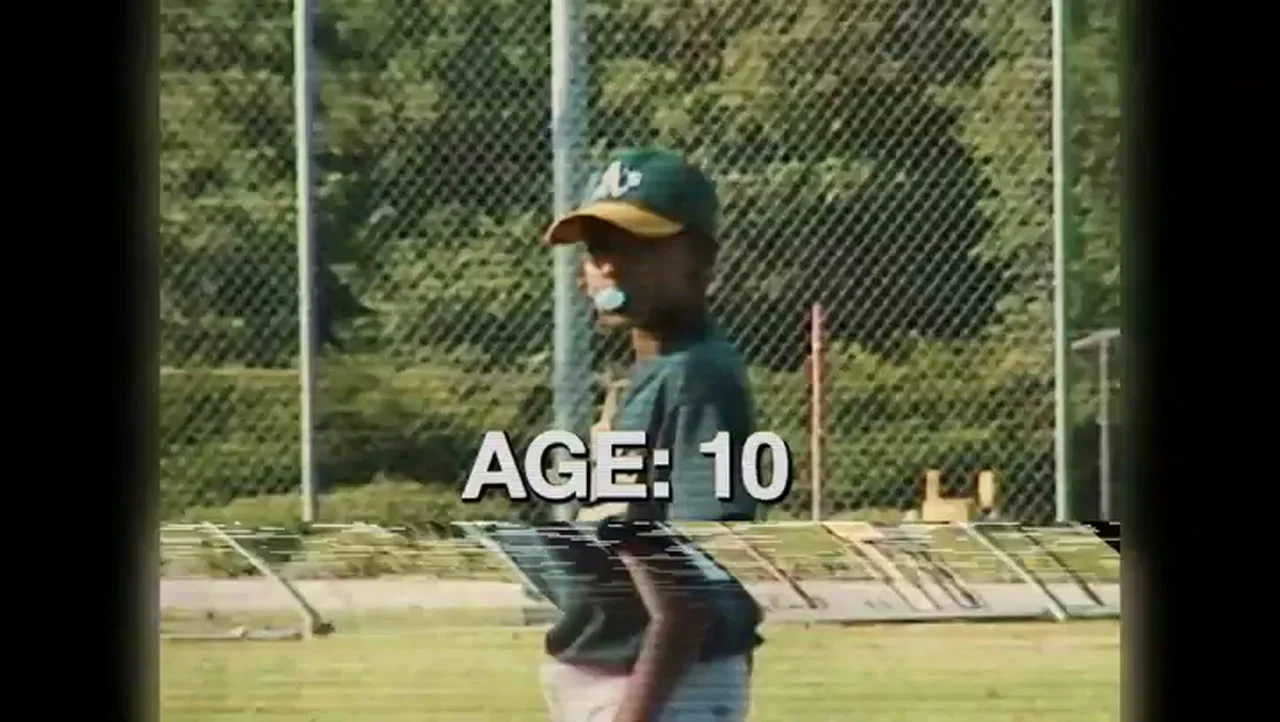
The home footage can be wonderfully embarrassing. Told that a drug test is positive, young DeSean takes the word as good news. The misunderstanding gets a laugh because his confidence is so badly matched to the information he has received. Including it also changes the texture of the biography. A future star is allowed to look foolish without the scene being converted into a lesson about his eventual greatness. Footage of marijuana use, including his acknowledgment of smoking before high-school and college games, further interrupts a polished account of talent steadily fulfilling its promise.
Byron’s narration supplies another reason to retain these uncomfortable moments. He describes a difference between the mild-mannered, respectful younger brother the family knows and the person the outside world might perceive. That concern gives the recordings cultural weight without requiring the film to explain every aspect of being a young Black athlete in public. We can see how much personality disappears when someone becomes a reputation. The footage complicates the family’s protective understanding, too: a street fight and DeSean’s defense of using a racial slur remain part of the record. Affection does not make every recorded choice defensible.
The later material requires distinctions that the film sometimes has limited time to explore. DeSean’s 2014 release from the Eagles arrives amid allegations of gang ties, which he denied; the documentary mentions that episode without closely examining the allegations. His antisemitic social-media posts in 2020 receive no defense. Those are different kinds of material, and acknowledging both is useful. Yet acknowledgment leaves questions about DeSean’s thinking only partly answered.
That limitation belongs to the allocation of attention, rather than a simple shortage of football. DeSean’s professional years occupy less space than his development, with selected highlights including his famous Eagles punt return against the Giants. I found the family history sufficiently absorbing that a longer catalogue of NFL achievements held little appeal. The archive lets us watch him grow older; the compressed career narrative gives us fewer opportunities to understand what growing older has meant to him.
Bill’s pancreatic cancer changes the significance of the time Byron has preserved. The speed of his decline brings a different limit into a story previously organized around reaching the next stage. Childhood, college, and the draft offer milestones to anticipate. Illness makes the family’s remaining time harder to imagine in those terms. The earlier recordings retain their arguments and awkwardness, but they also become records of access that cannot be renewed. Lovett’s concentration on the father and sons earns its emotional force here through people we have already spent time getting to know.
The scene I kept returning to was Bill walking across Pittsburgh’s Sixth Street Bridge in an Eagles jersey. A Steelers supporter in his hometown, he happily explains that his son’s selection by Philadelphia has changed his allegiance. All that forceful conviction has found a cheerful public outlet, and the pleasure of the scene lies in how readily he wants strangers to share it.
Go Deep: The DeSean Jackson Story premiered globally on Prime Video on September 24, 2026. Directed by Mandon Lovett, the sports documentary utilizes decades of raw family home video footage to trace the journey of the electrifying NFL wide receiver, exploring the intense family dynamics and sacrifices that shaped his career.
Where to Watch Go Deep: The DeSean Jackson Story (2026) Online


Full Credits
Title: Go Deep: The DeSean Jackson Story
Distributor: Amazon MGM Studios (Prime Video)
Release date: September 24, 2026
Rating: TV-MA
Running time: 1 hour 31 minutes (91 minutes)
Director: Mandon Lovett
Writers: Mandon Lovett
Producers and Executive Producers: Adam McKay, Todd Schulman, Byron Jackson, DeSean Jackson, J.M. Harper, Emmet McDermott, Scott Jay Kaplan
Cast: DeSean Jackson, Byron Jackson
The Review
Go Deep: The DeSean Jackson Story
Go Deep finds its strongest material in the relationship between the brother recording, the son pursuing football, and the father determined to shape his future. Lovett makes that family history funny, uncomfortable, and moving without treating athletic success as an answer to every disagreement. The opening rushes, and the adult DeSean remains less fully understood than the young prospect. Still, Byron’s footage gives Bill’s pride and pressure an immediacy that a career retrospective could struggle to match.
PROS
- Decades of family footage preserve candid, revealing behavior.
- Byron’s narration brings personal stakes to the archive.
- Bill’s affection and pressure receive a nuanced portrait.
- Humor and grief grow naturally from family interactions.
CONS
- The early pace leaves limited room to absorb family history.
- Compressed later coverage restricts insight into DeSean’s changing outlook.