




![Kingdom Hearts Collection [I-III] Review](https://gazettely.com/wp-content/uploads/2026/10/Kingdom-Hearts-Collection-I-III-1-360x180.webp "Kingdom Hearts Collection [I-III] Review: KHII Holds Steady as Newer Entries Fluctuate 36")




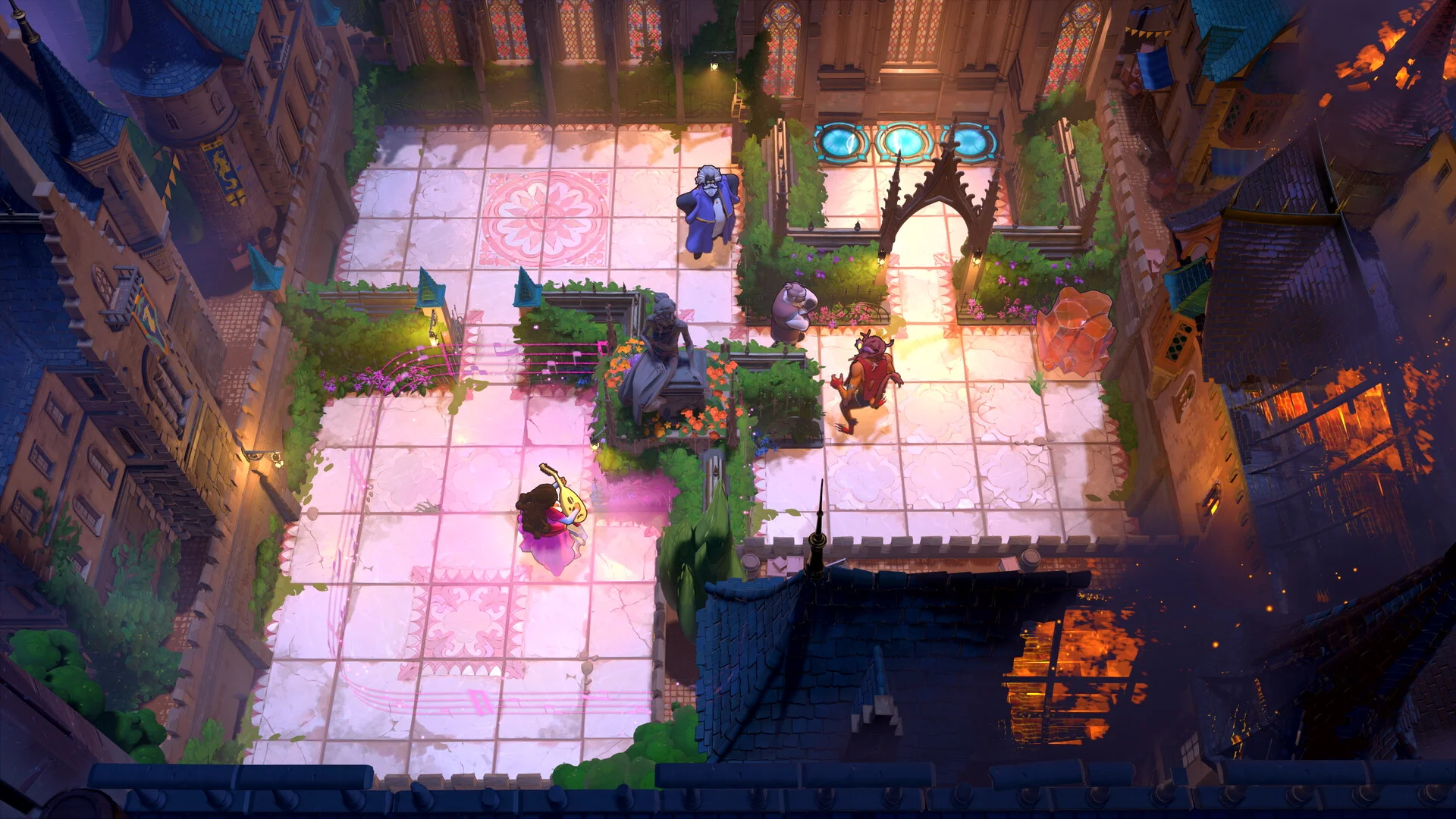

Sokoban’s rule that a box can be pushed but never pulled becomes a question of character in Order of the Sinking Star. The Warrior can shove several blocks together; the Thief can drag objects behind her; the Mage exchanges places with whatever stands in his gaze. Each inhabits the same grid, yet each understands its obstacles differently. A puzzle form first published by Japan’s Thinking Rabbit in 1982 acquires a small cast of competing spatial perspectives, with cooperation built into the differences between their abilities.
That transformation has several authors. American studio Thekla, led by Jonathan Blow, brings together expanded versions of Jonah Ostroff’s Heroes of Sokoban, Alan Hazelden’s Mirror Isles and Skipping Stones to Lonely Homes, and Sean Barrett’s Promesst. Calling this simply another Jonathan Blow puzzle game obscures the collaboration that gives it its shape.
These earlier works retain recognizable rules inside a larger production, then encounter rules developed elsewhere. The interesting passage from Japanese precedent to contemporary independent gaming happens through those practical revisions: who may move an object, what counts as an obstruction, and which actions become possible when another designer’s system enters the room.
The fiction makes that encounter literal. A displaced protagonist explores a strange overworld containing entrances to four separate worlds, each with its own stranded inhabitants. Northern fantasy heroes supply the pushing, pulling, and exchanging abilities.
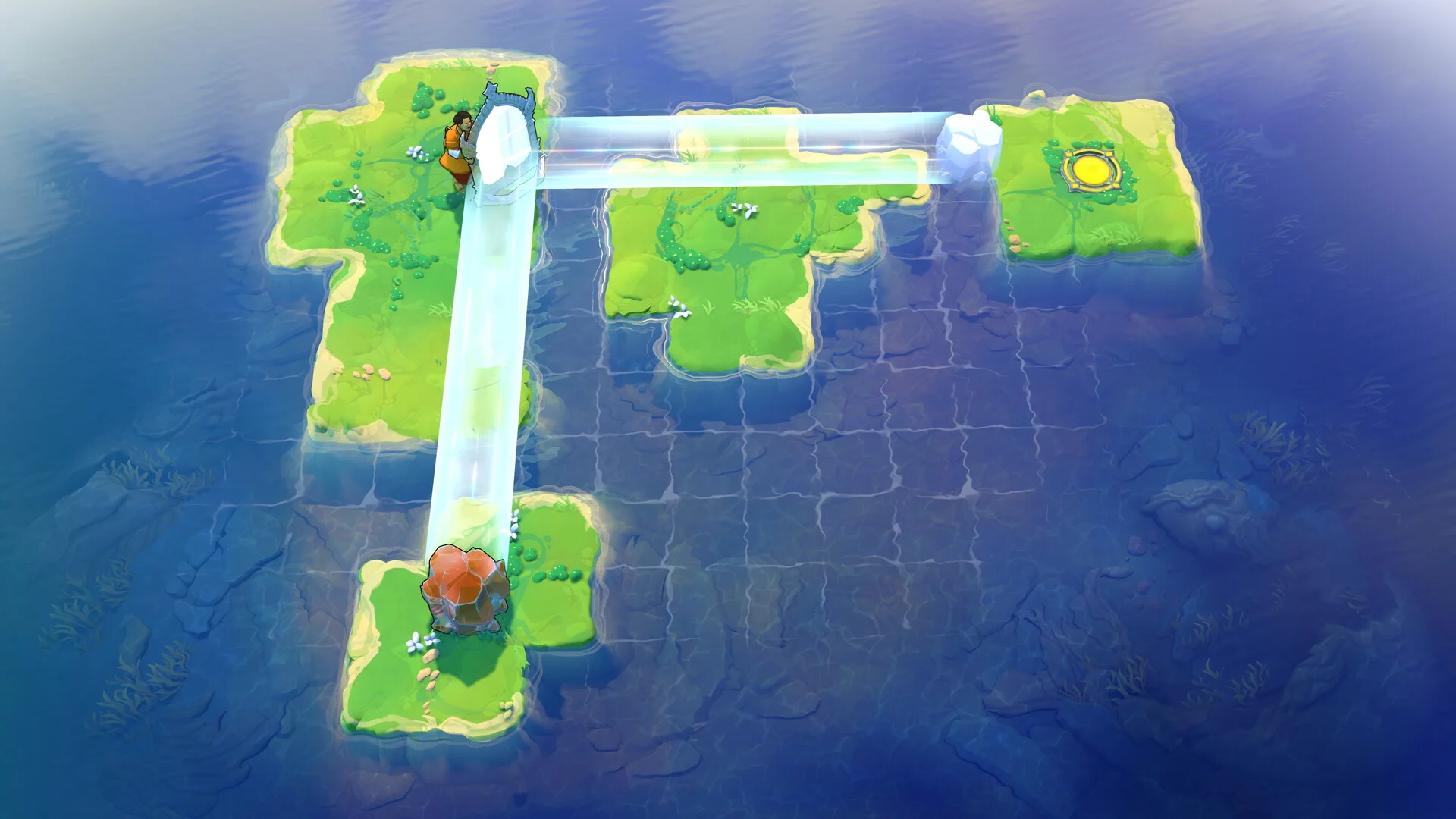
To the east, movable mirrors transfer characters and objects through reflections, sometimes producing duplicates that move together. Southern puzzles use skipping stones, water, and lily pads to establish routes. In the west, Vault of the Beamcasters combines gems with beams that permit teleportation, passage through walls, or destruction. Their shared grid provides a common frame for actions whose consequences remain distinct.
The regional identities are established through doing. Pulling requires room behind the character; swapping positions asks the player to reconsider the usefulness of something that previously blocked a route. Stones turn water into a problem of transport and access, while beamcaster gems serve both as power sources and objects that must reach a destination. The puzzle pieces have precise jobs, making a small board capable of sustaining considerable thought. The game can teach through successive arrangements because changing one relationship between familiar objects may change the entire problem.
Its richest discoveries arrive when those regional rules meet. One hybrid puzzle combines mirrors with a teleporting beam and produces four linked copies of a character. There is only one exit, and killing the surplus characters prevents completion.
Duplication, initially useful because it supplies additional bodies, becomes the obstacle. The solution requires finding a way to bring the copies back into one through the interaction of the systems. Without giving away that process, the important achievement is the reversal: an ability already understood must be understood again under different conditions. Familiarity becomes material for another discovery.
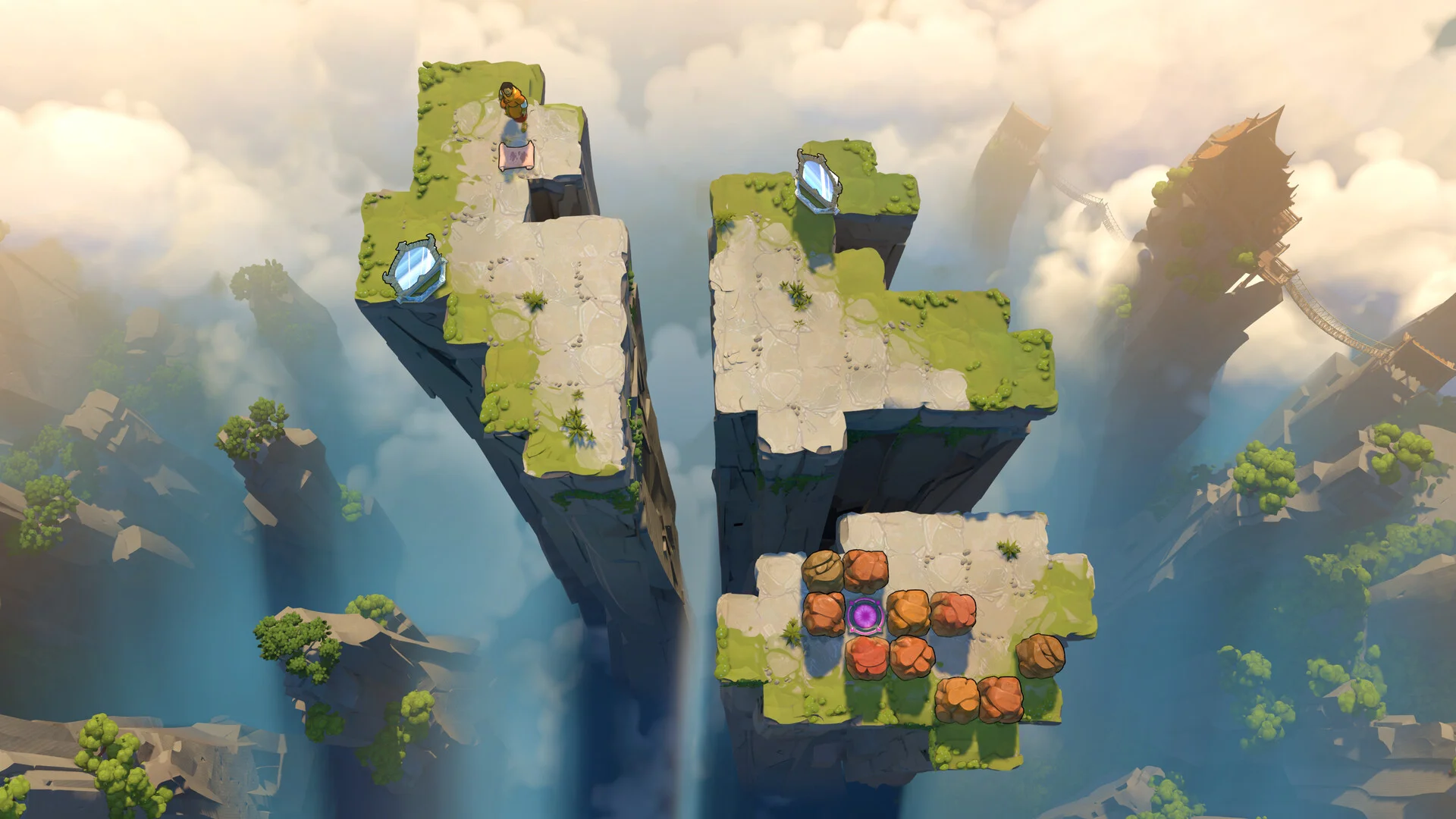
Later Gold Rooms extend this principle by bringing together characters and mechanics from separate worlds. Here the anthology earns its fictional premise. Worlds colliding means that an action developed within one set of assumptions must function inside another.
The overworld participates too, since knowledge gained within individual challenges can reveal access outside them. Returning to an earlier space with a new understanding gives exploration continuity. The player’s education changes the map’s possibilities, and a connecting area becomes an active part of the puzzle rather than a corridor between exercises.
Experimentation receives unusually considerate treatment. Undo reverses individual actions, including a single square of movement, while a reset restores the puzzle immediately. Time can be slowed for delicate timing or accelerated through waiting. Leaving a challenge can preserve its current state, and another region offers somewhere to think when one problem has become immovable. Quiet music and restrained, pleasant visuals support that concentration. These choices remove much of the repetitive handling that can make a difficult puzzle exhausting, leaving room to test an uncertain idea and inspect its consequences.
The larger structure creates a different expense. Consider a challenge combining a pushing character, a pulling character, and skipping stones: the obstacle can lie in recalling a stone interaction introduced long before, rather than discovering the arrangement in front of you.
With four systems circulating through an enormous game, a correct plan may look impossible because one remembered rule is wrong. Undo cannot repair that misunderstanding. Some crowded hybrid puzzles ask the player to hold so many qualifications together that the satisfaction of a new connection gives way to the work of recovering old information.
Freedom helps, but its effects are complicated. Switching worlds can release a stalled thought, and a solution may emerge while working on something else. The same movement can lengthen the interval between learning a rule and needing it again. Across roughly a thousand puzzles, smaller challenges also become prerequisites for reaching another substantial overworld problem.
The abundance is valuable when these encounters keep revising what the player knows. It wears when access to the next discovery depends on another long sequence of tasks whose immediate reward is further access. The game’s generosity with choices cannot always supply a satisfying sense of progress.
Its inhabitants face a similar problem of continuity. Their conversations arrive in small portions around puzzles, while recordings left by an earlier explorer supply fragments of the larger mystery. Full voice work gives these worlds a personable presence, and their motives offer recognizable differences: northern heroes pursue an oppressive authority, a mirror-world character carries the history of failed trials, and a beam-world scavenger collects gems for research and personal gain. Yet the gems’ mechanical purpose is easier to grasp than the importance of the research or profit. What the character must do receives a clarity that what the character wants does not consistently achieve.
That imbalance becomes pronounced when exploration interrupts a regional story for hours. An ability remains relevant whenever another puzzle calls upon it; a motive needs renewed dramatic attention. The first ending can leave character threads and the nature of the larger realm unresolved, with further endings and secrets extending the investigation. Continuing may still be rewarding, since the combinations retain considerable invention. But the unresolved stories provide a weaker reason to persist than the prospect of another unfamiliar interaction between familiar tools.
The southern sailor’s desire to return home gives this distance a particularly clear shape. Stones, currents, and lily pads turn the wish into a sequence of practical problems, so the mechanics initially serve an intelligible human purpose. Across the accumulating challenges, attention settles on how the water behaves and where a crossing can be made. The sailor’s destination has to survive long stretches in which every immediate decision concerns the next stone.
The Review
Order of the Sinking Star
Order of the Sinking Star turns Sokoban’s Japanese inheritance into an inventive collaboration between distinct puzzle systems. Its finest challenges make familiar abilities behave differently through contact with another world’s rules, while instant undo and flexible exploration encourage patient experimentation. The enormous scale sometimes burdens recall and delays satisfying progress, and its scattered stories struggle to sustain the people behind the abilities. Puzzle enthusiasts will find extraordinary ingenuity here, provided discovery itself supplies their reason to continue.
PROS
- Inventive interactions between distinct puzzle systems.
- Character abilities create different spatial perspectives.
- Immediate undo and resets encourage experimentation.
- Learned mechanics reshape overworld exploration.
CONS
- Dense rule combinations can overburden memory.
- Long prerequisite chains weaken the sense of progress.
- Fragmented storytelling leaves motives and early payoffs underdeveloped.