
























![Kingdom Hearts Collection [I-III] Review](https://gazettely.com/wp-content/uploads/2026/10/Kingdom-Hearts-Collection-I-III-1-360x180.webp "Kingdom Hearts Collection [I-III] Review: KHII Holds Steady as Newer Entries Fluctuate 37")



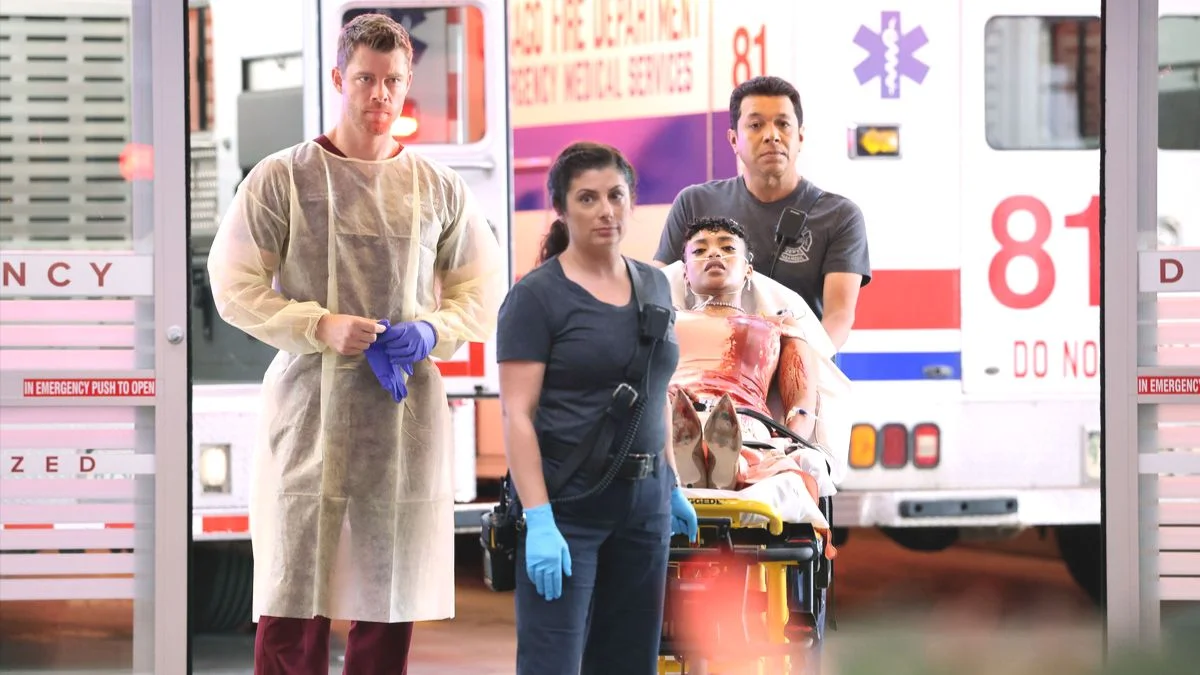

Hannah Asher arrives at Gaffney with baby Mabel during maternity leave and ends up removing a bullet from another woman’s uterus. Tamar, a bride injured in a shooting at her wedding, is 23 weeks pregnant; Hannah’s intervention allows the pregnancy to continue without an early delivery.
Chicago Med’s twelfth-season premiere, “Shots Fired,” gives this return to work an immediate, persuasive purpose. A doctor happens to be present when her expertise is needed, and a patient benefits. Hannah’s willingness to help needs no suspicion attached to it. The staffing arrangements around her deserve a less indulgent reading.
Mallory Sloane, replacing Sharon Goodwin as administrator, has cut staff to meet budget constraints. The emergency department therefore confronts the wedding casualties already short of people. Hannah’s presence helps cover that shortage, making maternity leave porous precisely when the hospital needs another pair of capable hands.
The episode celebrates a voluntary act within conditions that make such generosity useful to management. Its affection for Hannah is earned through the treatment itself; its institutional account is thinner. Sloane’s cuts establish her as an obstacle to care, while Goodwin’s absence invites the comforting belief that the right person behind the desk would put things right. What those people would have to work with receives less attention.
The care given to Dakota, the wedding’s flower girl, supplies a richer understanding of what a hospital community can do. Injured after her mother pushes her beneath the pews during the shooting, Dakota arrives unable to see and separated from the person who tried to protect her. Abrams attempts to stimulate her brain activity and restore the connection to visual input.
His gentleness matters alongside his expertise: the child’s distress does not become an excuse for another demonstration of medical arrogance. Bruno, the wedding guitarist, provides a different form of continuity by staying with her while staff search for her mother. The episode allows attention, presence, and specialized treatment to serve the same frightened patient.
Bruno’s death disrupts that patient work with an escalation whose calculation is difficult to ignore. Henry, Tamar’s violent ex and the shooter, drives into the hospital reception area just as Bruno is leaving after discharge. The violence follows the victims into a place intended to treat them, refusing the neat division between danger outside and safety inside. Yet the exact convergence of Bruno’s departure and Henry’s arrival makes the emotional mechanism conspicuous.
Having established Bruno through his kindness to Dakota, the writing positions him for another blow to the child. The objection concerns that arrangement, rather than any requirement that sympathetic people survive. Henry, meanwhile, receives enough jealous aggression to propel two assaults, but little characterization beyond the aggression.
Dakota’s mother, Edith, is initially reported dead before Ripley establishes that she is alive. That correction gives the child a surviving relationship rather than leaving her entirely dependent on hospital strangers. Bruno’s fate remains withheld from her, however, and Ripley’s protection becomes harder to assess. Waiting until a wounded child is reunited with her mother has an understandable immediate logic. Silence also leaves Dakota without an explanation for the disappearance of someone who stayed beside her. The episode makes care depend partly on a doctor deciding how much reality a patient can bear, without yet showing how he will relinquish that control.
Ripley’s confrontation with Dr. Wu exposes a sharper problem in his use of authority. Professional obligation here is abrasive rather than reassuring: Henry remains entitled to treatment after destroying other people’s lives. After Wu challenges Ripley’s treatment decision concerning Henry, he accuses her of deliberately making the shooter suffer.

Wu maintains that her intervention was necessary to keep Henry alive and suggests that Ripley is projecting his own feelings. Having witnessed Bruno’s death, he has ample reason to feel rage. That feeling does not establish the resident’s motive. The suspicion that Ripley himself wants Henry to suffer is a plausible reading of the exchange, not a confession the scene supplies. Wu’s resistance gives the encounter its value: the newcomer refuses to let seniority settle an accusation about her ethics.
Goodwin’s fight for her position tests loyalty at an administrative level. Miranda presses her to accept a payout with an assurance that the hospital will not pursue charges over the leaked medical records. The threatened consequences make the pressure clear, even while the evidence against Goodwin remains undisclosed.
Her refusal carries the weight of a career placed in jeopardy. Still, the premiere’s final disclosure prevents the dispute from staying a simple contest between a humane administrator and hostile management: Doris privately admits that she leaked Dr. Rabari’s files to save Dr. Charles’s job. Loyalty explains the action while leaving the patient’s confidentiality breached.
Doris’s 15 years at Gaffney and her position as charge nurse give that admission emotional and practical stakes. She helps organize the department whose capacity the opening emergency has already tested. Accountability could therefore affect a valued colleague and the work others rely on her to perform.
Neither consideration erases Rabari’s claim to privacy, and neither makes the prospect of losing Doris trivial. Goodwin now possesses information that can change her own defense while exposing someone she has worked alongside. The confession reaches her privately, before any response has been decided, with her job still under threat.
Chicago Med Season 12 premiered on NBC on October 7, 2026, with next-day streaming available on Peacock. The medical drama returns to follow the dedicated doctors and nurses of the Gaffney Chicago Medical Center emergency department as they handle high-pressure crises and complex interpersonal challenges.
Where to Watch Chicago Med Season 12 Online










Full Credits
Title: Chicago Med Season 12
Distributor: NBC, Peacock
Release date: October 7, 2026
Rating: TV-14
Running time: 42–45 minutes per episode
Writers: Allen MacDonald
Producers and Executive Producers: Dick Wolf, Allen MacDonald, Diane Frolov, Andrew Schneider, Arthur W. Forney, Peter Jankowski
Cast: S. Epatha Merkerson, Oliver Platt, Steven Weber, Jessy Schram, Luke Mitchell, Darren Barnet
Composer: Atli Örvarsson
The Review
Chicago Med Season 12
Chicago Med Season 12’s premiere earns its emotion through attentive care, particularly Dakota’s treatment, while Dr. Wu’s challenge to Ripley gives professional ethics genuine friction. Its institutional thinking is less developed: staffing cuts make Sloane an easy antagonist, and Bruno’s death exposes the calculation behind the escalating tragedy. Doris’s confession offers the strongest complication, making loyalty understandable without allowing it to erase patient confidentiality. This is an affecting opening whose difficult questions are sharper than some of its dramatic shortcuts.
PROS
- Dakota’s treatment integrates expertise and reassurance.
- Wu challenges Ripley’s unsupported ethical accusation.
- Doris’s confession gives loyalty meaningful ethical stakes.
CONS
- Bruno’s death depends on conspicuous contrivance.
- Sloane’s administrative position receives limited development.
- Henry’s characterization scarcely extends beyond violent jealousy.







