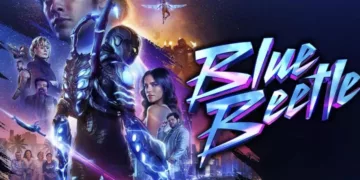






















Superhero cinema thrives on inheritance, and Blue Beetle arrives carrying decades of comic lore. The mantle dates back to the 1930s, passing through multiple alter-egos before settling on Jaime Reyes, a Latino teenager bonded to an alien Scarab. That history hums in the background, yet the film narrows its gaze to a single household and a single accident that changes everything.
Jaime returns home from college armed with a business degree and a plan to rescue his parents’ struggling auto shop. Capitalism, family duty, and youthful optimism share the same cramped living room. A meeting with Victoria Kord, CEO of Kord Industries, and her niece Jenny reroutes that plan. Jenny slips him the Scarab, stolen from her aunt’s lab. Curiosity prevails. The device activates.
The transformation unfolds with flashes of sci-fi horror. Tendrils pierce Jaime’s spine while his family watches in shock. Armor blooms across his body. Pain precedes power. The Scarab installs its own A.I., audible only to Jaime, a sardonic internal voice that guides and needles him in equal measure. Flight, enhanced strength, advanced weaponry arrive through awkward experimentation and collateral embarrassment.
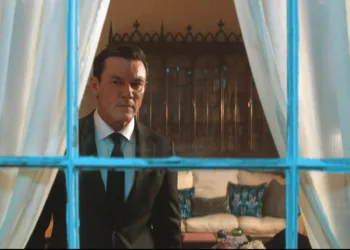
Victoria wants the Scarab back and dispatches her enforcer to secure it. Jaime accepts the suit in order to protect his family and uncover the artifact’s secrets. His parents, sister, uncle, and grandmother stand beside him, offering commentary, courage, and occasional chaos. A climactic clash with Victoria’s nearly invincible operative decides the Scarab’s fate, though the extended CGI duel blurs into visual noise. Spectacle dominates. Character recedes.
Family, Power, and a Community Under Pressure
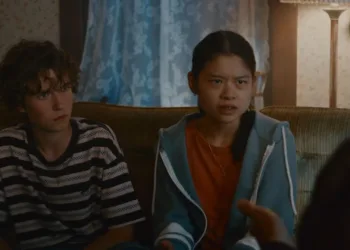
Blue Beetle organizes itself around kinship. The Reyes household occupies the narrative foreground, speaking Spanish, teasing one another, sharing meals, arguing about money. The film embeds Mexican cultural details into daily life, from decor to music, granting texture to a working-class environment rarely centered in this genre. Jaime’s status as a first-generation college graduate weighs on him; expectations linger in every conversation.
The story links personal stakes to economic anxiety. Gentrification threatens the neighborhood, and Kord Industries embodies corporate appetite. Jaime’s conflict with Victoria extends beyond alien technology into questions of ownership and displacement. The Scarab becomes a symbol of contested power, a device that can secure dominance or defend home.
Victoria seeks control and weaponization. Jaime acts out of protection. The contrast frames a moral inquiry about authority and restraint. Power acquires meaning through intention. The film suggests that responsibility grows from family bonds rather than abstract hero codes. Jaime does not hide from his relatives or operate in isolation. Their support shapes his decisions and grounds his fear.
The Kord family drama reinforces this thematic tension. Victoria’s ruthlessness collides with Jenny’s idealism, and their connection to the previous Blue Beetle, Ted Kord, adds generational residue. Susan Sarandon plays Victoria with theatrical relish, savoring villainy. Carapax, her primary enforcer, carries hints of deeper motivation that never fully crystallize. The core conflict remains clear: alien technology in human hands rarely stays neutral.
Superhero Echoes and Cultural Specificity
Comparisons emerge naturally. The teenage inexperience and humor recall Spider-Man: Homecoming. The suit-based origin invites parallels with Iron Man. Cultural identity shapes the narrative in ways reminiscent of Black Panther. Each reference point hovers like a ghost of genre past.
Jaime’s arc differs in emphasis. His family participates directly in his transformation, widening the emotional frame beyond solitary adolescence. The Scarab bonds to him without invitation, shifting the origin away from deliberate invention. His motivation centers on duty to family rather than personal atonement or royal obligation. The film plants Easter eggs for comic readers, including nods to earlier Blue Beetles and appearances such as El Diablo, while keeping the plot accessible for newcomers.
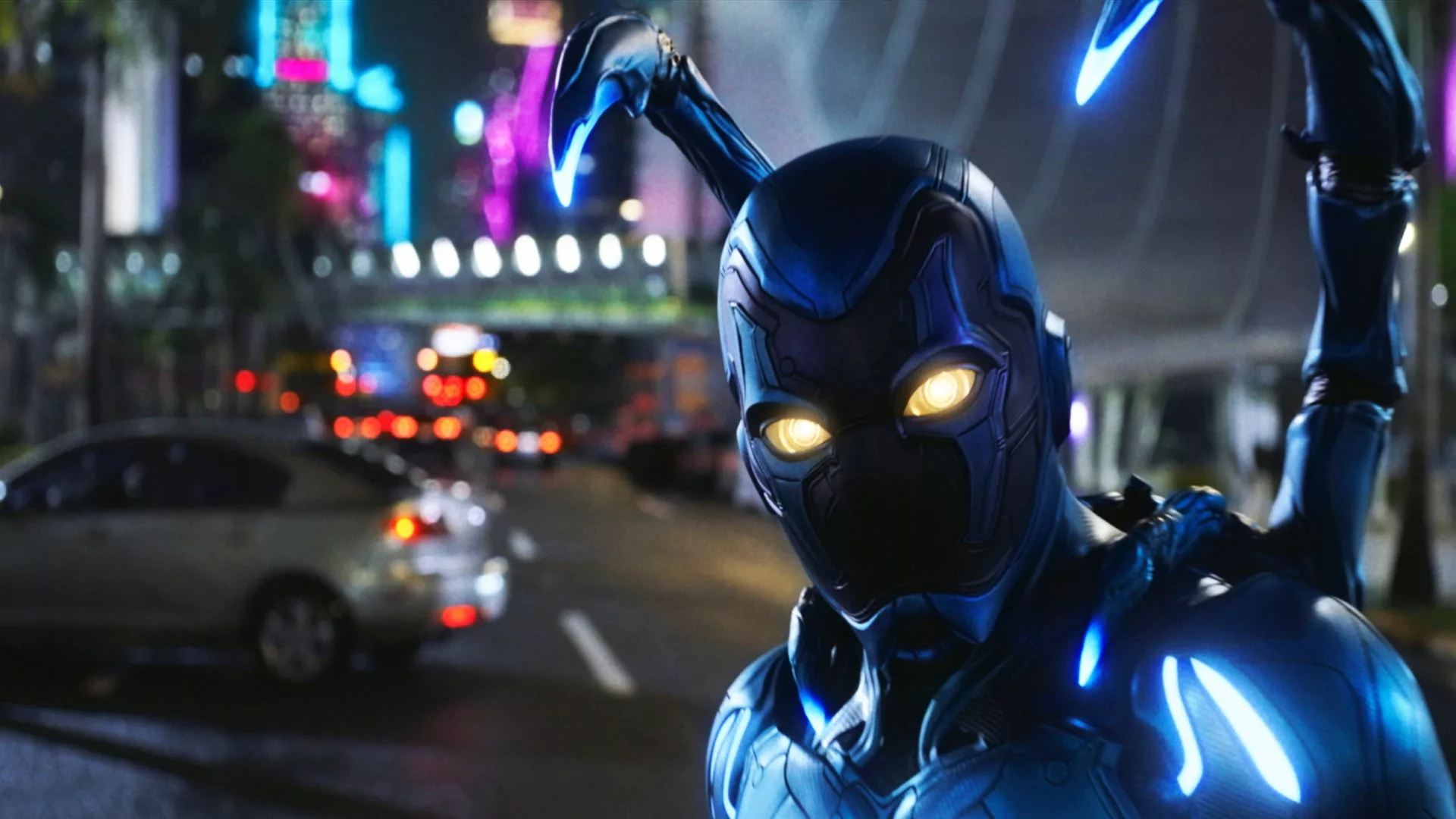
Thematically, Blue Beetle rehearses familiar beats: a dead parental figure, a science experiment gone wrong, training sequences, a climactic armored showdown. Yet the film’s humor and cultural grounding lend freshness. Spanish dialogue and Mexican-American textures function as narrative substance, not ornament. The neighborhood feels lived-in, supported by production design that renders the Reyes home and auto shop with worn authenticity.
Director Ángel Manuel Soto balances comic-book exuberance with intimate family scenes. Editor Douglass Crise maintains brisk pacing. Cinematographer Enrique Chediak employs low-angle hero shots and point-of-view flights that energize the action while preserving spatial clarity. The Scarab’s fusion sequence benefits from layered practical and digital effects, amplified by sharp sound design. The final battle extends too long and loses visual distinction, though earlier power discoveries carry playful invention.
Blue Beetle does not attempt reinvention. It operates within the established grammar of superhero origin stories. Its distinction arises from tone and focus: a street-level narrative rooted in heritage, economic strain, and collective resilience. Jaime Reyes emerges as a grounded, charismatic lead through Xolo Maridueña’s performance, balancing insecurity with dawning confidence. The film suggests that heroism grows in kitchens and garages before it reaches the sky.
In a franchise marked by uneven entries ranging from Aquaman and Shazam! to Justice League and The Flash, this installment favors optimism and familial solidarity. It tells a contained story, lightly connected to larger continuity, and trusts character over mythology. The result feels earnest, occasionally formulaic, intermittently exhilarating. A young man, an alien scarab, a family refusing to step aside. Sometimes that is enough.
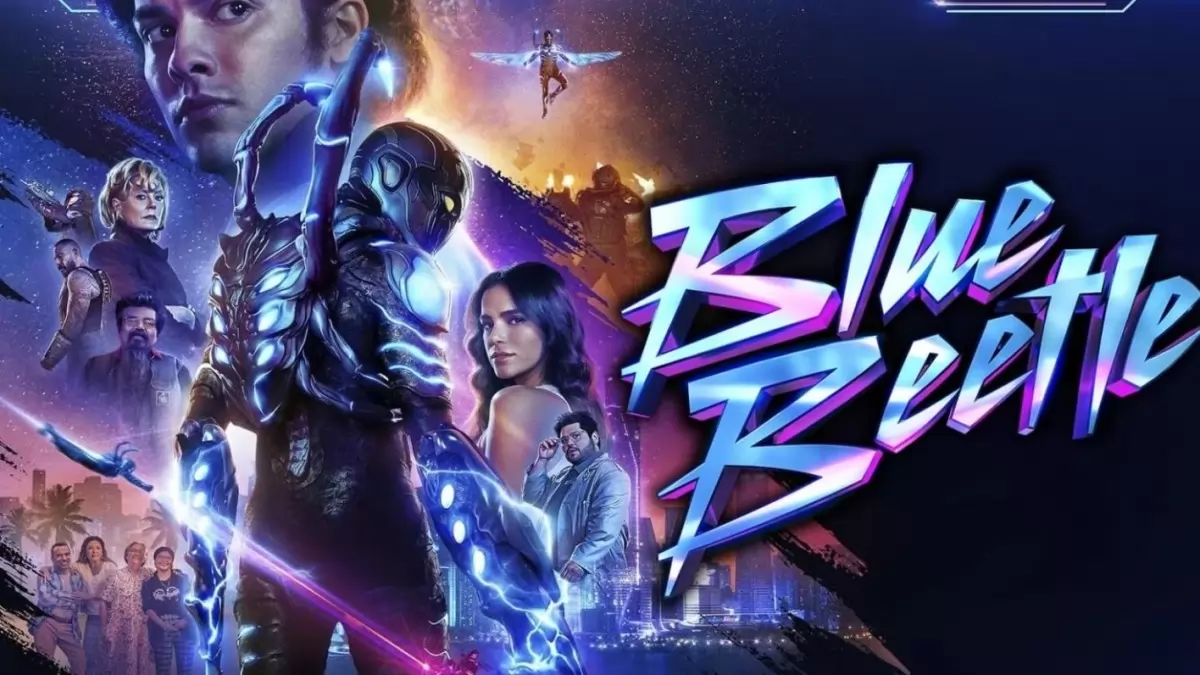
Blue Beetle is a vibrant superhero film that marks the first time this DC character has appeared on the big screen. The story centers on Jaime Reyes, a recent college graduate who unexpectedly comes into possession of an ancient relic of alien biotechnology known as the Scarab. When the Scarab chooses Jaime as its symbiotic host, he is bestowed with an incredible suit of armor capable of extraordinary but unpredictable powers, forever changing his destiny. The film is celebrated for its strong focus on Latino family dynamics and culture. You can watch the movie on the streaming service Max, or purchase/rent it on platforms like Apple TV, Amazon Prime Video, and Google Play.
Where to Watch Blue Beetle (2023) Online










Full Credits
Title: Blue Beetle
Distributor: Warner Bros. Pictures
Release date: August 18, 2023
Rating: PG-13
Running time: 2 hours 7 minutes
Director: Angel Manuel Soto
Writers: Gareth Dunnet-Alcocer
Producers and Executive Producers: John Rickard, Zev Foreman, Walter Hamada, Galen Vaisman, Garrett Grant
Cast: Xolo Maridueña, Bruna Marquezine, Becky G, Damían Alcázar, George Lopez, Adriana Barraza, Belissa Escobedo, Elpidia Carrillo, Susan Sarandon, Raoul Max Trujillo
Director of Photography (Cinematographer): Pawel Pogorzelski
Editors: Craig Alpert
Composer: Bobby Krlic
The Review
Blue Beetle
Though it relies heavily on standard superhero origin story tropes, Blue Beetle takes flight thanks to Xolo Maridueña's earnest lead performance, thoughtful themes of family and culture, and a lighter tone that sets it apart from the crowded pack of DC films. This first Latino-led superhero romp might not reinvent the genre, but represents a fun step forward.
PROS
- Winning lead performance by Xolo Maridueña
- Thoughtful representation and themes
- Lighthearted tone compared to other DC films
- Creative family dynamic
CONS
- Overly formulaic plot and generic villains
- Uneven CGI and repetitive action sequences
- Underdeveloped female characters
- Over-reliance on existing superhero tropes