























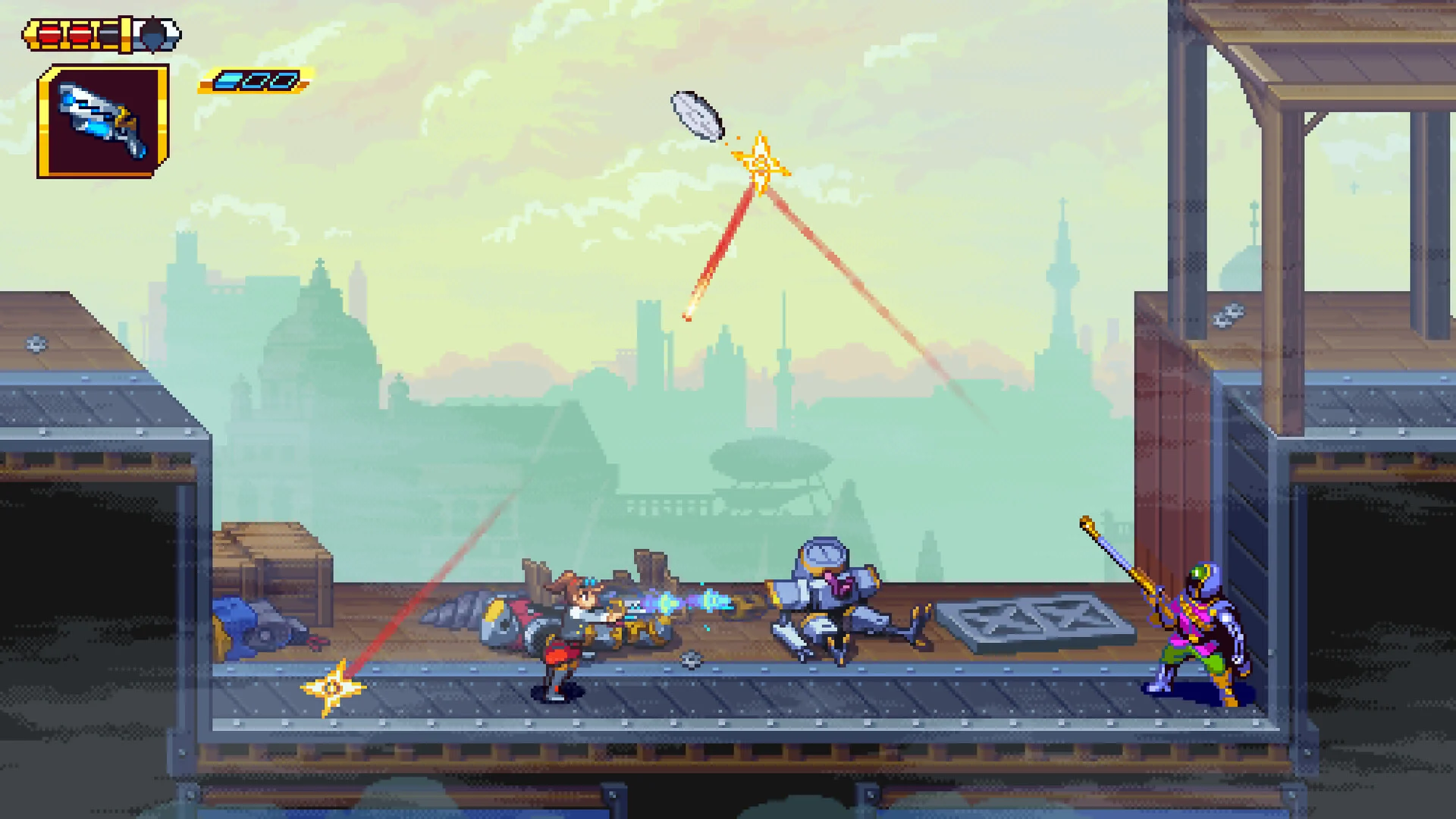

Sending rockets forward, upward, and downward at once has a particular, slightly childish appeal in Clockwork Ambrosia. Fit the right mods and those missiles can split, then scatter spikes when they explode. The pleasure comes from watching a weapon grow into something you wanted to make, with a few excesses you are happy to accept. Since ordinary firing lacks free directional aiming, that T-shaped spread also gives your enthusiasm a practical outlet. An enemy overhead becomes a reason to try your latest arrangement.
The punch of the explosions and the bright trails across the screen make each alteration feel tangible. You can change equipment through the menu during encounters, so curiosity need not wait for a return to safety. There are useful limits to this freedom: armored enemies encourage explosives, while faster targets can make rockets awkward.
Having a second gun ready lets you keep a favorite without asking it to solve every encounter. The temptation to fill every available inch with ammunition has its own drawback, though. Some combinations obscure incoming attacks, leaving the spectacle of your handiwork competing with the information needed to survive it.
Iris, the pilot doing all this enthusiastic tinkering, has been stranded on Aspida after an encounter with a mechanical dragon. Realmsoft sends her through a 2D island of hostile machines, settlements, and underground passages, with four principal firearms to reshape.
The starting pulse blaster, revolver, grenade launcher, and missile launcher offer different foundations. What makes finding equipment exciting is the possibility that the next piece will change your relationship with one of them. Extra projectiles or a ricochet are easy to appreciate because you can immediately see what your discovery permits.
That anticipation needs feeding, and the game can leave it hungry. Early configurations can remain largely unchanged for hours, while a newly acquired weapon competes with a familiar gun that already has a richer selection of mods. It is difficult to feel adventurous about the newcomer under those conditions. Settling on a favorite is satisfying in itself; no game needs to punish affection for a reliable tool.
Here, however, extra-projectile blaster setups and double rockets can make further experimentation feel optional before the alternatives have had much chance to charm. Sluggish switching between equipped guns adds friction precisely where a quick change might invite another experiment.
Exploration does keep putting things in your hands. Mods, armor, scrap, and upgrade resources give a detour a purpose, and finding something usable is a persuasive invitation to investigate another branch. Yet the distance between rewards matters as much as their number.

A short dash arrives only after several bosses, and sprint takes longer to obtain. Early return trips therefore happen before Iris has the movement vocabulary to make them lively. Sprint eventually adds speed, but its activation after sustained running puts a run-up and quick reactions between the player and certain obstacles. The freedom suggested by a new ability arrives with conditions attached.
The map makes remembering those obstacles needlessly tiring. Its colored regions and destination icons provide a basic framework, but missing area names and the lack of a useful zoomed-out view weaken the sense of how places connect. Three custom marker types offer limited help in distinguishing the barriers waiting for different abilities. There is pleasure in remembering an inaccessible route and returning with the right tool. Having to reconstruct which stretch of the island contained it spends some of that pleasure before the return trip begins.
Fast travel offers an odd mixture of relief and disorientation. It takes several hours to unlock, and access to destinations Iris has not visited can then loosen the connection between discovering a place and earning a route there. That broad reach does not guarantee a conveniently placed departure point when one is wanted. Such broad access makes travel easier in one respect while leaving local repetition intact. For a game whose rewards encourage poking around, it can be strangely difficult to feel securely acquainted with the ground already covered.
Technical problems can put a harsher interruption into that process. Reports from the ROG Xbox Ally X include slowdown, control and menu trouble, crashes, and a freeze after swimming becomes available and Iris enters water. Those are device-specific observations, rather than evidence of uniform PC performance. The swimming freeze is especially unfortunate for this kind of game: acquiring an ability should make an unfamiliar surface inviting. A failure at the point of testing it interrupts the very curiosity that progression depends on.

Aspida’s appearance gives that curiosity welcome support. The mossy Manitari settlement, home to diminutive mushroom people, feels distinct from the abandoned mines and the capital’s red brick and metal towers. These are places with enough visual character to be recognizable even when the map struggles to explain their relationship. The slightly elevated, lateral perspective gives the pixel environments depth, and their arrangements can conceal secrets while offering clues to attentive eyes. Looking closely has both an aesthetic pleasure and a possible practical reward.
There is affection in the mechanical imagination, too. An early robotic centaur carries two spinning lances, making a boss encounter memorable through a wonderfully specific silhouette. Fluid animation lets these small figures carry their own energy, while area-specific music gives each region an audible identity. I like that the invitation to explore survives outside the equipment menu. A settlement can be worth seeing before it offers anything useful, and the contrast between organic softness and constructed machinery gives the island places to linger between bouts of extravagant gunfire.
Conversations have a harder time sustaining that interest. Selectable topics provide background about residents and their problems, but Iris expresses little response, leaving her personal investment thinly established. Her predicament gives her a reason to move through Aspida; helping its inhabitants needs a sense of involvement that information alone struggles to supply.
Silence would be sufficient if her participation made those relationships felt. Instead, the dialogue often leaves her in the position of receiving explanations and indirect directions. Choosing another topic carries less anticipation than fitting a new mod, because the equipment offers a clearer sense that the next interaction might change something.
The Review
Clockwork Ambrosia
Clockwork Ambrosia earns affection through the delight of making its weapons misbehave and the character of its pixel-art island. Splitting rockets and ricocheting bullets give exploration a purpose that Iris’s story struggles to match. Slow early progression and an awkward map can wear down that curiosity, while reported ROG Xbox Ally X problems warrant caution on that device. There is plenty here worth discovering, but the game makes sustaining your enthusiasm harder than it needs to be.
PROS
- Weapon mods create tangible, playful changes.
- Distinctive environments and imaginative mechanical enemies.
- Punchy combat audio and area-specific music.
- Useful equipment rewards optional exploration.
CONS
- Uneven pacing of mods and movement upgrades.
- Awkward map and inconsistent travel convenience.
- Iris’s personal investment remains thin.
- Reported instability and control problems on ROG Xbox Ally X.