









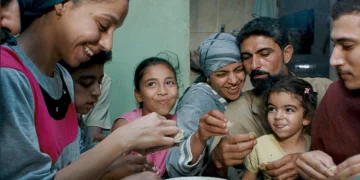


















The Sikkas have to return to their new apartment to convince their son that they live there. During video calls with Ansh, an engineer working in Norway, they perform the contentment his expensive gift was supposed to bring them. Between calls, they prefer their old neighbourhood. Ritesh Menon’s Dilwali Diwali finds an affectionate absurdity in this arrangement: the parents protect their son’s feelings by concealing the life they actually enjoy. Gratitude has become a small domestic production, complete with a location everyone must reach.
Ansh’s return for Diwali after three years makes that production harder to sustain. He wants a celebration with the friends he assumes his family has made in the building. The request exposes what the apartment cannot purchase: relationships ready to fill it. Ritu Mago’s screenplay gives the deception an uncomfortable foundation beneath its comic business. Having accepted Ansh’s generosity, his parents feel obliged to furnish him with evidence that it has succeeded. The festive reunion brings an expectation of happiness before anyone has been allowed to describe their unhappiness.
For Sudhir, the father played by Manoj Pahwa, the old address carries a history Ansh’s idea of improvement cannot easily accommodate. Flashbacks connect the neighbourhood to a refugee camp where the family’s ancestors arrived from Rawalpindi after Partition, the division of British India in 1947.
The attachment belongs to people whose family once had to build a home after displacement. Moving away can therefore mean relinquishing the place where an earlier generation finally managed to stay. This gives Sudhir’s resistance a specific Punjabi inheritance without making nostalgia sufficient proof that every old arrangement deserves preservation.
The film’s treatment of place is less persuasive than that historical connection. The neighbourhood’s conspicuous quality as a set weakens the claim that generations of ordinary life have accumulated there. Familiar visitors and communal closeness supply recognizable social habits, but the setting too often feels prepared to demonstrate togetherness. The high-rise, with its access-card doors and chilly encounters, is equally quick to announce its meaning. Menon makes the difference between the two environments easy to understand; he is less successful at allowing either to exist beyond its usefulness to the family argument.
Sukhmani complicates that division. Played by Neelu Kohli, she can miss the old community and still appreciate quiet, comfort, and doors that open with a card. Her connection with a neighbour, Anita, gives the new building a social possibility that Sudhir’s account of it leaves little room for. These details matter because they keep the mother from serving as a second vote for the father. She has preferences that neither his defence of the past nor Ansh’s plans for the future fully represents. The apartment has something to offer her, even if accepting it on her son’s terms remains difficult.

Kohli makes that mixed response feel unforced, particularly alongside Pahwa’s settled authority. Their ease together allows disagreement to sit within an established marriage rather than threaten it at every turn. Pahwa gives Sudhir’s objection to being directed by his provider a humane force: financial support does not cancel a parent’s right to choose. Yet Sukhmani’s interest in the new surroundings quietly tests the reach of his own certainty. If Sudhir wants Ansh to listen, the household cannot simply exchange the son’s definition of happiness for the father’s.
Mihir Ahuja makes Ansh’s wish to provide sufficiently sincere that the conflict retains its tenderness. His work abroad and the apartment are credible expressions of care; the difficulty comes when he expects his family to experience them exactly as he imagined. The writing gives him less room to develop beyond that assumption.
Sukhmani’s advice about his pursuit of success opens a question about the life he is building for himself, but the film moves past it too readily. His younger sister Mahi, played by Aurra Bhatnagar Badoni, receives similarly brief attention as she adjusts to a new social environment. The move changes her possibilities too, though the parental dispute largely determines how those changes are understood.
Music helps hold these unevenly developed lives within the same festive mood. “Tappa” (Amreeka VI), “Ghar Lagda,” and “Yeh Duniya” belong to the narrative’s emotional movement rather than interrupting it for separate attractions. Their contribution is substantial: they sustain an affection that the dialogue sometimes has to explain. The background score performs a quieter task, supporting the celebration without continually competing for attention. Together, songs and scoring make family closeness readily felt, even where the screenplay has given individual frustrations only a short hearing.
That musical warmth also makes the dramatic compression easier to overlook. At approximately an hour, the film has enough time to establish the video-call deception and turn the party into a practical predicament. It spends less time allowing Sukhmani’s changing response, Ansh’s expectations, or Mahi’s adjustment to alter their relationships through sustained interaction. The issue is the distribution of attention within the short form. The concealment generates business; the preferences being concealed need development, and the movement toward reconciliation too often supplies reassurance in its place.
The accommodating spirit of the ending makes sense through Sukhmani, whose attachment to the old neighbourhood survives her discovery of pleasures in the new one. Her position permits a family reunion without requiring everyone to want the same future. What remains underexplored is how the household might make room for that difference after the celebration, when her interest in a new acquaintance or a quieter home must coexist with Sudhir’s desire to remain among familiar people.
Dilwali Diwali premiered globally on Netflix on November 5, 2026. Directed by Ritesh Menon and Pratish Mehta, the Hindi family drama comedy follows a well-meaning young man who purchases a lavish modern apartment to upgrade his parents’ lifestyle for Diwali, only to realize that true happiness and home lie in the cherished connections and memories they left behind.
Where to Watch Dilwali Diwali (2026) Online


Full Credits
Title: Dilwali Diwali
Distributor: Netflix
Release date: November 5, 2026
Rating: TV-PG / U
Running time: 1 hour 1 minute (61 minutes)
Director: Ritesh Menon, Pratish Mehta
Writers: Ritu Mago
Producers and Executive Producers: Anuj Gosalia, Vijay Subramaniam, Sharanya Rajgopal
Cast: Manoj Pahwa, Mihir Ahuja, Neelu Kohli, Aurra Bhatnagar Badoni, Nimisha Sirohi, Manmeet Singh, Ashish Kaul, Vivek Tandon
Composer: Advait Nemlekar
The Review
Dilwali Diwali
Dilwali Diwali gives its family disagreement a persuasive cultural history: Sudhir’s old neighbourhood carries memories of settlement after Partition. Neelu Kohli’s Sukhmani prevents that attachment from becoming the household’s only legitimate desire, while the songs sustain the affection between people who want different lives. Manoj Pahwa and Kohli make the relationships convincing, but schematic settings and abbreviated character development limit their dramatic force. The film reaches an agreeable accommodation before its competing wishes have received enough attention.
PROS
- Pahwa and Kohli’s convincing marital chemistry.
- Partition history gives Sudhir’s attachment specific weight.
- Sukhmani complicates the division between old and new.
- Songs sustain the family’s emotional closeness.
CONS
- Settings feel constructed around the film’s message.
- Ansh and Mahi receive limited character development.
- Dialogue sometimes explains feelings instead of dramatizing them.