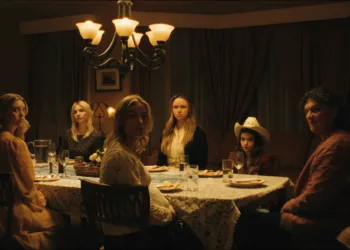










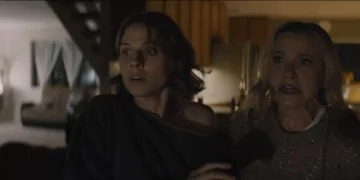

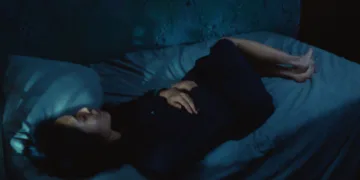













Netflix’s ten-part Brazilian melodrama The Gift of Deceit spends a substantial secret before its first episode is over. Maíra, the apparently dependent daughter whose health has driven her mother toward spiritual treatment, boards a boat and kisses the woman administering that treatment. Their alliance changes the terms of the series. The healer’s intentions cease to be the principal mystery; attention shifts toward the people who will discover them, and the attachments that might complicate the scheme. Giving viewers this knowledge early leaves the relationships with considerable work to do.
The disclosure reaches backward into a quieter exchange. Maíra has told her mother, Lúcia, that she distrusts the healer but trusts her, then agreed to drink the prescribed water. What initially resembles an adult daughter accommodating an anxious parent becomes a performance of obedience. The episode uses the same conduct to support two readings, exposing how little Lúcia understands about the person she watches so closely. Here, the cliffhanger earns its place through reinterpretation. It gives the audience a reason to reconsider an intimate scene, alongside the usual incentive to select the next episode.
Lúcia’s surveillance already supplies enough material for an uncomfortable family drama. She keeps a nanny camera in Maíra’s room and makes decisions about her food and spending. Helping her daughter wash her hair belongs to the same domestic routine as ordering lunch on her behalf, although these actions involve different kinds of permission. The series locates coercion within recognizable acts of assistance. Lúcia’s wealth allows her to provide care, then helps her treat provision as a claim on Maíra’s choices. Her earlier intervention in Maíra’s engagement makes the reach of that claim explicit: Dante tells Fred that he ended the relationship at Lúcia’s request.
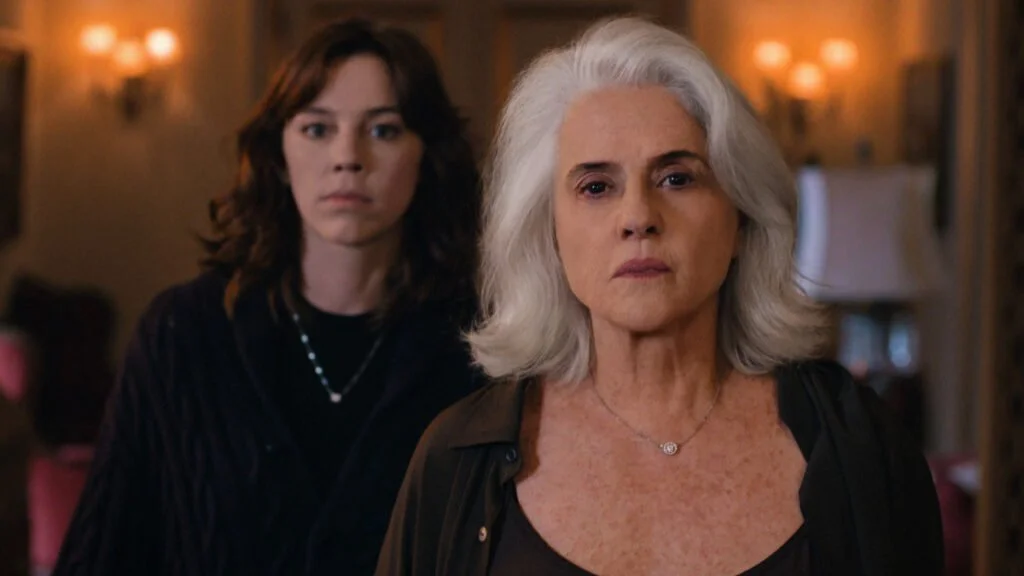
Marieta Severo gives this entitlement an emotional foundation without making it harmless. Her Lúcia needs to believe that controlling the circumstances of her daughter’s life will protect the daughter herself. Alice Wegmann has the difficult complementary task of making Maíra’s resentment credible while leaving room for calculated compliance. Their exchanges over meals, purchases, and treatment keep affection entangled with the struggle for authority. The concealed alliance prevents Maíra from becoming a simple illustration of injured innocence. Being controlled does not make her incapable of controlling someone else.
The spiritual treatment extends this arrangement into a commercial relationship. Lúcia initially claims that Maíra’s unexplained seizures are her own; the healer rejects that account, prompting her to disclose her daughter’s history, including a heart transplant in infancy. Before any cure has been attempted, the encounter establishes an apparent ability to distinguish truth from deception. For a woman exhausted by medical uncertainty, that authority has obvious appeal. Lúcia has arrived seeking an answer and encounters someone who can make even her unsuccessful lie feel like evidence of special insight.
The river treatment makes the transaction uglier. When the water turns black, the healer assigns the problem to Lúcia’s karma and proposes a cleansing ritual using expensive herbs. A frightening event becomes a diagnosis of maternal responsibility, followed by something available for purchase. Lúcia has already blamed herself for taking a long trip while pregnant to obtain a painting for Fred’s business. The healer’s explanation fits an accusation she has been making against herself. The series is persuasive here because exploitation requires no sudden conversion into stupidity. It needs a seller who can recognize an existing fear.
Sandra’s suspicion of the glowing online reviews and Orlando’s warning about exploitation keep alternative judgments present. Lúcia even proposes withholding payment until Maíra improves, while arranging access to funds. She has standards of proof, but those standards are vulnerable to whatever happens next. After a fire burns Maíra’s dolls, she interprets it as confirmation of the healer’s warning about hostile forces. The troubling mechanism is the absorption of frightening events into an explanation that strengthens the person selling relief. Spiritual comfort becomes dangerous here through the obedience and expenditure attached to it.
Yet this sequence also exposes the series’ appetite for escalation. Black water, maternal guilt, costly cleansing, a bedroom fire, and the secret alliance arrive in rapid succession. Each development supplies a fresh provocation before the preceding one has had much time to alter the relationship.
This Netflix series brings telenovela machinery into a ten-part format with considerable enthusiasm. Its most revealing production choice is the density of that machinery: an intimate dispute can become a supernatural warning, then a criminal maneuver, within the same episode. The actors preserve emotional continuity through changes that the plotting sometimes treats as interchangeable sources of excitement.
Nanda Costa’s Irina gives the romantic strand an attraction that the fraud plot cannot explain away. The concealed relationship offers Maíra access to desire outside her mother’s supervision, while making that freedom dependent on someone practiced in deception. Costa sustains the tension between intimacy and instrumental purpose.
The difficulty lies in how often the scheme supplies the relationship’s interest. Revealing that two women are lovers produces an effective reversal; examining how affection survives their use of other people requires sustained attention that another confrontation cannot provide. Their chemistry makes that missing development noticeable.
The art-heist strand gives the deception a financial destination. It also returns Lúcia’s possessions to a story in which obtaining a painting already figures in her account of maternal guilt. There is useful friction between art as family wealth and art as an object around which she has organized blame. The pursuit of the collection expands the criminal activity, but the more revealing connection is already there: Lúcia’s household has difficulty separating what it owns from what it believes it is owed.
Irina’s family complicates Maíra’s apparent escape further. Her father, Bóris, exercises control over his daughters, placing the lover within another family structure organized around authority and obligation. Maíra’s attraction can be sincere without granting access to a life free of those pressures. The pilot’s kiss allows her to choose someone her mother has not chosen for her. It also brings that woman’s family interests into a relationship Maíra might want to regard as her own.
The Gift of Deceit premiered globally on Netflix on October 28, 2026. Created by Diane Maia and Mirna Nogueira, the Brazilian thriller series follows an affluent art collector who falls victim to a calculated scam while desperately seeking a cure for her chronically ill daughter.
Where to Watch The Gift of Deceit Online


Full Credits
Title: The Gift of Deceit (Original title: Dom de Iludir)
Distributor: Netflix
Release date: October 28, 2026
Rating: TV-MA
Running time: 45 minutes per episode (10 episodes)
Director: Mauro Mendonça Filho, Gabriela Amaral Almeida, Daniela Carvalho
Writers: Diane Maia, Mirna Nogueira, Carol Rodrigues, Felipe Sholl, Josefina Trotta, Pedro Riguetti
Producers and Executive Producers: Conspiração
Cast: Marieta Severo, Alice Wegmann, Nanda Costa, José de Abreu, Felipe Camargo, Luciana Paes, Laila Garin, Rui Ricardo Diaz
The Review
The Gift of Deceit
The Gift of Deceit gives Netflix’s telenovela machinery a persuasive subject: care that becomes authority, and guilt that becomes a sales opportunity. Severo, Wegmann, and Costa keep affection alive inside manipulative relationships, while the pilot’s disclosure rewards reconsideration. The crowded escalation leaves emotional consequences underexamined, particularly within the romance. Its strongest drama emerges when the next revelation changes our understanding of someone, rather than simply creating another confrontation.
PROS
- Severo and Wegmann sustain affection alongside resentment.
- The pilot’s disclosure meaningfully reinterprets earlier scenes.
- Spiritual fraud exploits credible fears and parental guilt.
- Costa gives the romance attraction and uncertainty.
CONS
- Rapid escalation leaves insufficient room for emotional aftermath.
- Romantic trust receives less development than the scheme.
- Art-heist expansion proves less revealing than the family material.