



























Hilltop Studios has moved from putting a twelve-year-old in charge of a cartoon border checkpoint to appointing an adult governor of a decaying island colony. The distance between Lil’ Guardsman and Curse of Resthaven looks enormous, though both place public responsibilities in the hands of someone with personal concerns. Ambrose accepts his position in the Aurelian Empire’s troubled outpost to search for his missing niece, Amalia. Improving local businesses becomes part of finding her, since the wilderness requires supplies that this struggling town must provide.
Hilltop’s musical interests survive the darker setting in a particularly useful form. At the Black Pony Tavern, the Bard performs original songs; listen on three separate days during the same loop and he can become an expedition companion. That connection gives the music a place in Ambrose’s schedule. Making time for someone’s performance can change who accompanies you beyond the walls. For players returning from Lil’ Guardsman, it is a welcome sign that the studio’s personality has survived its change of register.
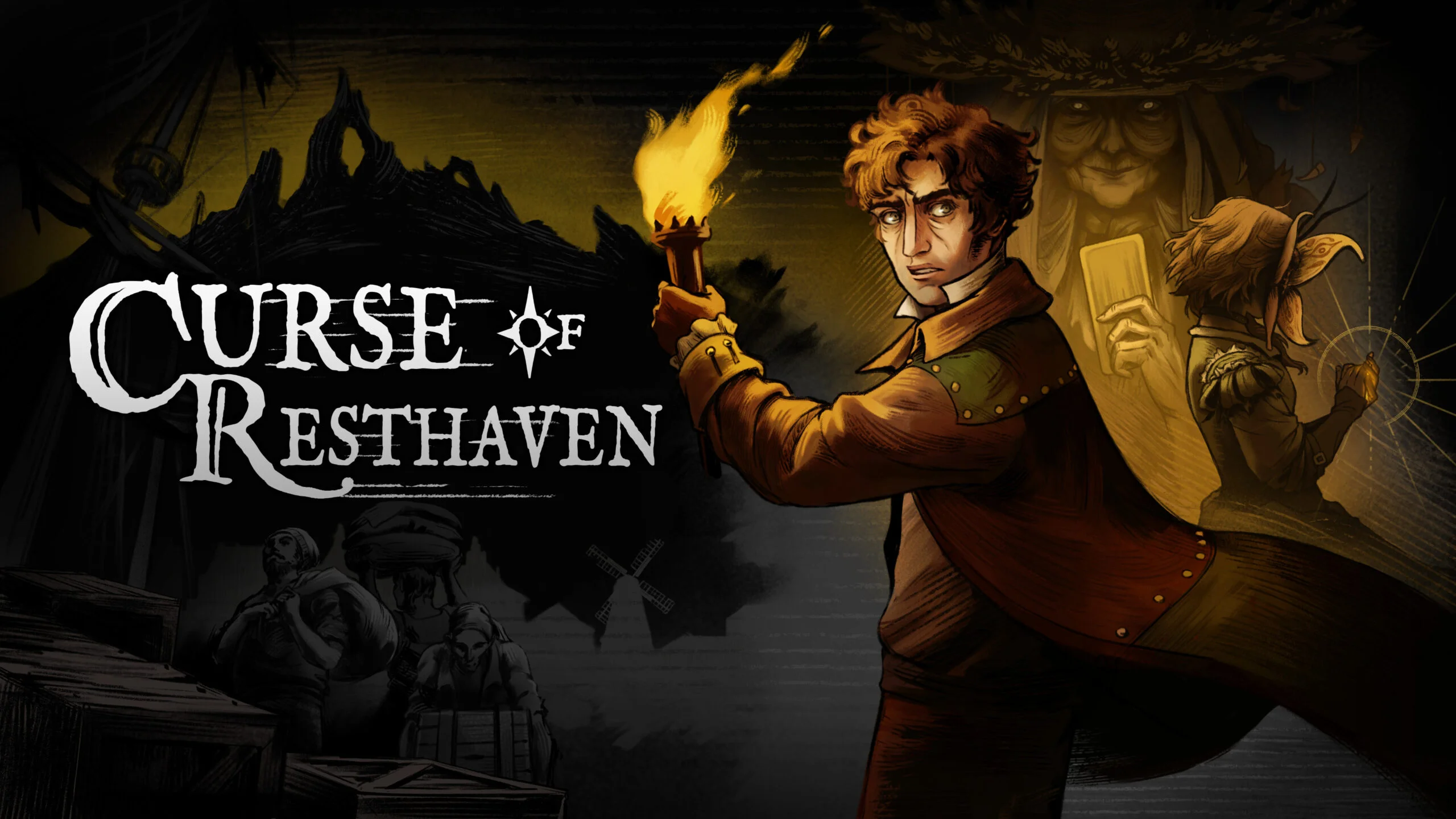
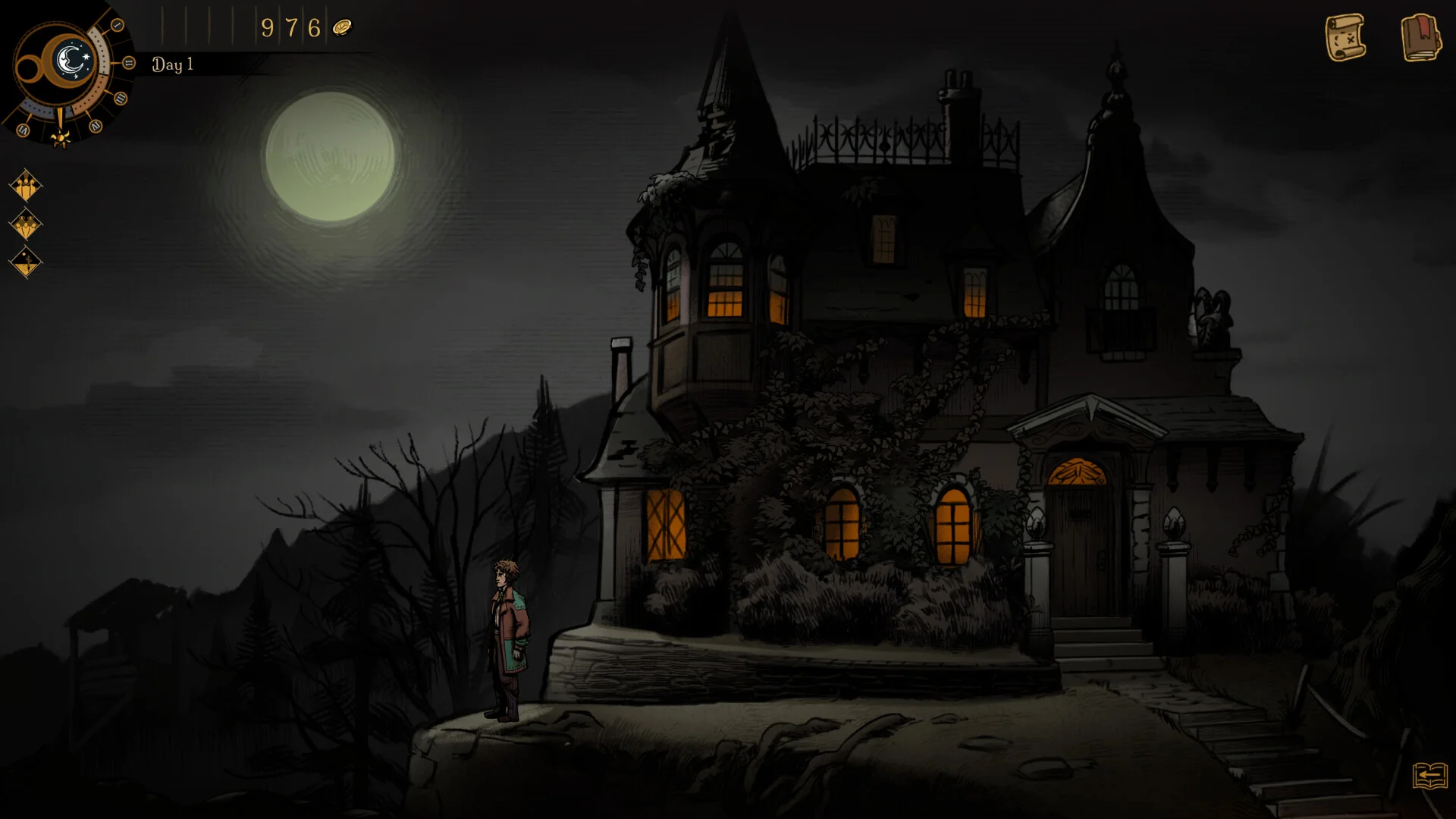
The schedule ends violently. On the sixth day, a supernatural catastrophe destroys Resthaven, returning Ambrose to his arrival with memories the inhabitants lack. The hand-drawn presentation gives this repetition a disturbing visual progression. Layered, colourful streets establish a town worth exploring, while expedition scenes use stark monochrome illustrations to suggest what lies outside it. Later alterations to familiar faces, drained of colour and disfigured, bring that threat into the population. Recognition becomes part of the horror: the portrait belongs to someone whose earlier appearance you already know.
Conversations make those residents useful company before they become potential clues. Discovered information unlocks topics, but an available question can produce a lead, disclose personal history, or meet a refusal. Their guardedness stops the investigation feeling like a procession of cooperative witnesses. Ambrose’s authority cannot guarantee an answer. Major exchanges receive voice performances, while narration and some lighter dialogue remain text-only. The static portraits are less responsive: their designs communicate occupation and temperament clearly, but their unchanging expressions leave the voices carrying shifts that the images cannot register.
The economic work initially gives this detective structure an appealing practical foundation. Businesses pay tribute in resource cards, from bread and lumber to shields and arcane objects. Visiting ships offer markets whose prices reflect supply and the demands of the nations they serve. Ambrose proposes the terms, with aggressive pricing risking the merchant’s departure. Profits fund vendor improvements and better equipment, which can support expeditions. Successful expeditions establish outposts that unlock further upgrades. These activities have reasons to coexist beyond simply giving the governor several menus to manage.
Expeditions provide the clearest test of that preparation. Their encounter cards hint at required objects or companion abilities, sometimes accepting a category of equipment and sometimes demanding something specific. You cannot bring your whole inventory to cover every possibility. An unsuccessful attempt consumes time and the cards committed to it, so interpreting a clue has material consequences.

A seer will reveal the precise requirements for an increasing fee. Paying for certainty can be sensible, but it also puts a price on information that careful preparation might have supplied. The cards serve an adventure game’s equipment puzzles rather than a combat deckbuilder’s encounters.
There is plenty to learn before these relationships become comfortable. Item categories, qualities, trading conditions, companion skills, and building improvements compete for attention alongside the missing-person investigation. Once understood, they make the day legible as a series of priorities. Questioning and commerce consume hours, shops close, and particular events belong to particular days. This is a clock moved by activities, rather than a real-time countdown hurrying you through every decision. Missing an opportunity can mean returning tomorrow or arranging another loop around it.
Resthaven supplies useful tools for that return. Its investigative records preserve leads and the times and places of important events; fast travel and jumping forward reduce the effort of reaching a known appointment. Ordinary resets preserve knowledge and vendor upgrades, while gold and inventory usually disappear unless a perk permits retention. Permanent improvements gradually ease the workload. Separately, shuffled boon choices complicate that efficiency: faster questioning and trading can come with costlier companions or less forgiving negotiations. These trade-offs make a familiar week open to a revised plan.
The limitation appears when a revised plan encounters a restriction that preparation cannot overcome. Expeditions are limited to one per day. Concentrating on the economy early can leave the wilderness investigation behind, even after the town produces everything needed to support it. That creates a different kind of delay from misjudging a merchant’s offer or arriving after closing time. A richer governor still has to wait for another expedition slot. Repeated tribute collection also becomes less interesting once the decisions about developing suppliers have largely been settled.
The larger narrative asks you to carry that routine into additional playthroughs. An early interpretation of a dream image selects one of three paths, offering different perspectives and antagonists. Within each path, the main sequence remains comparatively linear. That distinction matters: choosing another route promises a changed story, but it does not make every familiar conversation along the way newly responsive. A route can reach an ending around the ten-hour mark while leaving Amalia’s larger story unfinished.
Starting another route also differs from an ordinary six-day reset. Much of the accumulated progress is removed, although earned boons remain. A déjà-vu mechanism lets Ambrose delegate some remembered quests to his butler, and fewer expeditions are required to push Amalia’s search forward. Those are thoughtful concessions to an audience that already understands the town. They make another attempt easier to organize, and the alternate material gives that attempt a purpose.
The remaining problem is how much familiar activity sits between those differences. Trading and questioning work best when their answers change what you intend to do next. Repeating them after learning their immediate outcomes gives the same actions a weaker pull, even with delegation reducing the load. Hilltop has made the town’s welfare materially relevant to a private search; its longer structure then ties that search to another substantial commitment. A player satisfied with one route’s ending can leave, but the relative whose disappearance brought Ambrose to Resthaven may still be waiting for him to return.
The Review
Curse of Resthaven
Curse of Resthaven carries Hilltop’s personality from Lil’ Guardsman into a darker, thoughtfully connected adventure. Trading equips expeditions, discoveries reshape daily plans, and familiar faces become unsettling through stark visual changes. Its six-day structure rewards learning, but the daily expedition cap can stall a well-prepared governor. Alternate story paths offer reasons to return, although replay shortcuts leave too much familiar commerce and conversation between discoveries. An absorbing investigation whose repeated duties gradually lose their purpose.
PROS
- Trading, town development, and expeditions support the investigation.
- Monochrome imagery makes familiar characters threatening.
- Investigative records and time-skipping simplify planning.
- The Bard connects musical personality with practical rewards.
CONS
- Familiar dialogue and commerce weaken subsequent playthroughs.
- Daily expedition limits can stall progress despite adequate preparation.
- Several overlapping systems demand substantial initial learning.
- Unchanging dialogue portraits limit expressive responsiveness.