








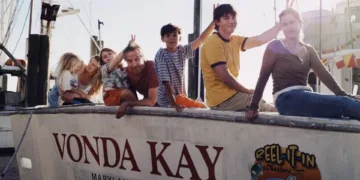





Fenna hears cries and banging at the steel door of her wind turbine and leaves it closed. Inside, she has shelter, routines, a manageable solitude. Outside is the flooded Netherlands of First Zone, where the distinction between a refuge and a trap can disappear with a change in the weather. When a malfunctioning hatch forces her into the sea during a storm, a family aboard a boat rescues her. Her continued existence depends on the kind of response she has withheld.
Being rescued does little to diminish her desire to leave. Fenna wants to get from Zone 11 back to Zone 1, to the concrete interior where nobody makes demands on her attention. Thom Lunshof’s feature debut, co-written with Sam Dijkstra, gives this insistence an uncomfortable moral weight. Practical independence remains possible in small, temporary arrangements; another person’s help can become necessary without warning. Fenna’s resourcefulness has kept her alive, yet it offers no adequate account of the people whose actions allow that life to continue.
Hadewych Minis makes the defensive habits legible without turning Fenna into a psychological case study. Her guarded eyes and economical speech establish someone accustomed to limiting contact. Brief memories of domestic happiness and children suggest the life behind that reserve, while her descents through the hatch into the flooded turbine make withdrawal a physical practice. She floats in the water, touching the small metal container worn around her neck. These passages give grief its own secluded space. They also complicate the apparent security of her routine: she repeatedly enters the element that threatens the shelter around her.
 The turbine carries a cultural irony that Lunshof wisely leaves available for interpretation. A structure associated with renewable energy has become an isolated dwelling after environmental catastrophe. Its surviving value is measured in the space it can offer one person. The film supplies no history that would turn this image into a claim about failed policy or futile mitigation. Half-submerged electricity pylons provide its spare account of a damaged country. Infrastructure remains visible after the collective life it once supported has become difficult to discern.
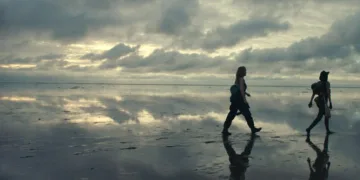
Sami El Hassani’s widescreen photography gives that altered geography a persuasive ordinariness. Water extends across spaces that can still be crossed on foot; figures wade through still shallows, and wooden walkways thread through flooded vegetation. Small patches of land barely clear the surface. The catastrophe has settled into the conditions of daily movement, making even a modest distance an expenditure of effort. The Dutch setting acquires its force through these stubborn remnants of habitable ground. The landscape allows survival to continue while steadily increasing the labor required to reach another person.
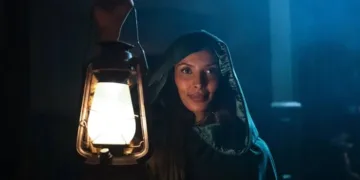
There is considerable beauty in those expanses, though their scale seldom offers relief. A human figure can occupy the image without making much impression on it. At night, the reach of a single torch contracts the visible world, its glare disorienting the camera instead of securing a clear route forward.
Nico Maas’s spare guitar score sustains the film’s subdued register. Lunshof trusts such limited means, and the prolonged crossings make exhaustion perceptible. Yet the attention granted to physical passage also exposes a disparity: the film gives its terrain time to become familiar while repeatedly moving past its inhabitants.
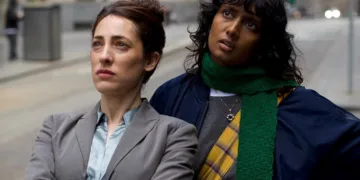
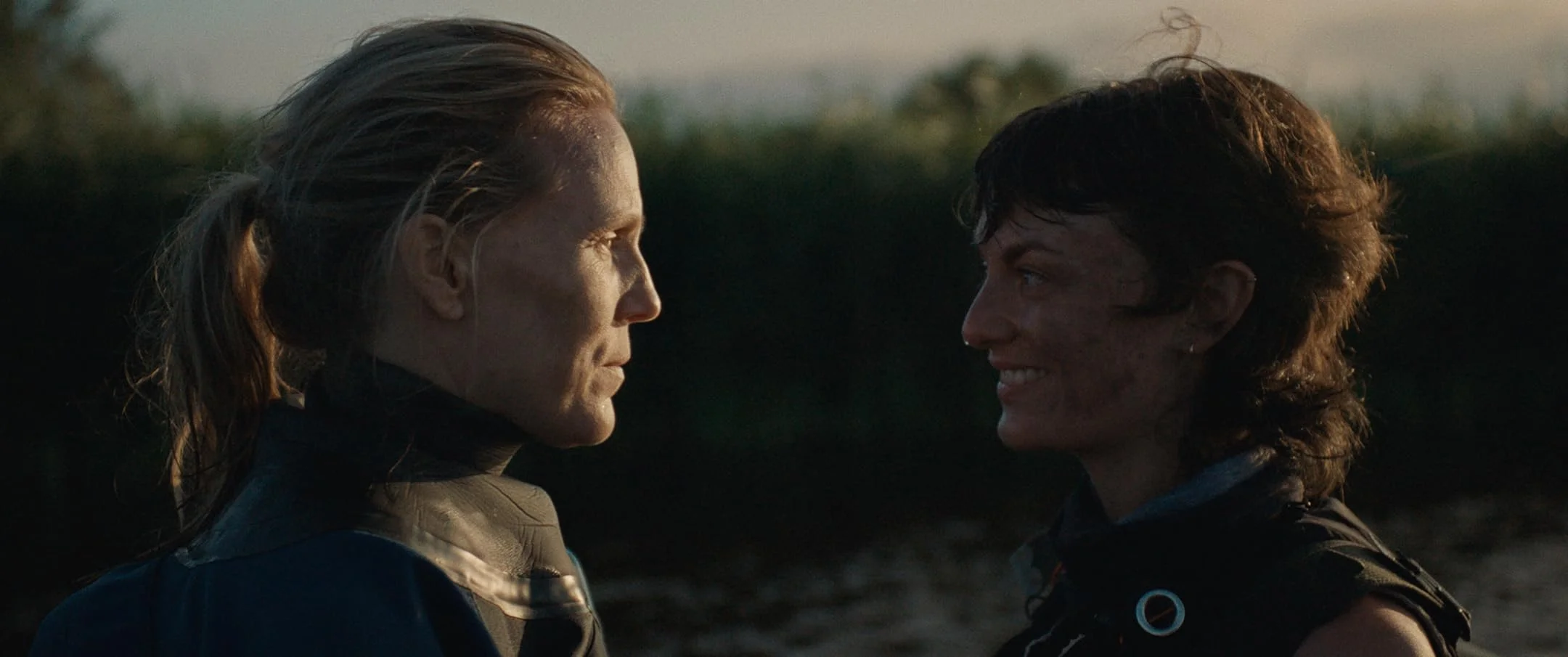
Ive provides the strongest interruption to that imbalance. Violet Braeckman’s restless sociability presses against Minis’s reserve, creating a relationship through incompatible ways of occupying the same space. Fenna’s curtness encounters someone unwilling to let it determine the entire exchange. Small, wordless signs of warmth become noticeable because Minis has established so little expectation of them. Braeckman’s energy gives those changes something to answer. For this stretch, companionship has a texture beyond its obvious usefulness to a stranded traveler.
The writing also places a familiar burden on Ive: the lively woman must make emotional contact available to the withdrawn protagonist. Her section ends before their contrasting temperaments can develop into an equally substantial understanding of what each needs. Braeckman gives the role enough unsettled energy to resist simple cheerfulness, but the film’s onward movement restricts the relationship. Fenna’s departures preserve the difficulty of attachment while repeatedly cutting short the evidence for what attachment might offer. Slowness alone cannot supply the development that these abbreviated encounters leave unfinished.
That limitation reaches into the numbered zones. Their sparse explanation preserves Fenna’s restricted perspective, and the film needs no comprehensive account of the flood to make her predicament intelligible. Still, repeated arrivals and departures give little sense of how the surviving groups sustain a common life. The lack matters because the film places such pressure on her refusal of company. Beyond immediate assistance, the possible terms of staying with others remain indistinct. The horizon receives a patient scrutiny that the arrangements beneath it rarely receive.
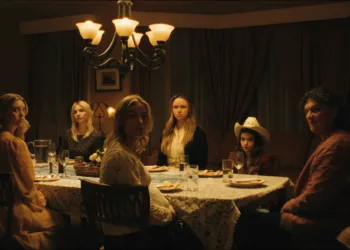
A later survivor group includes a child, bringing Fenna’s memories of motherhood back into the emotional argument. This association is readily understood, perhaps too readily: a child’s presence can make her past do work that a new relationship needs time to earn. Her attachment to the turbine holds a harder possibility. Familiar shelter can preserve a connection to what has been lost without providing a reason to admit anyone new. The family that rescues her acts without that prior connection. Accepting its help makes her return to solitude a decision about living people as well as the ones she remembers.
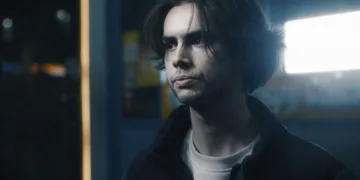
First Zone premiered at the Edinburgh International Film Festival in August 2026. Directed by Thom Lunshof, the sci-fi drama is set in a future-flooded Netherlands, following a hardened woman living in an isolated wind turbine who is forced back into society.
Full Credits
Title: First Zone
Distributor: Makaki Productions
Release date: August 19, 2026 (Edinburgh International Film Festival)
Running time: 1 hour 30 minutes (90 minutes)
Director: Thom Lunshof
Writers: Thom Lunshof, Sam Dijkstra
Producers and Executive Producers: Not publicly specified
Cast: Hadewych Minis, Violet Braeckman, Aus Greidanus Jr., Oona de Kok, Nazmiye Oral, Eelco Smits, Bram Flick, Frieda Pittoors
Director of Photography (Cinematographer): Sami El Hassani
The Review
First Zone
First Zone makes self-sufficiency look precarious: Fenna’s retreat from others survives through their willingness to help her. Hadewych Minis gives that contradiction emotional weight, while the flooded landscapes make catastrophe feel like an enduring condition of daily life. The film’s patience serves its geography better than its relationships, leaving Ive and the surviving communities insufficiently developed. Its strongest insight remains the uncomfortable obligation carried home by someone who wanted only to be left alone.
PROS
- Minis’s restrained, expressive performance.
- Flooded infrastructure gives the climate setting cultural weight.
- Photography and spare guitar sustain isolation and exhaustion.
- Rescue complicates Fenna’s ideal of independence.
CONS
- Ive’s catalytic role receives limited development.
- Survivor communities remain too indistinct.
- The later child leans on established maternal associations.