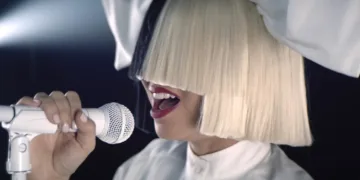

























Sia gives the main performance space to other people. In Sia: Nostalgic for the Present, she sings from a platform to the side while dancers occupy an illuminated square stage. This arrangement is a piece of blocking, the positioning of performers that guides our attention before anyone needs to explain anything. The voice draws us toward its owner; the movement gives our eyes somewhere else to go. Sia remains easy to identify beneath the half-black, half-blonde wig, oversized white bow, and white outfit, even though her face stays concealed.
Maddie Ziegler makes that division rewarding to watch. Her forceful, gymnastic movement and exaggerated expressions give the songs a physical restlessness that Sia’s comparatively stationary presence holds in check. I particularly like the friction between the assurance of the singing and the agitation of the dancing. Songs associated with strength can sound settled about their own resilience. Ziegler’s strained expressions and bodily exertion suggest the effort required to sustain it. The voice and the body can occupy different emotional positions, leaving the viewer to hold them together.
The sound creates a less comfortable division. Crowd responses are audible, yet the spectators remain unseen. Cheering supplies some of the familiar atmosphere of a concert, but we cannot look toward the people responding or discover an expression that changes our understanding of the performance. Their participation exists on the soundtrack. That choice gives the film an odd mixture of communal excitement and visual isolation: we hear a gathering while watching performers within a carefully contained space. At times, I wanted the images to acknowledge the people the sound kept inviting me to imagine.
The production’s origins help explain this peculiar viewing experience. The material was created for the 2016 Nostalgic for the Present tour, with filmed dance performances projected during shows as live performers mirrored their movements.
Its 2026 cinema presentation puts that filmed component before us on its own. Something designed to operate alongside bodies in a shared venue now has to sustain our attention as a screen work. The closed set directs attention toward choreography, props, costumes, and lighting, without the surrounding activity of a concert venue competing for it.
Ryan Heffington’s choreography benefits from that concentration. Ziegler’s facial contortions matter alongside the larger movements because expression becomes part of the dance’s vocabulary. With Sia’s face withheld, there is an unusual amount of emotional responsibility placed on the faces we can see.
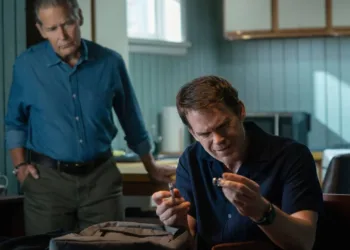
The repeated two-tone wigs connect those performers visually, but they leave room for individual expressions to interrupt the uniformity. Paul Dano and Kristen Wiig enter this shared design as recognizable performers, their familiar identities briefly rubbing against an appearance that belongs to the ensemble.
The songs provide another kind of recognition. “Titanium,” “Unstoppable,” and “Chandelier” offer firm musical footing within a presentation that declines many of the usual invitations to watch a pop star perform herself. Sia’s commanding delivery gives the choreography something substantial to answer.

Her version of “Diamonds” also helps keep the set from feeling restricted to the most immediately expected selections. The pleasure comes partly from hearing these songs, certainly, but their familiarity serves a useful structural purpose. We can follow the musical movement even when the relationships among the figures on screen remain elusive.
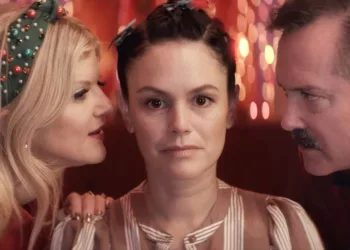
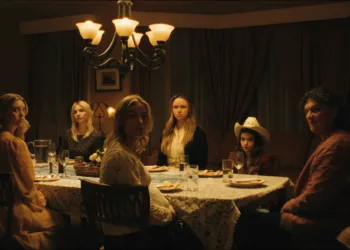
Those relationships become a problem during the brief interludes connecting the numbers. Recurring characters suggest that events are carrying across the breaks, yet the connections are difficult to turn into a developing story. The distinction matters: recognizing someone from an earlier passage does not necessarily tell us what has changed for them.
Within individual performances, movement and expression communicate feeling directly. Between performances, the film asks us to track a continuity that has less expressive clarity. I found myself returning to the arrival of the next song rather than becoming increasingly invested in the connecting action.
A conventional plot would be an unnecessary demand here. Dance can organize attention through gesture, repetition, and emotional association without explaining a chain of events. The interludes raise expectations through their use of recurring characters, and the film gives those expectations limited nourishment. At roughly 75 minutes, the film is compact enough to accommodate some of that looseness.
The decade separating the material’s creation from this cinema presentation changes its texture, too. The emphatic expressions, forceful choreography, and instantly recognizable wigs belong to a particular period of pop imagery. Their familiarity can reduce the surprise, but it also allows a clearer look at how the design functions.
Even without the excitement of discovering this performance language for the first time, the contrast between Sia’s stillness and Ziegler’s volatility remains legible. Viewers with an attachment to these songs will bring their own associations; the arrangement gives everyone else something concrete to watch and understand.
The extended backstage ending puts pressure on the film’s compactness. After the songs have supplied its strongest rhythm, the additional passage lets that concentration slacken. Yet the crew’s matching wigs introduce a thought that the performance space alone cannot quite express.
The visual identity continues beyond the dancers and guest actors to include the people making the images possible. Going backstage usually offers access to the individuals behind a production. Here, those individuals appear wearing its signature design, inviting us to notice how much collective work has gone into an image still identified with a single singer.
Sia: Nostalgic for The Present was released in theaters on July 23, 2026. The cinematic music experience reimagines Sia’s visionary 2016 world tour, blending live stage spectacle, choreography, and dramatic interludes.
Where to Watch Sia: Nostalgic for The Present (2026) Online
Full Credits
Title: Sia: Nostalgic for The Present
Distributor: Trafalgar Releasing
Release date: July 23, 2026 (United States)
Running time: 1 hour 15 minutes (75 minutes)
Director: Daniel Askill, Sia
Producers and Executive Producers: Jason Baum, Daniel Askill, Jonathan Daniel, Sara Greco, Jennifer Heath, David Russell, Sia
Cast: Gaby Hoffmann, Paul Dano, Ben Mendelsohn, Kristen Wiig, Tig Notaro, Maddie Ziegler, Nick Lanzisera, Stephanie Mincone
Director of Photography (Cinematographer): Bobby Shore
Editors: Lorin Askill
Composer: Sia
The Review
Sia Nostalgic for The Present
Sia: Nostalgic for the Present finds an expressive partnership between a largely stationary singer and dancers who give her songs visible strain, vulnerability, and force. Maddie Ziegler makes that division especially rewarding, while familiar music anchors the unconventional staging. The connecting story remains elusive, the unseen crowd creates some distance, and the backstage ending lingers. Still, the interplay between voice and movement gives this compact performance film plenty to watch beyond the recognition of a favorite song.
PROS
- Ziegler’s expressive, physically forceful dancing.
- Effective interplay between Sia’s voice and the choreography.
- Familiar songs anchor the experimental presentation.
CONS
- Connecting interludes offer unclear narrative development.
- Unseen spectators limit the sense of shared concert experience.
- Extended backstage ending weakens the pacing.