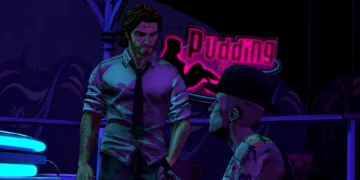

















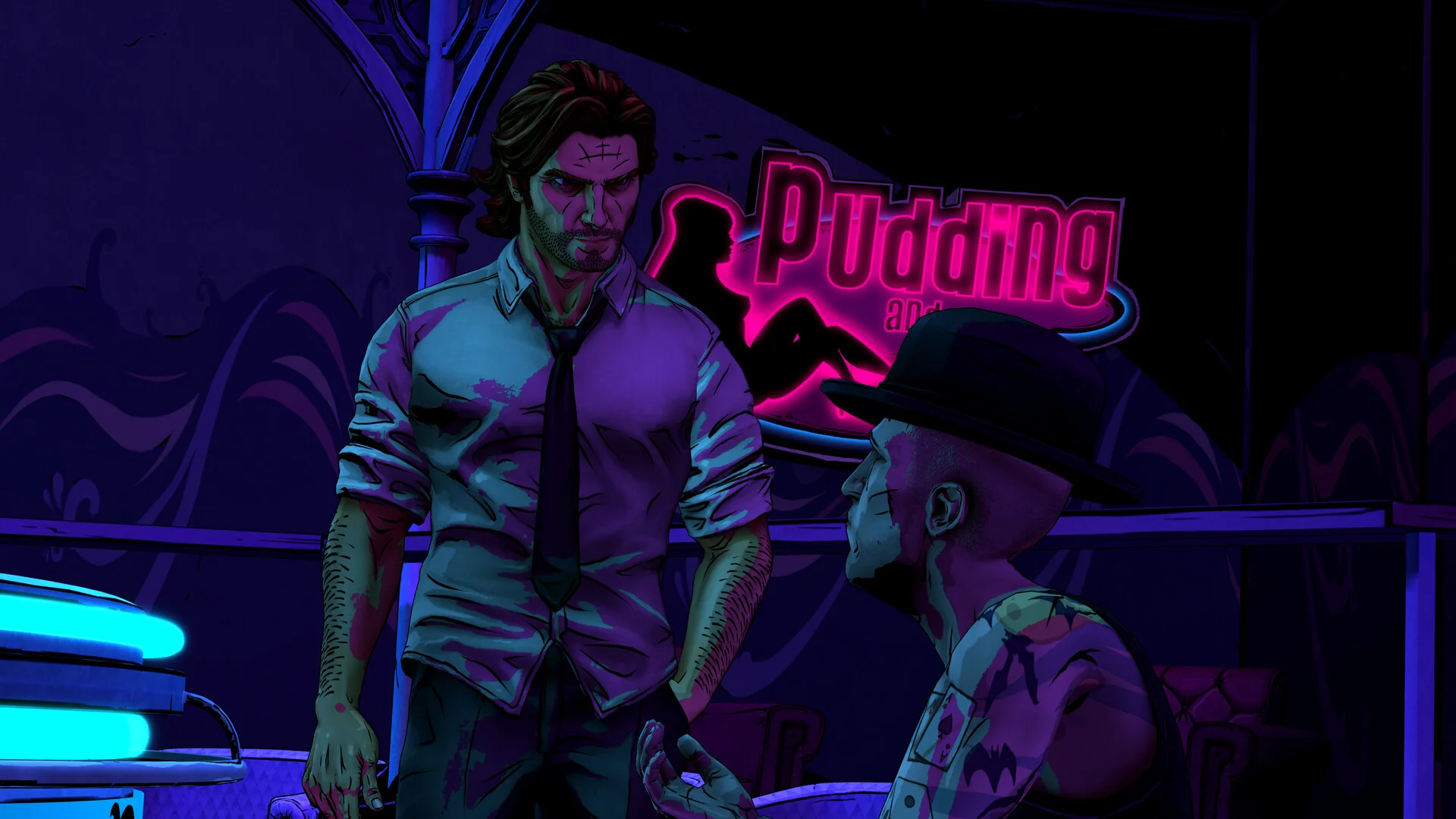

Bigby Wolf can knock on a door or kick it open. For the former Big Bad Wolf, now employed as Fabletown’s sheriff, that decision carries more baggage than the damage to the hinges. His constituents have reasons to fear him before he arrives. Choosing how to enter puts the player in charge of how readily he draws on that fear to get his job done.
Conversations make that responsibility harder to manage. The Wolf Among Us Remastered gives you a handful of responses and a shrinking window in which to select one. A reluctant witness can be pressed, threatened, or sometimes physically coerced. The timer makes restraint an active decision taken under pressure, with an abrasive answer readily available. Adam Harrington’s gruff performance holds these possibilities together: courtesy and intimidation both sound credible coming from Bigby, which makes deciding between them uncomfortable.
The murder mystery provides a strong framework for those decisions. Adapted from Bill Willingham’s Fables, the game places displaced fairy-tale characters in a concealed New York community, where Bigby’s response to a domestic disturbance leads into an investigation of corruption and exploitation.
Its main narrative destination remains substantially fixed, although decisions alter relationships and certain characters’ fates. That limits the reach of its branching, but leaves considerable room to define how Bigby treats people along the way. The game is especially effective when his usefulness as an intimidating presence complicates the effort to become someone his community can trust.
Between conversations, the player’s freedom narrows. Bigby walks through bars, offices, and apartments, inspecting objects and collecting information for subsequent exchanges. Detection is lightly demanding, and moving between objects can feel cumbersome. Much of the pleasure comes from hearing what Bigby notices and learning how these spaces fit together. The game supplies enough interaction to make the investigation feel like work you are conducting, though the evidence rarely requires much independent deduction.
Some of its better investigative decisions concern the people around the clues. Choosing whether to interrupt a wake places the pursuit of information beside an immediate obligation to grieving residents. The interaction is mechanically simple, yet it gives the sheriff’s responsibilities competing claims on his attention. That is where the modest adventure-game framework earns its place: obtaining the next piece of information becomes an occasion to consider what Bigby is entitled to demand.
Physical encounters change the pace through quick-time prompts. You direct the cursor toward an object to strike an attacker, press a direction to dodge, or repeatedly tap to escape a grip. Brawls such as the Woodsman confrontation make Bigby’s aggression something the player must carry out through successive inputs. The choreography remains tightly controlled, but the prompts keep his physical power connected to your hands. Frequent checkpoints limit the disruption when a missed input leads to failure, preserving urgency without making mastery of the controls a major obstacle.
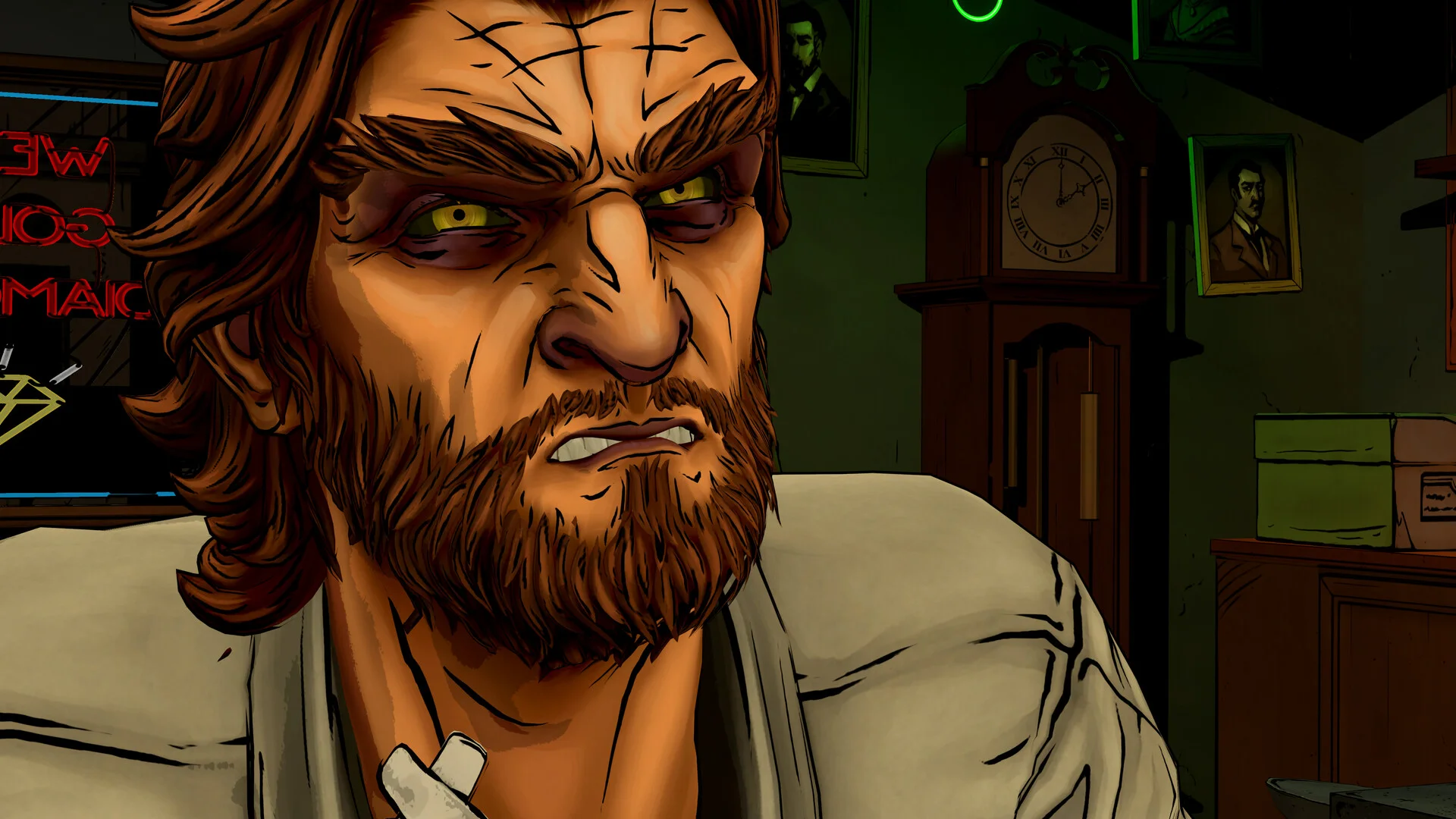
Across five episodes and roughly ten hours, that alternation between questioning, inspection, and violence usually sustains a persuasive rhythm. Episode four exposes its weakness. Characters reiterate positions as the investigation approaches its payoff, leaving the player waiting for movement after gathering information that already seems sufficient. Repetition hurts particularly here because understanding people’s motives is the principal reward for paying attention. The finale restores urgency, but the preceding slowdown remains an awkward stretch in an otherwise gripping mystery.
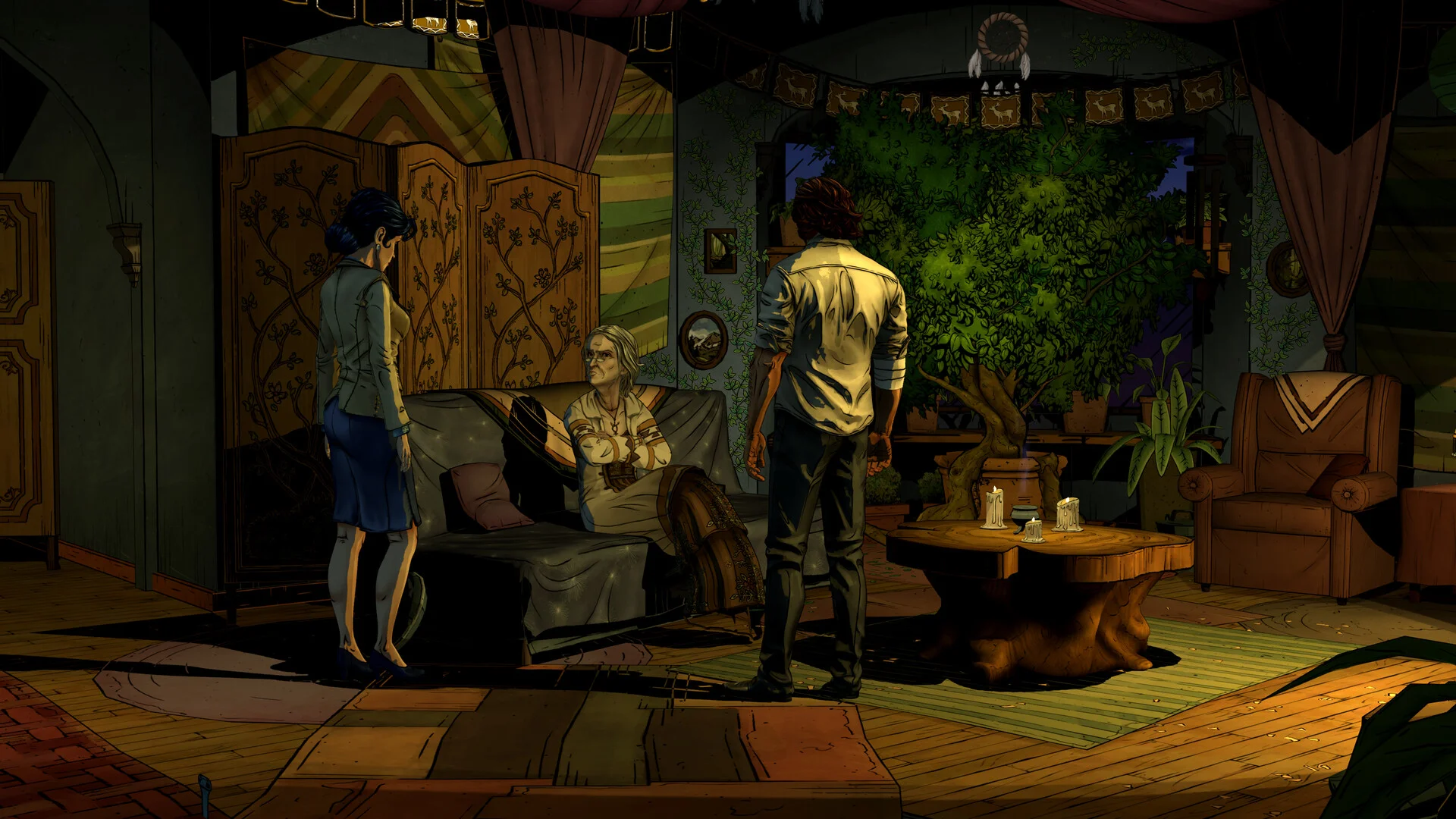
The remaster’s environmental work gives inspection a richer setting. Aunt Greenleaf’s apartment gains hanging tassels and scattered curios that strengthen its identity as a witch’s workspace. The denser Woodlands Business Office sharpens the contrast between administrative surroundings and Fabletown’s shabby bars and homes. These improvements help an investigation concerned with unequal power: moving between locations supplies visible differences in how people live and where authority resides. More detail serves the story when it makes those differences easier to absorb.
Character revisions are less consistently successful. Sharper textures can improve definition while making a stylized face feel overworked; Mr. Toad loses some charm through his fuller, slightly uncanny appearance. Rigid clue-inspection movements and characters turning as though mounted on swivels also remain conspicuous beside the richer surroundings.
Smoother scene transitions and reduced stuttering are welcome improvements to a game so dependent on conversational continuity, although residual hitches, loading delays, and texture problems qualify the sense of technical renovation. Improved stability and convincing movement are separate achievements, and this edition is more persuasive on the former.
Noir Mode introduces a more direct conflict between presentation and play. Its monochrome treatment evokes the detective films that inform the story, but sacrifices the neon palette that gives Fabletown its particular atmosphere. Directional quick-time arrows can also become harder to distinguish without their usual red coloring. An optional visual treatment becomes difficult to recommend when it weakens both the setting’s identity and the clarity of instructions during action. The standard palette already does valuable work.
For newcomers, the strength of the campaign makes this an appealing package despite those uneven changes. Returning owners face a narrower proposition: the story, investigative demands, and scope of its decisions remain largely unchanged.
Interviews with developers and cast members, alongside a concept-art gallery, provide worthwhile context, but their appeal depends on an existing interest in how the game was assembled. The promised transfer of choices into the sequel offers another reason to revisit Bigby’s conduct, though its eventual significance cannot establish greater consequence in the campaign available here.
The most useful additions are the five playable deleted scenes, including material following the Woodsman fight and an alternative treatment of the final sequence. Unfinished dialogue, rough visuals, and bugs limit their polish, yet playing them gives discarded possibilities a presence that a gallery cannot.
Kept separate from the campaign, they allow the player to encounter another version of a familiar passage without confusing it with a restored branch. After a story spent making decisions inside carefully maintained boundaries, these scenes shift attention toward the decisions that established those boundaries in the first place.
The Review
The Wolf Among Us Remastered
The Wolf Among Us Remastered remains compelling because choosing how Bigby exercises authority gives a largely fixed mystery personal stakes. Timed dialogue, Harrington’s performance, and socially charged interactions make that responsibility tangible. Richer environments strengthen Fabletown, while playable deleted scenes offer worthwhile insight into its construction. Limited deduction, a sluggish fourth episode, and uneven technical polish remain, and Noir Mode compromises prompt visibility. Newcomers have a strong reason to investigate; returning players should weigh the extras against a substantially unchanged campaign.
PROS
- Choices give Bigby’s conduct emotional weight.
- Harrington’s performance sustains contrasting responses.
- Richer environments strengthen the setting.
- Playable deleted scenes expose discarded narrative possibilities.
CONS
- Light deduction and occasionally cumbersome inspection.
- Episode four stalls through repeated information.
- Stiff animation and residual technical issues.
- Noir Mode weakens color identity and prompt clarity.