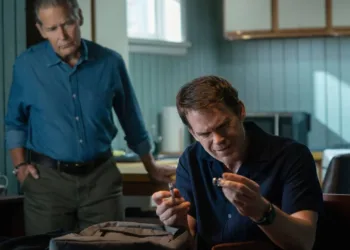

























Everyone at the gym stops to watch a television report about a vicious murder. Dexter Morgan keeps going on the treadmill. The joke works through the mismatch: communal alarm, uninterrupted exercise. Michael C. Hall barely needs to advertise the difference between Dexter and the people around him because their behavior supplies it. Across the first two episodes of Dexter: Resurrection’s second season, that familiar comic detachment remains a reliable pleasure. Other people have encountered something dreadful. Dexter still has cardio to finish.
His internal narration makes us comfortable with that separation, which is a slightly grubby trick the series continues to perform well. We get the commentary withheld from everyone sharing his space, and Hall’s dry delivery makes the access feel companionable. The gym scene lets us enjoy his failure to respond appropriately without pretending that his response is normal. This arrangement has served Dexter nicely. Now he wants recognition outside the voiceover. Having spent years keeping his fellow characters out of the conversation, he is beginning to resent the lack of applause.
That dissatisfaction gives the midlife-crisis premise some bite. Dexter remains a New York rideshare driver whose private activities follow the murderous code taught by his adoptive father, Harry. He considers those activities socially beneficial and would appreciate some acknowledgment. The self-pity is funny because his preferred explanation omits the obvious difficulty: people tend to ask follow-up questions when you disclose hundreds of killings. His fantasy of public appreciation has precedent in the original series. Resurrection gives the appetite fresh emphasis by attaching it to a man beginning to worry about how much time he has left.
The blurry vision helps make that worry practical. Dexter’s body can introduce errors into work that depends on precision, while the killers surrounding him turn age into something he can measure. Brian Cox’s retired New York Ripper represents a possible future; Dan Stevens’ emerging Five Borough Killer supplies an unwelcome reminder that younger men are available. The casting establishes a useful generational arrangement before either new adversary has received extensive development. Harry, again played by James Remar, offers paternal guidance through this anxiety. Advice from a dead father is reassuringly convenient when your own mind supplies both sides of the discussion.
The opening’s handling of time is less settled. A multi-year jump gets Harrison, played by Jack Alcott, through the police academy and into the NYPD without making us wait through his preparation. The premiere, “Risky Business,” still finds room for unfinished business following Leon Prater’s death, including Eric Stonestreet’s return as the Rapunzel killer. Other killings from the intervening period receive brief appearances. This is efficient selection: retain a continuing threat, compress some completed activity, move the family situation forward. It also means the episodes are simultaneously clearing away old business and finding space for a substantial new load.
Harrison’s employment is the strongest reason to make that jump. His oath immediately places a professional obligation beside his loyalty to Dexter, and the detectives’ recognition of his name from an old murder case prevents the uniform from functioning as a clean start.
The situation has an effective procedural awkwardness. Harrison enters a system whose members already possess information about him, while his father operates according to rules that system cannot accept. These episodes establish the competing demands clearly. They have barely begun to dramatize the choices those demands could produce, so the father-son conflict currently carries considerable promise and limited development.

The surrounding plots create a similar imbalance. Detective Claudette Wallace’s pursuit of the Ripper gives Dexter’s potential intervention a consequence outside his own need to kill: she has spent years trying to secure a conviction, and the police still lack sufficient evidence. Charley, Uma Thurman’s former security chief to Prater, offers to facilitate Dexter’s work, introducing another person into an activity he prefers to control.
Each thread asks something different of him. Wallace complicates his claim to dispense justice; Charley complicates his independence. Yet the opening keeps adding these arrangements before allowing many of them sustained dramatic space. Circumstances change quickly. Relationships need longer.
Joey Quinn’s return offers a sharper kind of uncertainty. Desmond Harrington’s former Miami detective, now a private investigator, arrives in New York carrying a history Dexter cannot dismiss. Quinn previously suspected him and chose to leave those suspicions unconfirmed, influenced by Dexter’s help in keeping him out of prison and his own attachment to Deb. Those qualifications matter. A returning investigator with a settled mission would give Dexter a straightforward problem. Quinn’s earlier willingness to let things rest leaves his present intentions harder to read, especially after Angel Batista’s death.
Some old-series knowledge is required to appreciate the discomfort, though the essential point is simple: Quinn once had reasons to stop looking. Dexter now needs to determine how much that accommodation still protects him. The audience shares the uncertainty instead of merely waiting for an investigator to catch up with information it already possesses. Harry can advise, disagree and reassure from inside Dexter’s head. Quinn arrives with a mind Dexter cannot consult. For a man growing tired of supplying his own appreciation, how much independent judgment can he actually tolerate?
Dexter: Resurrection Season 2 premieres on Paramount+ on October 30, 2026. Created by Clyde Phillips, the psychological crime thriller follows Dexter Morgan as he navigates a turbulent midlife crisis while attempting to suppress his dark impulses under a new identity.
Where to Watch Dexter: Resurrection Season 2 Online










Full Credits
Title: Dexter: Resurrection Season 2
Distributor: Paramount+
Release date: October 30, 2026
Rating: TV-MA
Running time: 60 minutes per episode
Director: Marcos Siega, Michael C. Hall
Writers: Clyde Phillips, Scott Reynolds
Producers and Executive Producers: Clyde Phillips, Michael C. Hall, Scott Reynolds, Marcos Siega, Bill Carraro
Cast: Michael C. Hall, Jack Alcott, Uma Thurman, Ntare Guma Mbaho Mwine, Desmond Harrington, Kadia Saraf, Dominic Fumusa, James Remar
- Composer: Pat Irwin
The Review
Dexter Resurrection Season 2
Dexter’s midlife crisis makes an entertainingly dangerous addition to his usual problems: secrecy is difficult enough without wanting credit. Across these first two episodes, Hall’s dry delivery and Quinn’s uncertain intentions supply dependable pleasures, while the crowded plotting gives several relationships insufficient room to develop. The revival remains enjoyable, especially when Dexter’s self-importance becomes the joke. Its appetite for new complications currently exceeds the time available to explore them.
PROS
- Hall’s dry narration and comic detachment.
- Recognition anxiety complicates Dexter’s need for secrecy.
- Quinn’s uncertain knowledge creates effective suspense.
- The time jump puts Harrison’s police career into play efficiently.
CONS
- Crowded plotting limits relationship development.
- Quinn’s ambiguity depends partly on original-series history.