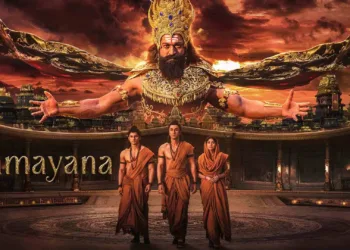
























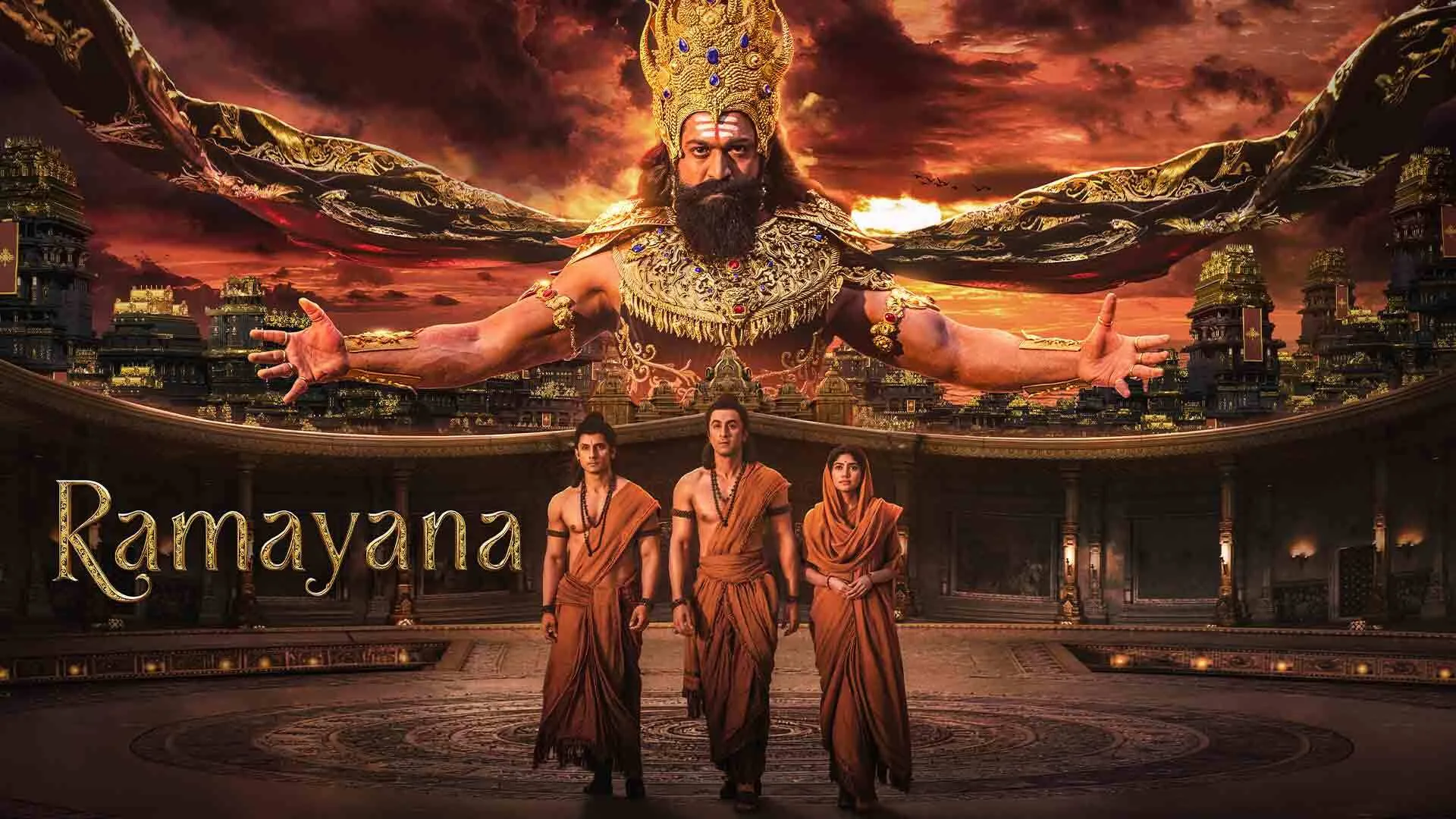

Ravana’s dance of worship gives Yash something the virtuous characters in Ramayana: Rise of a Legend seldom receive: an opportunity to express several desires through the same action. Addressing Shiva, he makes devotion physically forceful, allowing reverence and the appetite for power to occupy one body. The sequence has the scale of a star entrance, yet its musical form does useful dramatic work. We can see why this man commands attention before the narrative asks us to condemn what he does with it. Worship establishes the intensity of his attachment to divine power; his conduct will determine its moral value.
His ten heads receive an equally expressive reinterpretation. Different versions of Ravana converse within his consciousness, giving conflicting impulses their own faces and voices. The device turns an immediately recognizable attribute into a method of characterization: revenge can encounter restraint, confidence can coexist with insecurity. Director Nitesh Tiwari allows the antagonist to deliberate, while Yash gives those divisions a personality large enough to hold the screen. Ravana’s movement from resistance to oppression toward conquest therefore has a disturbing continuity. The desire to overturn a hierarchy survives his acquisition of the power to impose one himself.
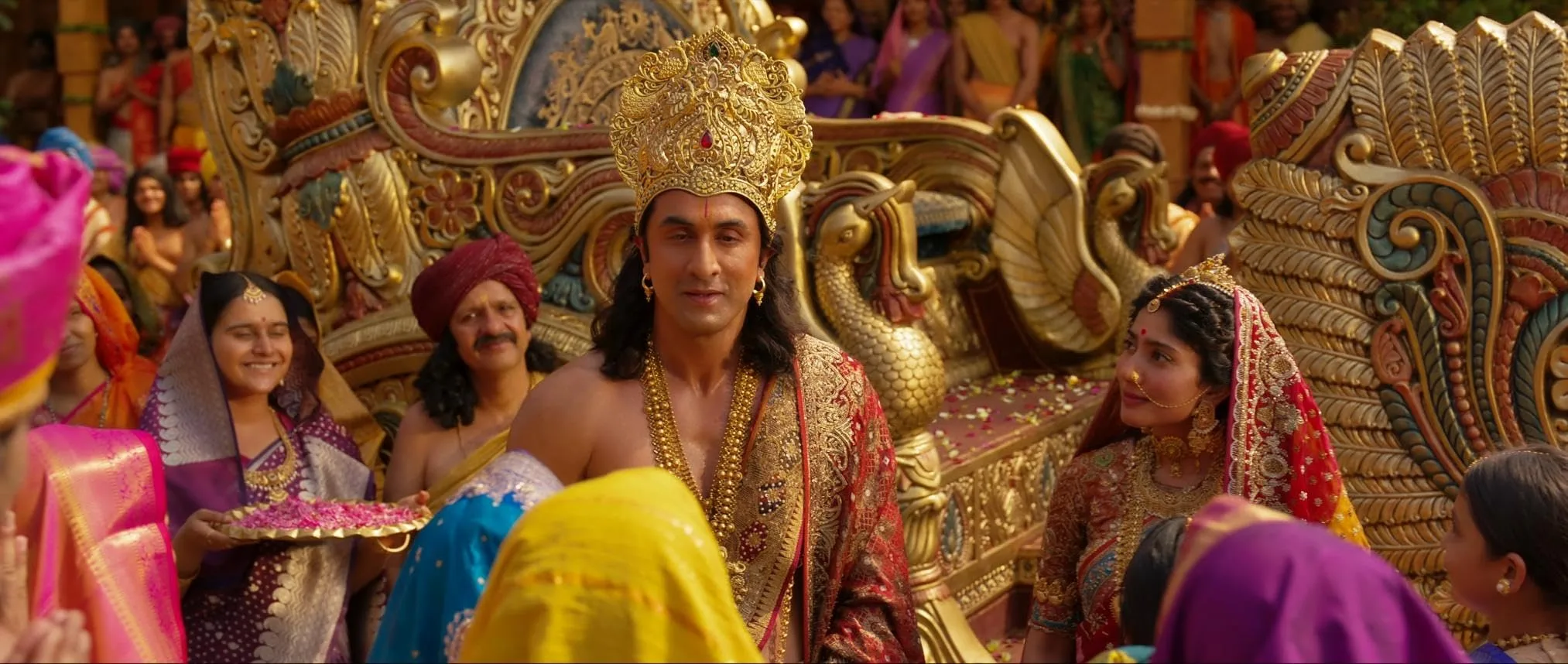
The shift to Rama exposes how unevenly the film distributes this expressive freedom. Played by Ranbir Kapoor, the prince of Ayodhya is Vishnu’s human incarnation, born into a world threatened by Ravana. His destiny establishes his importance, but his acceptance of fourteen years in exile supplies the more immediate dramatic test. Kaikeyi wants her biological son Bharata to inherit the throne, placing family allegiance and royal obligation under painful pressure. Rama’s response belongs to the film’s understanding of dharma, the ethical and sacred duties binding a person to others. Kapoor’s composure is appropriate to that understanding. The difficulty lies in how little space the writing gives us to experience what maintaining it costs.
An abrupt cut from a nightmare to an empty throne briefly makes responsibility tangible without another declaration of principle. The throne becomes a place burdened by expectation, its vacancy charged with the prospect of a life Rama must either assume or relinquish. Here, editing supplies an uncertainty that the dialogue often settles too readily. Kaikeyi’s demand has already made duty a matter of intimate damage, involving a father, his wives, and his sons. Yet the film tends to move toward the nobility of Rama’s response before fully inhabiting the family’s injury. A sacred figure can remain steadfast while the people around him make that steadfastness difficult to bear.
Sai Pallavi’s Sita encounters a related limitation. Her armed resistance to rakshasas gives her physical capability and interrupts the expectation that she will simply await protection. Pallavi’s grace also suits a character whose earthly presence carries divine significance. These qualities need a relationship in which to acquire particular emotional meaning, however. The brief tenderness between Sita and Rama suggests affection, but their shared life receives less attention than the roles they fulfill within the epic. Their dignity does not require modern romantic banter or conspicuous psychological turmoil. It requires time for the audience to recognize how these two people belong together, especially once Sita accompanies Rama into exile.
That shortage of emotional time makes the musical choices in the English-language adaptation especially consequential. This version reduces the musical material of the Hindi film, altering the balance between performed expression and narrative movement. A song can let a relationship occupy the screen without requiring another plot development; devotion or desire can become the event itself. Ravana’s dance demonstrates how effectively such an interval can reveal character. The reduced presence of song leaves the English adaptation more dependent on dialogue and background scoring to sustain its emotional connections. It would be too easy to assume that restoring musical passages would solve every weakness, but their dramatic function deserves recognition.
- R. Rahman and Hans Zimmer’s score gives encounters with divinity and scenes of combat an imposing musical scale. Its force helps sustain the sense that human actions belong to a cosmic struggle. The succession of revelations, destinies, and confrontations nevertheless puts that force under strain. So many events arrive with the weight of a culmination that there is limited opportunity to wait for one, or to remain with its aftermath. The music can announce the significance of a turning point; it cannot supply all the experience that makes the point significant. Ravana’s devotional performance has an advantage here because the character actively inhabits the musical event.
The English presentation also intervenes directly in the relationship between voice and body. Brahma AI lip synchronization reshapes mouth movements to match the translated dialogue, with the conspicuously animated mouth of Brahma’s digital face providing an early distraction. The visual attention slips from the divine encounter to the mechanics of speech. This matters in a film that asks composed faces and elevated language to communicate spiritual conviction. Small disruptions in their coordination can weaken the authority of a performance. English itself poses no necessary obstacle to this material, but accessibility depends on the persuasiveness of the speech and its embodiment, not simply on making the lips correspond to the words.
The airborne confrontation between Ravana and Jatayu around the Pushpaka Vimana offers a welcome release into imaginative action. Flight gives the encounter a scale and freedom suited to the epic, and the sequence sustains interest without requiring Rama’s presence. Its achievement is qualified by the limited preparation for Jatayu’s intervention. The creature’s visibly digital body also sits uneasily alongside the human performers, though that integration problem should be distinguished from the battle’s imaginative conception. We can understand the nobility of the action and enjoy its spectacle while feeling only a modest attachment to the figure undertaking it.
The installment’s stopping point creates a different demand. Rama and Ravana have yet to meet directly, and the abduction turns the story toward the rescue that will drive its continuation. An epic divided across films can leave its principal conflict unresolved, provided the first part has established something substantial that the next part can place in danger. Here, separation asks Rama and Sita’s relationship to carry a weight their brief moments of intimacy have only begun to support. For viewers who bring an existing attachment to these figures, the loss already has meaning. Those meeting them through this film must imagine much of the shared life whose interruption is supposed to make the wait painful.
Ramayana: Rise of a Legend is a monumental mythological action-fantasy epic directed by Nitesh Tiwari, scheduled to hit theaters worldwide on November 5, 2026. Based on the ancient Indian epic, the film follows Prince Rama, who embarks on a legendary journey of sacrifice, duty, and destiny after his exile and the abduction of his wife Sita by the formidable demon king Ravana. You will be able to experience this grand cinematic spectacle exclusively in movie theaters.
Where to Watch Ramayana: Rise of a Legend Online (2026)
Full Credits
Title: Ramayana: Rise of a Legend
Distributor: Prime Focus Studios, Monster Mind Creations, DNEG, Sony Pictures Releasing
Release date: November 5, 2026
Rating: PG-13
Running time: 195 minutes
Director: Nitesh Tiwari
Writers: Nitesh Tiwari, Shridhar Raghavan, Shreyas Jain
Producers and Executive Producers: Namit Malhotra, Yash
Cast: Ranbir Kapoor, Yash, Sai Pallavi, Sunny Deol, Ravi Dubey, Rakul Preet Singh, Lara Dutta, Arun Govil, Sheeba Chaddha, Indira Krishnan, Kunal Kapoor
Director of Photography (Cinematographer): Pankaj Kumar, Mahesh Limaye
Editors: Huzefa Lokhandwala
Composer: A. R. Rahman, Hans Zimmer
The Review
Ramayana: Rise of a Legend
Yash’s Ravana gives Ramayana: Rise of a Legend its richest dramatic expression, particularly when worship, ambition, and inner conflict share the screen. Rama and Sita receive less space to make their devotion emotionally tangible. Rahman and Zimmer’s imposing score sustains the cosmic scale, but the English adaptation’s reduced musical storytelling and distracting lip synchronization complicate its invitation to newcomers. The airborne spectacle can enthrall; the central relationship needs greater intimacy to make its threatened destruction hurt.
PROS
- Yash’s expressive, internally divided Ravana.
- Music that gives divine encounters imposing scale.
- - Imaginative airborne confrontation with Jatayu.
CONS
- Limited emotional development for Rama and Sita.
- Relentless dramatic peaks leave little breathing room.
- - Jatayu’s intervention receives insufficient emotional preparation.
- Distracting English lip synchronization.