

























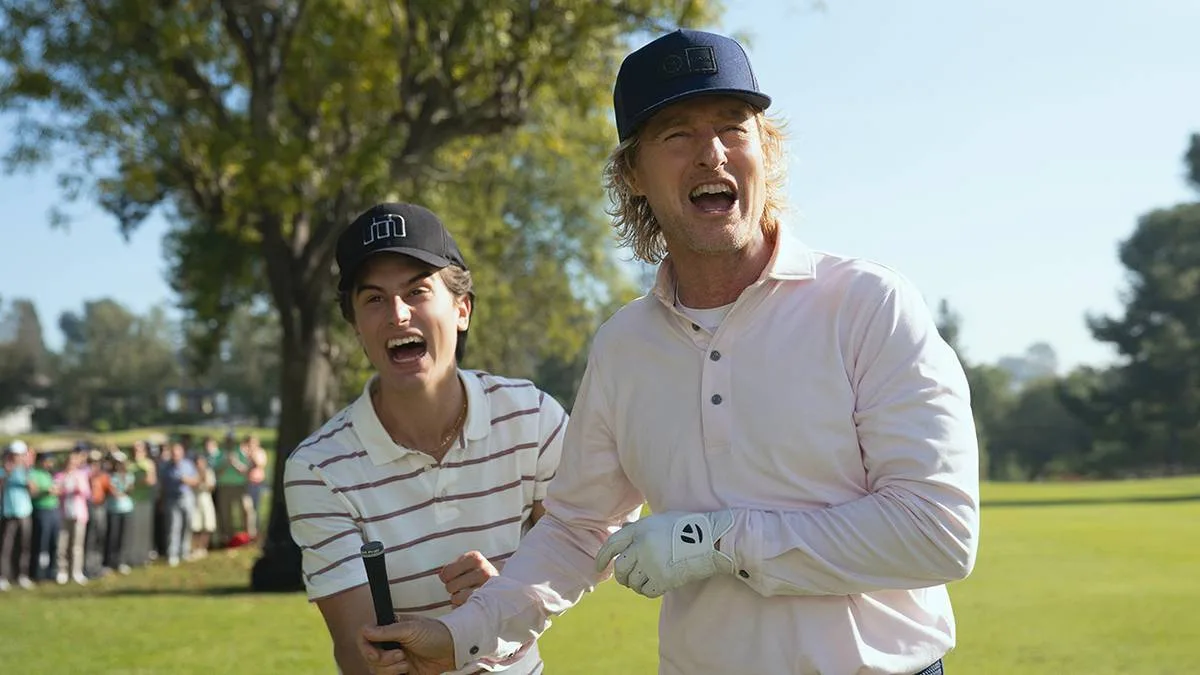
Pryce Cahill wants Santi Wheeler to take the golf scholarship. At eighteen, his protégé has time to get an education and prepare for professional competition; the money and attention can wait. It is sensible advice from a man whose own career fell apart. It is also advice that lets Pryce remain the experienced adult in somebody else’s story. Owen Wilson’s former golf star found purpose through mentoring Santi in Stick’s first season, following the death of his son and the collapse of his marriage. Giving the boy guidance has become easier than deciding what he wants for himself.
The second season makes Pryce answer that question. Encouraged by his old caddie Mitts and former rival Clark Ross, he considers a comeback, with the ambition of becoming the oldest U.S. Open winner. A record-setting charity pro-am round gives him evidence that the talent remains. Santi, meanwhile, chooses professional golf over college. Their decisions create a useful complication: the mentor fears testing himself too late, while the pupil risks testing himself too early. Separating them gives each an independent story, though it reduces the contact through which those opposing choices might challenge each other.
Across the first seven episodes of the ten-episode season, Pryce receives the stronger development. Santi’s professional debut supplies credible pressures, especially as agent Jeremy Pierce, played by John Higgins, begins edging his mother Elena and girlfriend Zero out of his circle. Sponsorship obligations and tournaments for which he is insufficiently prepared turn an exciting opportunity into a schedule other people help control. Peter Dager makes Santi’s inexperience understandable. He is being asked to make adult decisions while the rewards encourage him to mistake being wanted for being ready.
The difficulty is that this strand identifies its pressures with greater confidence than it develops them. Commercial commitments establish Santi’s frustration, but the business of becoming a professional remains thinly sketched. The displacement of Elena and Zero has immediate personal stakes; the machinery surrounding those changes receives less attention. With Wilson and Dager sharing relatively few scenes, the show also limits its most promising source of friction. Pryce has relevant experience that Santi may resist, and personal regrets that could distort his advice. Their separate trajectories cannot fully replace the exchanges that would expose the difference.
Pryce’s search for coaching produces a sharper chain of discoveries. He travels with Mitts and Clark to see his former instructor, Butch Lydecker, only to learn that Butch has Alzheimer’s disease. Butch’s daughter Amanda, played by Rhea Seehorn, becomes his coach instead. She and Pryce have a romantic history, which means she recognizes the evasions beneath his agreeable manner. Seeking help with his swing brings him into contact with someone who will question why he keeps withdrawing when success becomes possible. The practical task and the personal obstacle belong to the same story.
Wilson’s self-deprecating delivery is particularly useful here. Pryce’s humor makes his discomfort easy to tolerate, including for people who should challenge him. Amanda refuses that arrangement and sends him to a performance specialist, played by Sasha Alexander. His fear is specific: attempting a comeback could destroy the comforting belief that he might have been great. The childhood flashbacks establish that his self-sabotage predates his bereavement, but they also explain behavior that the present-day coaching already makes legible. The psychological work is persuasive enough without every cause receiving an accompanying demonstration.
Amanda and Pryce’s playful competitiveness gives their relationship a less explanatory register. An arcade contest and a game of strip golf allow old familiarity and attraction to surface through what they do together. Those scenes earn their leisure. A match can alter the balance between two people without moving either career forward. Seehorn also gives Amanda a life outside Pryce’s recovery through her relationship with Butch. Her responsibilities do not pause because an old flame needs to rebuild his confidence.
Butch’s brief reassurance that he has always been proud of Pryce, followed by another loss of recognition, is the season’s most effective emotional reversal. Rex Linn gives Pryce the affirmation he wants and then makes its availability painfully uncertain. The scene cannot settle into a reassuring lesson about believing in yourself. For Amanda, this fluctuation belongs to the ongoing work of caring for her father. Seehorn’s restraint preserves that distinction: Pryce experiences a devastating encounter, while Amanda must continue living with the changes. The comeback story gains weight because her circumstances extend beyond its needs.
Clark’s increased involvement supplies a welcome change in comic rhythm. Timothy Olyphant retains the character’s self-absorption after moving him from rival to ally, so joining the group does not require a personality replacement. His exchanges with Marc Maron’s Mitts give Pryce’s support system some abrasion. This rearrangement is convenient for the comeback plot, but its immediate comic benefit is clear. The trouble elsewhere is less the familiar warmth than the uneven use of screen time. Roughly thirty-minute episodes remain easy to watch while certain relationships make surprisingly little progress.
Elena and Mitts provide the clearest example. Having agreed to move in together, they become separated when Elena stays in Los Angeles to help manage Santi’s career. Mitts’ encounter with Butch intensifies his fear of aging and inadequacy; Elena has obligations that complicate their plans. Both have reasons to struggle. Yet their mutual failure to call keeps those reasons from becoming an exchange in which either must respond to the other. The relationship has reached the stage where the principal obstacle is telephone operation. Maron and Mariana Treviño give the pairing enough appeal to make the missed interaction frustrating. Elena’s changing role in Santi’s career and Mitts’ newly unsettled view of his future could force them to negotiate what living together would actually mean.
Stick returns for its second season on Apple TV+ on November 4, 2026. Created by Jason Keller, the sports comedy series follows Pryce Cahill, an over-the-hill former pro golfer who gets a second chance at redemption while navigating the high-stakes world of golf alongside his new coach, trusted caddie, and an eccentric found family. You can stream the new season exclusively on Apple TV+.
Where to Watch Stick Season 2 Online


Full Credits
Title: Stick (Season 2)
Distributor: Apple TV+
Release date: November 4, 2026
Rating: TV-MA
Running time: 30 minutes per episode
Director: Jonathan Dayton, Valerie Faris, Jaffar Mahmood
Writers: Jason Keller, Bill Callahan, Christopher Moynihan
Producers and Executive Producers: Jason Keller, Owen Wilson, Ben Silverman, Guymon Casady, Howard T. Owens, Rodney Ferrell, Drew Buckley, Lee Eisenberg, Natalie Sandy
Cast: Owen Wilson, Peter Dager, Marc Maron, Mariana Treviño, Lilli Kay, Judy Greer, Rhea Seehorn, Timothy Olyphant, Billy Zane
Director of Photography (Cinematographer): Lachlan Milne
Editors: David Rennie, Kevin Bailey
Composer: Theodore Shapiro
The Review
Stick Season 2
Stick’s second season gives Pryce a worthwhile reason to pick up his clubs again. Wilson makes his fear of failure persuasive, while Seehorn and Linn give the comeback emotional stakes beyond winning. Across the first seven episodes, the divided narrative serves Santi less effectively, and some relationships stall while the cast remains pleasant company. The strongest scenes let people challenge each other; the weakest keep them apart and wait for that to count as development.
PROS
- Wilson’s convincing portrayal of Pryce’s self-doubt.
- Seehorn and Linn’s affecting caregiving storyline.
- Playful competition develops Amanda and Pryce’s chemistry.
- Olyphant and Maron’s abrasive comic exchanges.
CONS
- Thin treatment of Santi’s professional pressures.
- Limited interaction between Pryce and Santi.
- Elena and Mitts’ relationship stalls through noncommunication.
- Flashbacks overexplain established behavior.