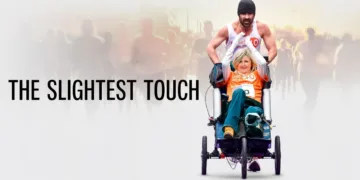


















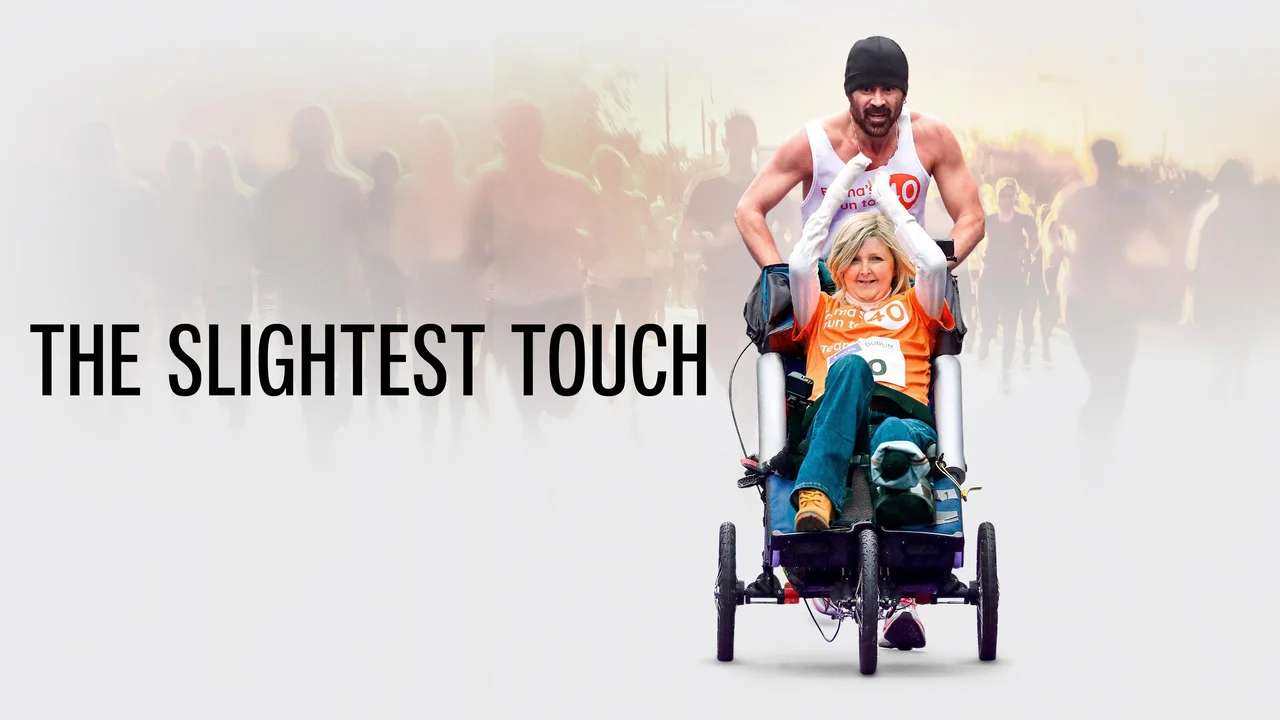

Doctors reportedly told Emma Fogarty’s parents that their daughter would not survive a week. Forty years later, those decades become four kilometres, the distance Colin Farrell pushes her in a specially adapted wheelchair during the Dublin Marathon. There is something suspiciously convenient about this arithmetic.
A lifetime of physical suffering becomes a measurable achievement, complete with a finish line and thousands of spectators. I approached The Slightest Touch expecting what I have come to think of as the inspiration tax: the peculiar obligation placed on people with disabilities to transform their suffering into something emotionally beneficial for the rest of us. It is a lucrative arrangement for the audience, which gets to feel profoundly moved before returning to ordinary life.
Rachel Fleit’s documentary initially appears perfectly equipped to collect that tax. Fogarty lives with epidermolysis bullosa, a rare genetic condition that makes her skin extraordinarily fragile. Physical contact can cause painful blistering and tearing, and the accumulated damage has been devastating.
She has lost a leg, endured the fusion of her fingers, and survived cancer twice. Changing her bandages requires hours of daily care. Meanwhile, Farrell, the internationally famous actor, has become one of her closest friends. He will run a marathon to celebrate her survival and raise awareness for DEBRA Ireland, an organization supporting people affected by the condition.
Yet The Slightest Touch is a genuinely affecting, frequently hilarious film that deserves a strong recommendation. Its greatest achievement has relatively little to do with Farrell’s athletic undertaking. Fleit allows Fogarty to exercise considerable authority over how her life is presented, and the documentary becomes especially interesting when that authority disrupts our expectations of a woman living with an extraordinarily painful condition.
Consider the sequences showing Fogarty’s daily bandage changes. They are difficult to endure as a spectator. Her skin requires continuous protection, and the hours spent replacing dressings give the condition a terrible temporal dimension. Pain here has a schedule.
It consumes portions of every day that most people can scarcely imagine surrendering. Fogarty wants the audience to witness this experience, an insistence that complicates the usual discussion about filmmakers exploiting vulnerable subjects. Her disease remains unfamiliar to much of the public, and polite descriptions of delicate skin cannot communicate what the bandaging entails.
Then, discussing wounds on her backside, she refuses to expose them to the camera. She makes the decision with a joke, apparently amused by the prospect of anyone expecting that sort of footage. The moment is wonderfully revealing (and perhaps the documentary’s most effective lesson in editorial ethics). Fogarty understands the value of showing her suffering, but she also recognizes that public awareness does not create unlimited rights of access to her body.
I had initially mistaken the film’s willingness to display pain for a familiar strategy of emotional manipulation. Fogarty’s refusal forced me to reconsider. The bandage sequences acquire a different significance once we understand that the person experiencing them has opinions about what deserves exposure and what remains private. She is participating in the construction of her public identity, sometimes by revealing things and sometimes by saying no.
That autonomy extends into the documentary’s humor. Fogarty delights in discovering that an internet search places her name near Emma Stone’s, enjoys Prosecco and Taylor Swift, and exchanges irreverent jokes with Farrell. Her personality is difficult to accommodate within the solemn categories usually reserved for people facing severe disabilities. She can be vain, mischievous, affectionate, and occasionally rather filthy. Good for her. The film’s comedy emerges from these ordinary appetites colliding with circumstances that have made ordinary experiences extraordinarily difficult.
The contrast becomes particularly painful when Fogarty discusses the possibilities she has lost. Romantic relationships, marriage, motherhood, owning a home, even swimming in the sea belong to a catalogue of experiences she cannot realistically anticipate.
Her humor does not dissolve these losses. Nor does her remarkable survival establish that positive thinking can overcome the biological consequences of EB. That would be a grotesque claim, although the inspiration tax encourages precisely this kind of reasoning. We celebrate exceptional determination because it is psychologically preferable to acknowledging suffering that determination cannot eliminate.
Her friendship with Farrell introduces another challenge to our habitual understanding of vulnerability. The marathon supplies an immediately recognizable image: an able-bodied celebrity physically helping a disabled woman complete a symbolic distance. It invites admiration, and Farrell certainly earns it.
Yet their connection, which began at a charity event in 2010, developed through years of messages, calls, and visits. Fleit follows the actor into his Los Angeles home and to Macau, where he is working on Ballad of a Small Player. Their relationship continues through text messages, voice notes, and video conversations, establishing a continuity that a single public act of generosity could never provide.
Farrell’s willingness to discuss his family changes the documentary’s emotional proportions. His eldest son, James, has Angelman syndrome, a rare neurogenetic disorder affecting development and communication. The actor speaks about his son with unmistakable tenderness, and his reflections on fatherhood are inseparable from his account of overcoming alcohol and substance abuse. He jokes about the enormous quantity of sweets he plans to consume after the marathon, now that alcohol is absent from his life. Recovery has apparently preserved his appetite for excess, merely redirecting it toward chocolate (his dentist may have questions).
The film also reveals a man confronting his complicated relationship with his own father, Eamon, during the latter’s final illness. Farrell discusses a difficult childhood relationship and the emotional demands of approaching loss. Later, he recalls breaking down when he saw Fogarty during this period. The direction of care has reversed. The woman being pushed toward a marathon finish line has become a source of comfort for the man doing the pushing.
We habitually imagine care as a transaction between someone possessing resources and someone lacking them. Farrell has wealth, mobility, influence, and public recognition. Fogarty has lived under extreme physical restrictions. Their relationship exposes the inadequacy of treating those facts as a complete account of either person.
Emotional dependency refuses such orderly classifications. Farrell’s experiences with James may have influenced his understanding of disability, but the film never needs to pretend that his circumstances are equivalent to Fogarty’s. Their friendship gains meaning from the affection that has developed across their profoundly different lives.
For all this emotional intelligence, Fleit’s filmmaking is less adventurous than her subjects. The marathon provides an entirely predictable destination, and the documentary arranges its personal material around preparations for that event. Much of the friendship is communicated remotely, with their shared physical presence concentrated near the final stretch. This reflects the geographical reality of their relationship, but it leaves the years between their first meeting and their current closeness surprisingly underexplored. We understand why these two people enjoy each other. We learn considerably less about the experiences through which that affection deepened.
The carefully controlled access presents a related limitation. Farrell’s openness about addiction, fatherhood, and grief feels substantial, particularly given his willingness to invite cameras into his family environment. Still, the film accepts the boundaries established by its participants rather than investigate the tensions behind them. I cannot entirely condemn that choice. A documentary concerned with consent would contradict its own strongest principle by treating unrestricted personal access as the measure of artistic seriousness. Even so, Fleit occasionally settles for emotional sincerity where greater curiosity might have uncovered something less comfortable.
The marathon itself presents the clearest example of that conventional approach. Four kilometres for four decades is symbolism almost too neat to resist. Farrell completes the full race before pushing Fogarty through its final section, turning their private affection into a public act of advocacy. The spectacle has an undeniable purpose. EB remains a devastating condition requiring research, financial support, and sustained public attention. Fogarty wants her visibility to benefit those who will face the disease after her.
There is something almost absurd about asking a marathon to represent a life that has already required such sustained endurance. Farrell crosses a finish line and receives the customary recognition for completing an exceptional physical undertaking. Fogarty receives recognition of a different kind, for four decades spent living with a condition that will continue demanding hours of care after the crowds disperse. Her commitment to DEBRA Ireland gives the celebration a practical purpose, although the distance between public applause and the daily needs of people with EB remains considerable. The next morning still requires clean bandages.
The Slightest Touch had its world premiere at the Dublin International Film Festival in February 2026 before receiving a limited US theatrical release on November 13, 2026, and debuting on HBO and HBO Max on November 25, 2026. Directed by Rachel Fleit, the documentary follows Emma Fogarty, who lives with severe Epidermolysis Bullosa, as she marks her 40th birthday and prepares to complete the Dublin Marathon alongside her longtime friend Colin Farrell.
Where to Watch The Slightest Touch (2026) Online
Full Credits
Title: The Slightest Touch
Distributor: HBO, HBO Max, HBO Documentary Films
Release date: February 2026 (Dublin International Film Festival world premiere), November 13, 2026 (US limited theatrical release), November 25, 2026 (HBO broadcast and HBO Max streaming premiere)
Running time: 1 hour 42 minutes (102 minutes)
Director: Rachel Fleit
Producers and Executive Producers: Rachel Fleit, Colin Farrell, Claudine Farrell, Trevor Birney, Eimhear O’Neill, Frank Marshall, Alexandra Bowen, Ori Eisen, Niamh Fagan, Katherine LeBlond, Aly Parker, Michael Raimondi, Tony Rosenthal, Ann Deshe, Ari Deshe, Elie Deshe, David Deshe, Daniel Deshe, Dawn Bonder, Daniel J. Chalfen, Marci Wiseman
Cast: Emma Fogarty, Colin Farrell, Claudine Farrell
Director of Photography (Cinematographer): Shane Sigler
Editors: Sloane Klevin
Composer: Wynne Ashley Bennett, Raphaelle Thibaut
The Review
The Slightest Touch
Rachel Fleit's The Slightest Touch borrows the tidy symbolism of a marathon, then finds its real subject in Emma Fogarty's refusal to be reduced to one. Her control over what the camera sees, wicked humor, and reciprocal friendship with Colin Farrell give this intimate documentary an intelligence its predictable structure sometimes lacks. The years that forged their bond remain frustratingly underexplored, and Fleit rarely presses beyond the boundaries her subjects establish. Still, the film recognizes something a finish line cannot measure: the ordinary hours that begin after the applause stops.
PROS
- Fogarty's humor and remarkable personal autonomy
- Thoughtful treatment of disability and consent
- Farrell and Fogarty's reciprocal emotional support
- Genuine intimacy and affecting personal disclosures
CONS
- Predictable marathon-centered structure
- Friendship's early development underexplored
- Controlled access occasionally limits deeper inquiry