

























![Kingdom Hearts Collection [I-III] Review](https://gazettely.com/wp-content/uploads/2026/10/Kingdom-Hearts-Collection-I-III-1-360x180.webp "Kingdom Hearts Collection [I-III] Review: KHII Holds Steady as Newer Entries Fluctuate 37")



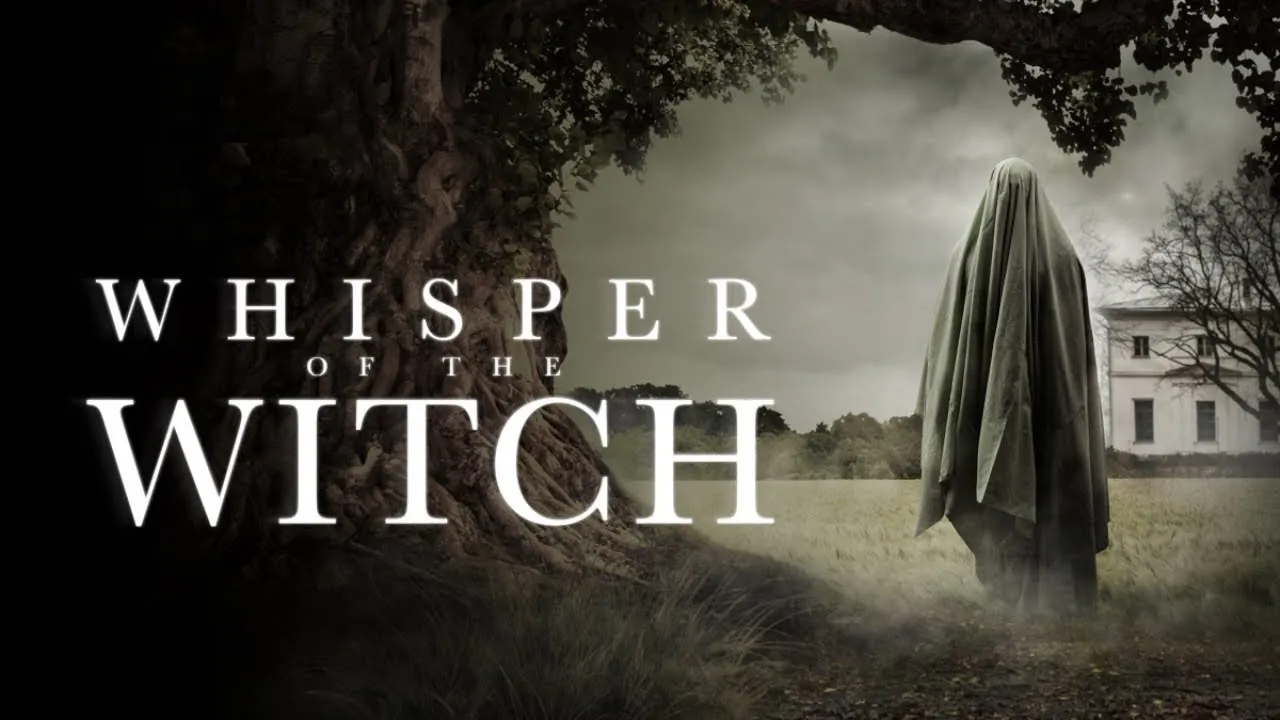

The language of folk horror is often specific, rooted in the soil of a particular culture. Whisper Of The Witch begins by speaking this language fluently. It lures us into a decaying mansion, a place of local legend where a group of teenagers discover an antique phonograph. The object is not merely old; it is a vessel for a malevolent spirit, a witch summoned by the crackle of its needle on wax.
The immediate horror that unfolds calls Detective Paul back to the hometown he fled. For him, this is not a new case. It is an echo of a traumatic event from his own youth, tying his past to the fate of the modern victims. The film sets its stage with two parallel timelines, promising a story where history repeats itself as a terrifying curse.
Atmosphere in the Absence of Story
Director Serik Beiseu demonstrates a skilled hand in crafting the film’s visual dread. There is a confidence in the aesthetic that suggests a much stronger film is trying to emerge. Working with cinematographer Kirill Zotkin, Beiseu builds an atmosphere thick with menace. The film avoids the common pitfall of impenetrable darkness; shadows are used to conceal threats, not to obscure the action, ensuring the audience can see every terrifying detail.
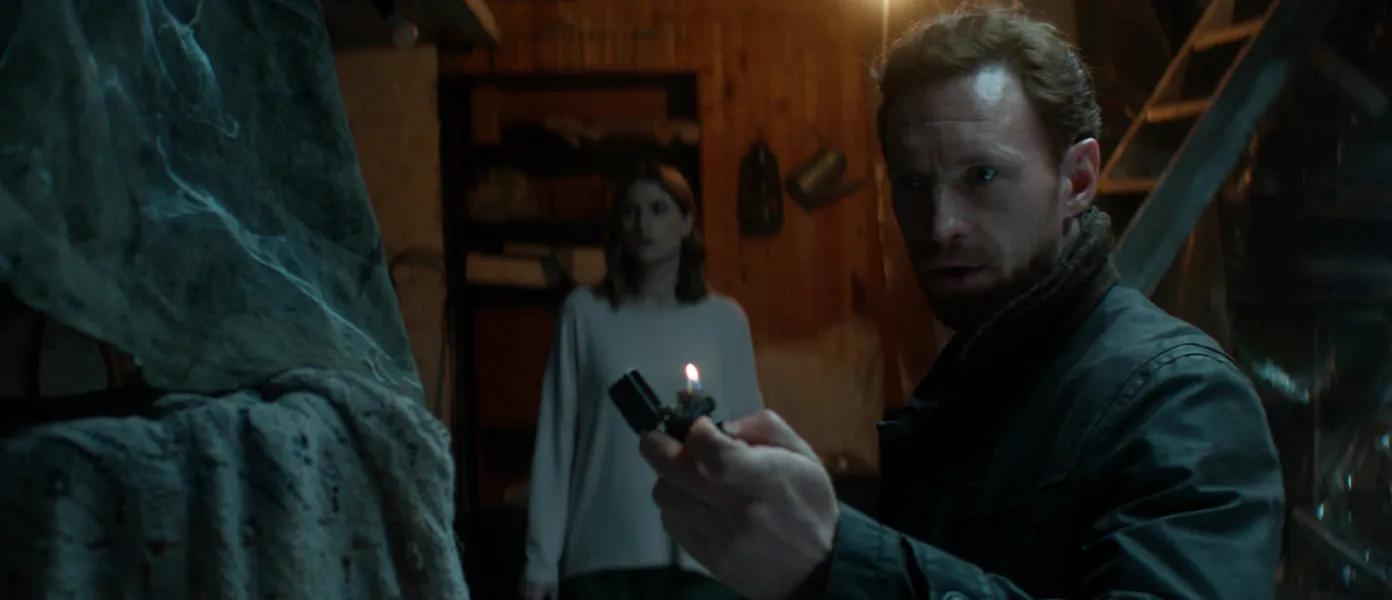
The camera moves with purpose, using slow, deliberate pans to heighten anticipation within the mansion’s decaying halls. This patient approach to building suspense shows a respect for classic horror techniques. The production design itself treats the mansion as a formidable character, its peeling wallpaper and dust-laden furniture telling a story of long-dormant evil. This technical proficiency is most apparent in the horror set pieces.
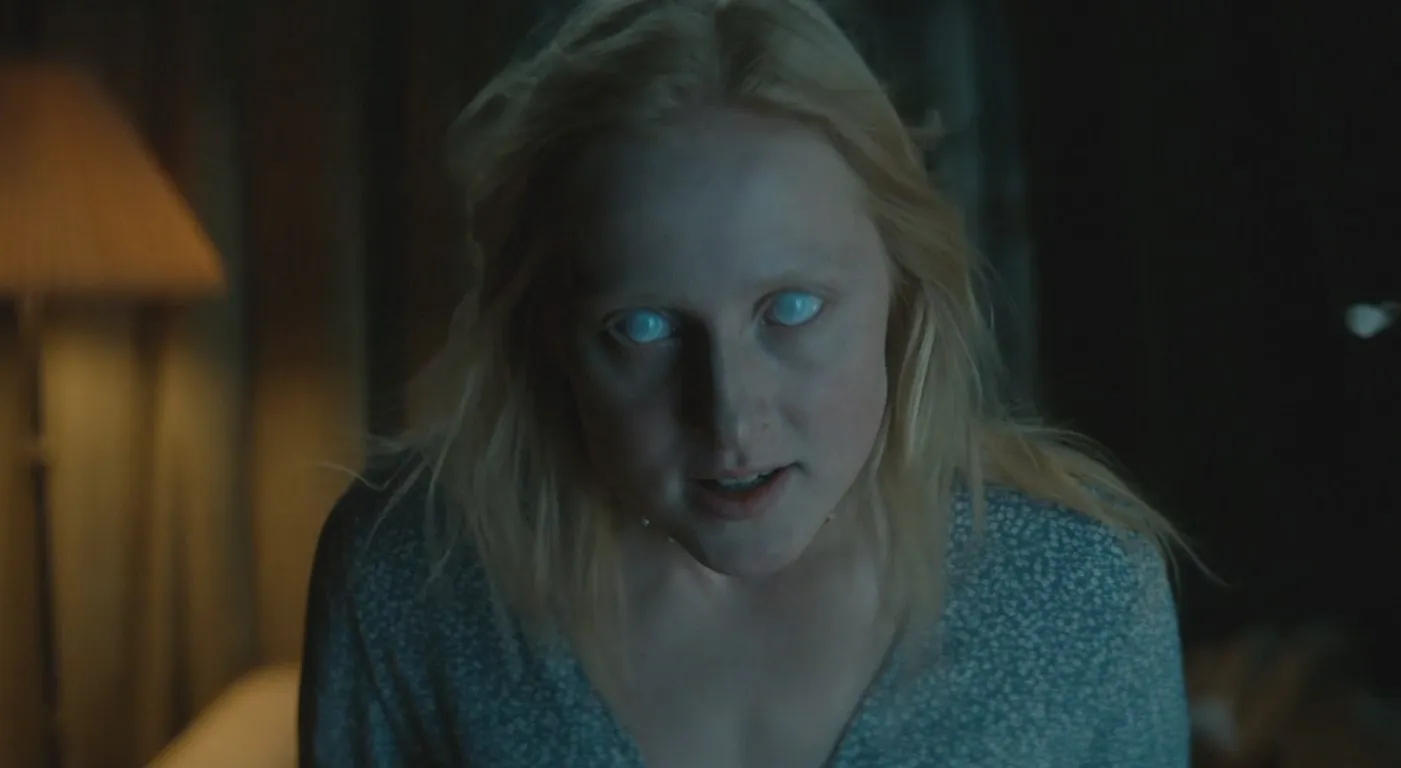
The manifestation of the witch, represented by a vibrating screen that aligns with her sonic nature, is a creative and unsettling choice that stands apart from typical ghost imagery. Another effective sequence uses a small mirror inside the cursed phonograph to generate a genuine scare, a clever use of the film’s central cursed object.
These moments show a clear vision for the film’s visual identity, borrowing the moody, creeping dread found in some J-horror classics. The professional look and polished execution suggest a solid foundation for suspense was carefully laid.
A Fractured Narrative
A film’s visual language can only carry it so far before the grammar of its story must take over. Here, the screenplay falters, offering a narrative that feels both disjointed and overly familiar. The plot seems assembled from the blueprints of other haunted-object films, losing a chance to explore its Slavic folklore roots in favor of a more generic, globalized horror template.
This derivative approach is hampered by severe pacing issues that disrupt any sustained tension. The story struggles to build a consistent rhythm, frequently setting up a suspenseful situation only to diffuse it with a confusing plot development or an abrupt shift in focus. Character arcs that are introduced with promise are left underdeveloped.
Paul’s history with the mansion is positioned as the story’s emotional anchor, but the script treats his trauma as a simple plot device rather than a deep psychological wound to be explored. Similarly, a subplot involving a teenager named Yana facing intense bullying is introduced with weight but is quickly sidelined, abandoning a potent source of character motivation.
The screenplay introduces these compelling ideas but fails to follow through, leaving the characters feeling like thin sketches. The integration of flashbacks is often clumsy, creating more confusion about the curse’s origins than clarity and preventing the dual timelines from merging into a satisfying whole.
Lost in Translation
The most profound failure of Whisper Of The Witch is its attempt at cultural translation. The English-language dub is a catastrophic choice that makes the film nearly unwatchable. The voice work is jarringly artificial, with dialogue that sounds recorded in a sterile audio booth, completely disconnected from the physical spaces the actors inhabit.
The performers speak in stiff, unnatural sentences, avoiding common contractions in a way that no native speaker would. An actor on screen may be showing terror or grief, but their expression is sabotaged by a voice-over that is either flatly delivered or wildly over-the-top. This audio disconnect shatters any immersion the visuals manage to create.
The effort to “Americanize” the production, which includes replacing Russian text on props with English, results in an uncanny valley effect. The film exists in a strange, placeless void, feeling neither authentically Russian nor convincingly American.
This process of cultural flattening is a common pitfall in international distribution, demonstrating a lack of faith in an audience’s ability to engage with a story outside its own cultural context. What could have been an interesting piece of folk horror, appreciated on its own terms with subtitles, becomes a frustrating example of how a film’s identity can be erased by clumsy post-production.
Whisper Of The Witch is a Russian horror thriller film directed by Serik Beyseu, also known as Zaklyatye. Shyopot vedm. It was originally released in Russia in June 2024 and was released for digital and video-on-demand in the US by Well Go USA Entertainment on August 19, 2025. The film was distributed theatrically in Germany in September 2024 and in France in March 2025.
Full Credits
Director: Serik Beyseu
Writers: Sergey Kaluzhanov, Yuliana Zakrevskaya, Dmitriy Zhigalov
Producers and Executive Producers: Alexandr Kurinsky, Nikolay Tabashnikov, Evgeny Melentev, Vladimir Denisyuk, Alexandr Denisyuk, Viktor Denisyuk, Irina Prokhozhay, Dmitry Sushchenko
Cast: Artur Beschastnyy, Maryana Spivak, Sofya Shidlovskaya, Igor Grabuzov, Sergey Safronov, Valeria Kot, Ilya Vinogorsky, Kirill Rusin
Director of Photography: Kirill Zotkin
Editors: Serik Beyseu, Konstantin Kvetkin
Composer: Sergey Lebedev, Konstantin Poznekov
The Review
Whisper Of The Witch
Whisper Of The Witch is a visually competent horror film with a strong sense of atmosphere, but its potential is completely undone by a fractured, derivative script and a disastrous English dub. The awkward voice acting and unnatural dialogue create a barrier to immersion that the film’s technical strengths cannot overcome. What begins as a promising folk-horror tale ends as a frustrating and forgettable experience, lost in a strange cultural no-man's-land.
PROS
- Confident direction and a strong visual aesthetic.
- Effective cinematography that creates a genuinely creepy atmosphere.
- Creative and memorable design for the witch's manifestation.
- Polished production value for an international horror film.
CONS
- An extremely poor-quality English dub that ruins immersion.
- A disjointed and unevenly paced narrative.
- Underdeveloped character arcs and emotional stakes.
- A derivative plot that borrows heavily from other horror movies.
- An awkward "Americanization" that feels inauthentic.







