




















There’s a special kind of catharsis that comes from stories about fighting the system, especially when that system is the soul-crushing banality of corporate life. Free Lives, the developer behind Anger Foot and Broforce, seems to understand this better than most.
Their latest project, Stick It to the Stickman, is a physics-based brawler wrapped in a roguelite structure, and its premise is brilliantly simple. You are a new hire at a vaguely dystopian company where the only path to promotion is through physical violence. To become the new CEO, you must literally kick, punch, and staple-gun your way to the top floor.
The game immediately establishes a tone of frantic, slapstick chaos. It channels the spirit of old Flash animations like Xiao Xiao and marries it with a sharp, satirical edge. This isn’t a complex narrative, but a primal scream against TPS reports and mandatory team-building exercises, setting a stage for some surprisingly deep gameplay systems.
The Grind as a Gameplay Loop
The game’s structure is its most potent piece of commentary, using the cyclical nature of the roguelite to mirror the Sisyphean struggle of the modern workplace. Each run is a new workday. You start at the bottom, full of potential, and attempt the climb. You fight through identical-looking cubicle farms and break rooms, your only objective to ascend.
Success means you defeat the CEO, take his corner office, and inherit his title. The reward for your victory is the chance to do it all over again, but from the other side, as your new character must fight their way up to dethrone you. This gameplay loop is a poignant and darkly funny metaphor for a career path that has no real destination.
Much like in games such as Hades, where each escape attempt from the underworld reveals more about its characters and world, each corporate climb in Stickman reinforces its central theme of hollow ambition. The difference here is the mundane setting. We are not fighting gods for familial freedom; we are fighting middle managers for a slightly better benefits package.
This central loop is supported by a robust meta-progression that makes the repetition feel meaningful. The currencies you collect are themselves part of the satire. You earn cash, but also “sweat” from exertion and “paperclips” from fallen office supplies. These are spent on a large skill tree that offers permanent upgrades.
You might unlock a new attack for all future characters, increase your starting health, or even alter the architecture of the office itself, adding helpful trampolines or hazardous electrified floors. This system creates a satisfying sense of forward momentum. Even a failed run contributes to your long-term power, making the next “workday” a little more manageable.
The emotional pacing is handled skillfully. The early floors of a run offer low resistance, building a sense of power. Then, difficulty ramps up, introducing specialized enemies that demand new strategies, creating tension before the final, climactic boss battle.
The unlocks also extend to entirely new ways to play. The Employee Evaluation Centre is a pure platforming challenge, while the Cage Fights offer focused one-on-one combat, providing welcome detours from the main ascent and allowing you to test new skills.
Building a Language of Violence
The game’s combat mechanics are a masterclass in accessible depth. At a glance, the system appears simple: one button executes all your attacks. The genius is in how you determine what that button does. Each character starts with a short sequence of moves. The Temp, for example, might throw a coffee mug, then do a spin kick, then an uppercut.

Each press of the attack button performs the next move in the chain before cycling back to the beginning. The game’s true identity emerges as you progress through a run. After clearing certain rooms, you are offered a choice of new moves or upgrades. This is where the comparison to deckbuilding games like Slay the Spire becomes clear.
You are not building a deck of cards; you are building a combo string. You might add a long-range staple gun attack to the end of your sequence to soften up distant targets. You could replace your basic kick with a devastating, high-launching variant that sends enemies airborne.
This system turns every run into a unique creative exercise in designing violence. The story you tell is written through your fists. A run might start with a simple punch -> kick combo. By the tenth floor, you could be wielding a beautiful, horrifying sentence of destruction, like chainsaw dash -> groin punch -> headbutt -> shotgun blast -> flaming backflip.
The strategic choices are significant. Do you create a long, versatile sequence with answers to every situation, or do you build a short, brutally efficient loop that you can repeat quickly for maximum damage? The physics engine adds another dimension of emergent chaos. This is not a game of canned animations. It is a dynamic simulation of stick figure bodies colliding with immense force.
Kicking an enemy into a group of his coworkers can create a chain reaction of tumbling bodies. The environment is an active participant. You can slam someone into a server rack, which then topples onto another poor soul. The feeling is reminiscent of a Jackie Chan film, where every piece of the set is a potential weapon. It is this combination of thoughtful mechanical design and unscripted physical comedy that makes the combat feel so special.
The Aesthetics of Anonymity
The game’s presentation is perfectly harmonized with its satirical themes. The choice to use stick figures is not a technical shortcut but a deliberate artistic statement about corporate dehumanization. Your character, and every person you fight, is a featureless avatar. They are anonymous, interchangeable cogs in a vast machine, defined only by the color of their tie.
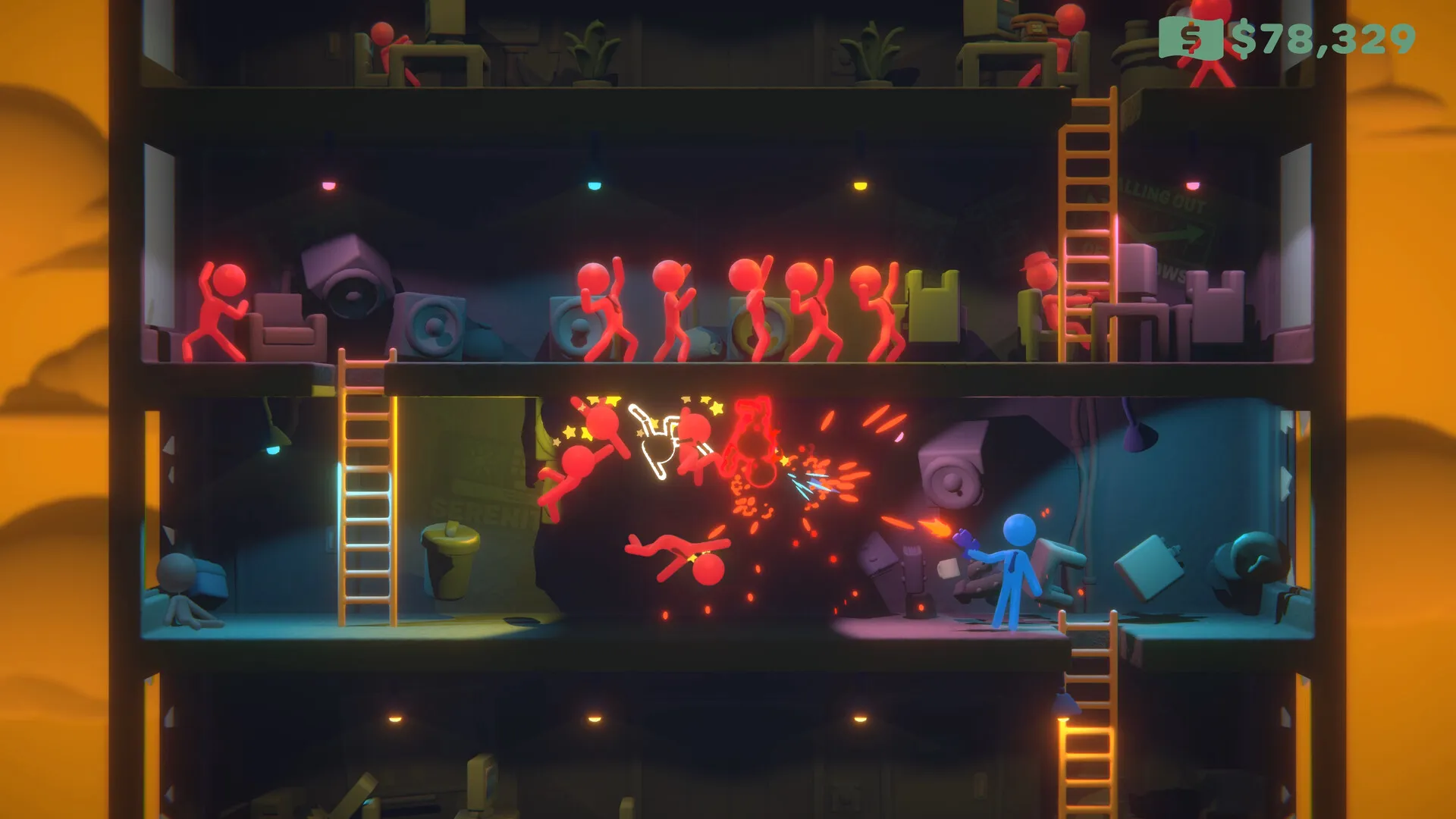
This minimalist approach allows the player to easily project their own workplace frustrations onto the action. The artists use this simplicity to great effect, contrasting the colorless, sterile office environments with the bright, kinetic explosions of the violence itself. Drab grey cubicles and beige break rooms become the canvas for a Jackson Pollock painting of cartoonish carnage. It is a powerful visual metaphor: the vibrant, chaotic expression of individuality breaking free from the crushing conformity of the corporate world.
This expressiveness is conveyed through stellar animation work. Though they lack faces, these stick figures are brimming with personality. Attacks have exaggerated windups and impactful follow-throughs that sell their power. Defeated enemies are sent flying with a floppy, ragdoll grace that is consistently hilarious. The sound design is a critical component of this comedic timing.
The audio landscape is filled with satisfyingly wet thwacks, sharp cracks, and the distinct cha-chunk of office equipment being used for unintended purposes. The voice acting amplifies the satire to absurd heights. The CEO and other corporate drones speak in a pitch-perfect parody of management jargon, delivering lines about “synergizing pain” and “optimizing hostile takeovers” with a chillingly straight face.
Every element of the presentation works in concert to support the central experience. The game understands that its violence is not meant to be taken seriously. It is a punchline, and the art, sound, and animation are all part of the setup, creating a memorable and coherent aesthetic that is both funny and surprisingly insightful.
The Review
Stick It to the Stickman
Stick It to the Stickman is a brilliant fusion of chaotic brawling and sharp corporate satire. Its unique sequential combat system turns every run into a creative exercise in destruction, while the roguelite loop cleverly mirrors the corporate grind. The game provides a hilarious and deeply satisfying experience through its smart design and wonderful physical comedy. It stands out as an essential title for anyone who appreciates inventive indie action games and a healthy dose of anti-corporate catharsis.
PROS
- Inventive and deep sequential combat system.
- Excellent marriage of gameplay loop and satirical theme.
- High replay value from many unlocks and playable classes.
- Genuinely funny physics-based, slapstick humor.
CONS
- Currency grind for permanent upgrades can feel slow.
- The humor, while effective, may be repetitive for some.
- Narrative is intentionally simple and serves mostly as a premise.