

























![Kingdom Hearts Collection [I-III] Review](https://gazettely.com/wp-content/uploads/2026/10/Kingdom-Hearts-Collection-I-III-1-360x180.webp "Kingdom Hearts Collection [I-III] Review: KHII Holds Steady as Newer Entries Fluctuate 37")




South Park began as an abrasive, immediate barometer for cultural outrage and has kept that role through persistent creative choices. Trey Parker and Matt Stone built a production model that lets the series respond to events with unusual speed. That responsiveness, combined with a taste for crude provocation, has kept the show relevant across three decades and made it a rare example of television that routinely folds current events into its storytelling.
Season 28 opens by continuing an existing story rather than offering a clean slate. The premiere, “Twisted Christian,” arrives after an atypical mid-season production halt and resumes the long-form narrative the series has developed in recent years. The episode concentrates on American politics, pervasive cultural anxieties, and the performative aspects of modern religion. It reads less like a standalone premiere and more like the next chapter in a running saga.
Serialization and the Political Grotesque
A defining feature of South Park’s recent run is its embrace of serialization. “Twisted Christian” demonstrates this by dispensing with episodic resets and sustaining ongoing arcs. The episode keeps alive the persistent Donald Trump/Antichrist storyline while continuing the subplot tied to J.D. Vance’s character and the Satanic pregnancy. That forward motion feels deliberate.
Longer gaps between episodes have shaped this approach to storytelling. The slower rhythm allows the creators to assemble a more concentrated arc than the frantic serialization attempt of 2016. Threads now reconnect with greater precision than one expects from a show historically associated with chaos.
The episode introduces a new satirical figure: tech billionaire and self-proclaimed “Antichrist expert” Peter Thiel. His appearance arrives with an almost jaunty theme song and rapidly places him inside the show’s surreal political frame. Thiel is shown investigating the students’ “6 7” craze. That storyline references Thiel’s reported lectures on biblical prophecy and his political backing, which the episode uses to fold a real-world eccentricity into its absurdist plot engine.
The series continues to offer an aggressive portrayal of the former President. The Trump satire remains designed to shock, particularly in scenes that test the boundaries of taste around the abortion attempt and the mechanics of the Satanic pregnancy. Shock functions here as a tool to illuminate moral and political extremity.
Deconstructing Faith and Identity
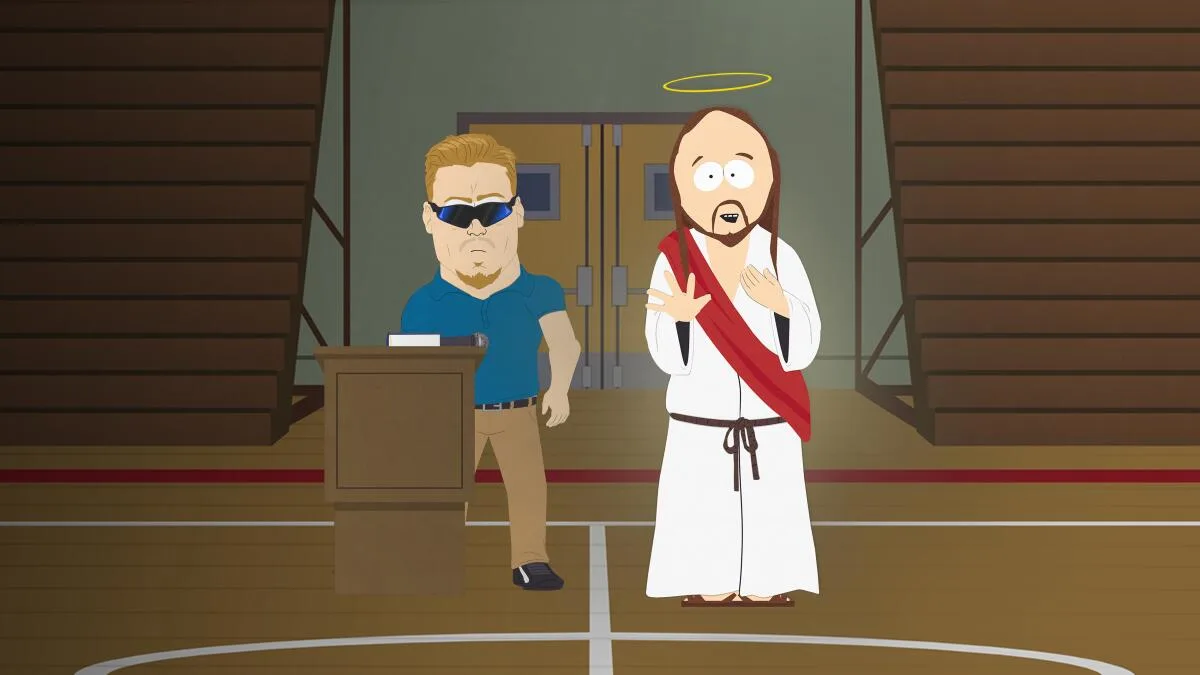
The episode’s most concentrated thematic work comes in its treatment of modern Christian identity. The core tension plays out between Jesus and PC Principal. Jesus appears in the role of school counselor and represents a reflective, traditionally minded faith. PC Principal embodies a hypermasculine, aggressive, nationalistic ethos that he labels “Power Christianity.” He explicitly uses the Bible as a means of exercising authority.

That satirical line extends to the women who adopt this form of Christianity, including PC Principal’s wife and Jesus’s blind date. The animation emphasizes cosmetic affectations such as large implants and lip filler and what the review terms “Mar-a-Lago faces.” These characters cite podcasts as a casual source of religious instruction. The episode critiques the performance and commercialization of religious identity, portraying it as superficial and detached from theological depth.
The conflict between Jesus and PC Principal escalates to a physical confrontation in a Cheesecake Factory. The sequence ends with Jesus adopting the aggressive, sleeveless look and manner of a manosphere-style Christian. The tonal turn reads as darkly comic and pessimistic about how authentic belief can be overtaken by public posturing and militant affect.
At the same time, the episode frames youth fads through adult fear. The “6 7” trend functions as gibberish Gen Alpha slang that the adults, with Thiel among them, interpret as Satanic numerology. That device mirrors the recent Labubus reference. The show lampoons adults who project sinister meanings onto innocuous youth behavior and shows them scrambling for frameworks to understand sudden generational shifts.
Character Utility and Narrative Pacing
The placement of the core child characters remains a structural question. Eric Cartman anchors the “6 7” subplot and appears to be consumed by the craze. That trajectory sends him toward Washington D.C. with Thiel. The choice prompts questions about consistency. At moments Cartman reads as a plot mechanism, a convenient way to move the story forward.

That functional use risks undermining last season’s more interesting existential thread, which tracked his struggle for relevance when society embraced his persona. The episode leaves the impression that Stan or Kyle could have fulfilled the same logistical role, producing a mismatch between character focus and narrative payoff.
Structurally, the episode is effective. It weaves together the Jesus/PC Principal confrontation, the Trump/Satan arc, the Thiel investigation, and the Cartman/6 7 storyline into a single, coherent episode. The narrative carries momentum without feeling crowded. The humor, though, continues to favor escalating outrage and elaborate setups over the compact, lethal punchlines that defined earlier seasons.
Still, specific beats succeed: the unexpected Towelie cameo and the absurdity of the Cheesecake Factory restroom clash land as memorable moments. A continuing trend persists in which adult characters drive the main chaos, reducing the centrality of the four boys and altering the series’ baseline dynamics.
Assessment of Trajectory
“Twisted Christian” operates as an entertaining and purposeful continuation of the show’s recent direction. It builds on the arc from Season 27 while shifting attention to new satirical targets. The addition of Peter Thiel and the extended lampooning of PC Principal’s form of faith show the creators’ ability to remain topical. The episode achieves a notable coherence among its multiple strands.

The show carries reservations. The comedy does not always match its highest standards and can substitute shock for sustained wit. The series would benefit from a clearer plan for the child protagonists, particularly in how Cartman’s existential predicament gets incorporated into the larger narrative.
Despite those structural and tonal flaws, Season 28 begins on a productive note. The creators demonstrate that they can continue to respond to an increasingly absurd cultural and political landscape, and the episode positions the Antichrist storyline for further development.
South Park is an American animated sitcom that first premiered on August 13, 1997, and is one of the longest-running and most successful adult animated shows in television history. Known for its crude humor, sharp satire, and fast turnaround time on current events, the series follows the surreal adventures of four elementary-school boys: Stan Marsh, Kyle Broflovski, Eric Cartman, and Kenny McCormick, in the fictional town of South Park, Colorado. The latest installment, Season 28, premiered on October 15, 2025. New episodes of South Park are typically broadcast on Comedy Central and are available to stream in the U.S. on Paramount+ and Max (HBO Max), depending on the episode’s nature and streaming rights agreements.
Full Credits
Director: Trey Parker
Writers: Trey Parker
Producers and Executive Producers: Trey Parker, Matt Stone, Anne Garefino, Frank C. Agnone II, Vernon Chatman, Eric Stough, Bruce Howell, Adrien Beard, Jack Shih
Cast: Trey Parker, Matt Stone, April Stewart, Mona Marshall, Isaac Hayes, Mary Kay Bergman, Eliza Schneider, Adrien Beard
Director of Photography (Cinematographer): Kenny Gioseffi, Greg Postma, Keo Thongkham, Hannah Friesen, David Brown, Shaina Reyes, Charis Patton, Robert Gilliam (Note: Due to the show’s animation style, the animation and storyboard artists often fulfill roles that overlap with cinematography/visual design)
Editors: Trey Parker, Matt Stone, Thomas M. Vogt, Gian Ganziano, David List, Nate Pellettieri
Composer: Jamie Dunlap, Adam Berry, Scott Nickoley, Trey Parker, Matt Stone, Primus (Theme Song)
The Review
South Park Season 28
The episode operates with remarkable narrative focus, deftly continuing the Antichrist plot and introducing a scathing critique of "Power Christianity" and Peter Thiel. The structural cohesion is a significant achievement. However, the reliance on adult plots continues to overshadow the core characters, raising questions about Cartman's narrative utility and the consistency of the episode's comedic punch. It is an effective, relevant, and engaging chapter that sets a strong trajectory for the season.
PROS
- The episode effectively continues the serialized Donald Trump/Antichrist storyline, avoiding the erratic plotting seen in past serialized efforts.
- It successfully integrates new, relevant targets, including a biting portrayal of Peter Thiel and the hypermasculine, intolerant brand of "Power Christianity."
- The confrontation between Jesus and PC Principal provides a layered critique of modern faith and hypocrisy.
- The episode weaves four distinct subplots together smoothly without feeling fragmented or rushed.
CONS
- The main children, particularly Cartman, are used primarily as plot devices, detracting from their established character depth.
- The humor occasionally relies too heavily on boundary-pushing shock and setup, lacking the sharp punchlines of the show’s peak seasons.
- The frequent breaks and confusing season numbering suggest continued scheduling challenges behind the scenes.







