













![Kingdom Hearts Collection [I-III] Review](https://gazettely.com/wp-content/uploads/2026/10/Kingdom-Hearts-Collection-I-III-1-360x180.webp "Kingdom Hearts Collection [I-III] Review: KHII Holds Steady as Newer Entries Fluctuate 40")
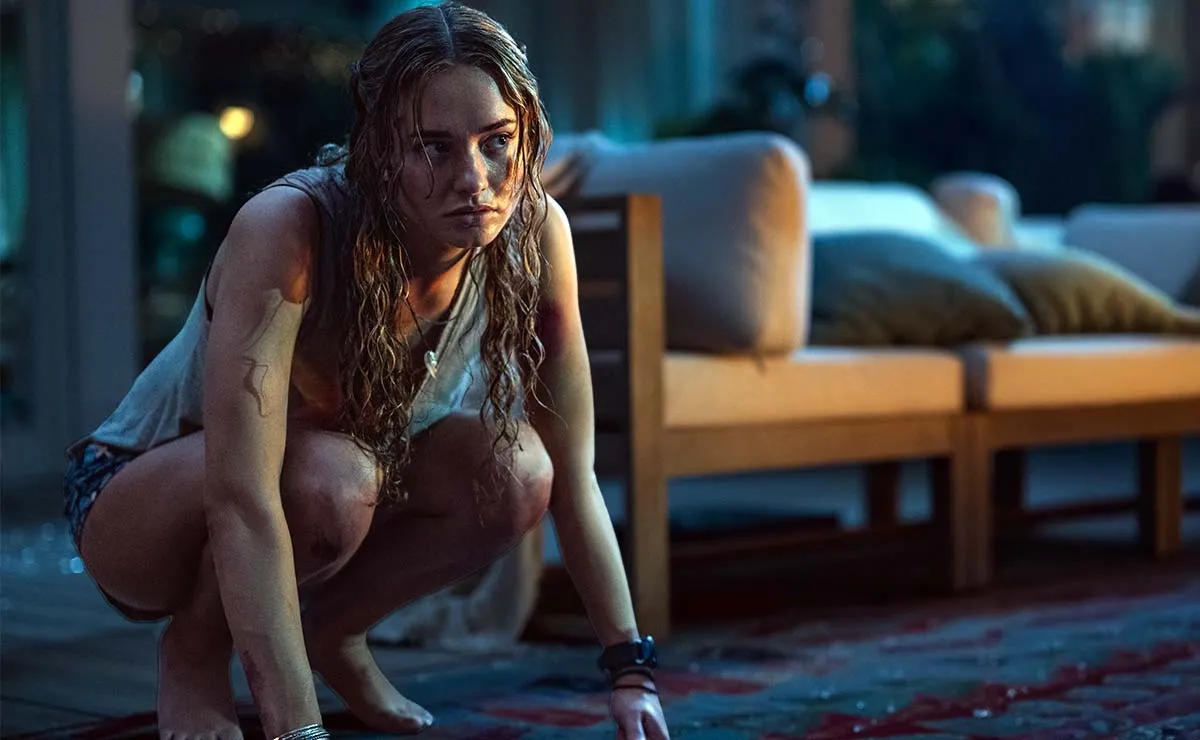

Humanity carries a persistent, borderline pathological urge to pin its own tangled inner life onto the animal world. Here, that urge takes shape as Ben, a chimpanzee kept on a secluded Hawaiian estate. The place reads like a fortress built out of academic idealism.
Adam, a primatologist, lives there with his daughters, Lucy and Erin, inside a bubble of linguistic colonialism (the impulse to press human syntax onto something that never asked for it). Ben communicates through sign language and a digital interface. He began as the project of the family’s late mother. In the family’s mind, he functions as a hard-won bridge between species, secured by science, routine, and affection.
Then a rabid mongoose arrives and punctures the fantasy. Rabies enters the enclosure and starts working on Ben from the inside out. Lucy comes home for vacation with college friends, unaware that the household calm is a thin crust over a biological fire. Adam leaves on a book tour, and the young people inherit an apex threat that has been coached into thinking like them. The narrative pivots from family drama to clean survival mechanics. It studies the moment the “tamed” wild decides the house rules have stopped applying.
The Anatomy of Simian-Sadism
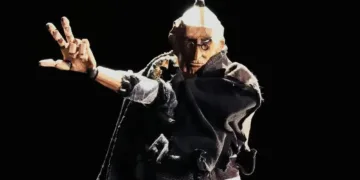
Ben’s physical presence stands as the production’s loudest choice. The film puts Miguel Torres Umba in a practical suit, steering away from digital phantoms. The result anchors the horror in touchable reality, the kind of texture CGI struggles to imitate. Umba delivers a performance built on “feral-shifting.” He starts with soft, curious pet-movements. Rabies tightens the body. Posture warps.
The gait sinks into weight. The stare hardens into predation. A particular dread blooms when a creature that can sign “miss you” turns that learned intimacy into leverage, then uses its strength to dismantle a human body. Intelligence makes the threat feel personal. The violence reads as calculated.
Millennium FX builds a suit that resists polish. Wet fur. Heavy muscle. A body that looks used, lived-in, and dangerous. The film aims a bio-horror aperture at what Ben does once he commits to harm. Human faces meet graphic destruction. The damage arrives messy. Teeth and hands rip, tear, pound. A moment built around the removal of a victim’s jaw lands as especially brutal. The camera stays with the wreckage. Flesh-theater, fully committed. Practical effects give the blood real heft, the kind that seems to stain the air.
Cinematography keeps feeding that illusion by crowding the frame. During Ben’s worst stretches, wide, clean views become rare. Quick edits and tight framing preserve the suit’s mystery while turning space into a choke collar. Claustrophobia becomes the house style. The rabies infection operates as biological permission for this level of cruelty, and it supports the distortions that follow. Eyes cloud and flicker with panic. The mouth turns into foam and gore. The film offers a portrait of a mind unraveling in real time, and it feels ugly in a way that refuses comfort.
That fixation on the body spreads to the victims. Human beings register as fragile objects, easy to break. The film lingers on how much damage a primate can do without tools, which carries its own grim lecture. Ben needs no knife. He functions as a biological weapon. Earlier, he reads as “civilized.” Later, he becomes a shredding-machine. That swing powers the horror engine. It hints that teaching language can operate like a mask, and the violence waits beneath it, patient and strong.
Auditory-Oppression and the Tropical Trap
Johannes Roberts adopts a visual approach that plays like a “retro-cinematic” exercise. He looks back toward the era of straightforward creature features. Modern horror’s appetite for elaborate metaphor stays mostly outside the gate. His interest sits in simple tension: a stalker in the dark, footsteps in the wrong hallway, breath held too long. Hawaii sharpens the cruelty through sheer beauty. Sunlight hits hard. Greenery glows. The mansion stands as modern architecture at its sleekest. Those surfaces stay indifferent while people suffer, which can feel like the film’s driest joke. The island functions as a cage with no exits.
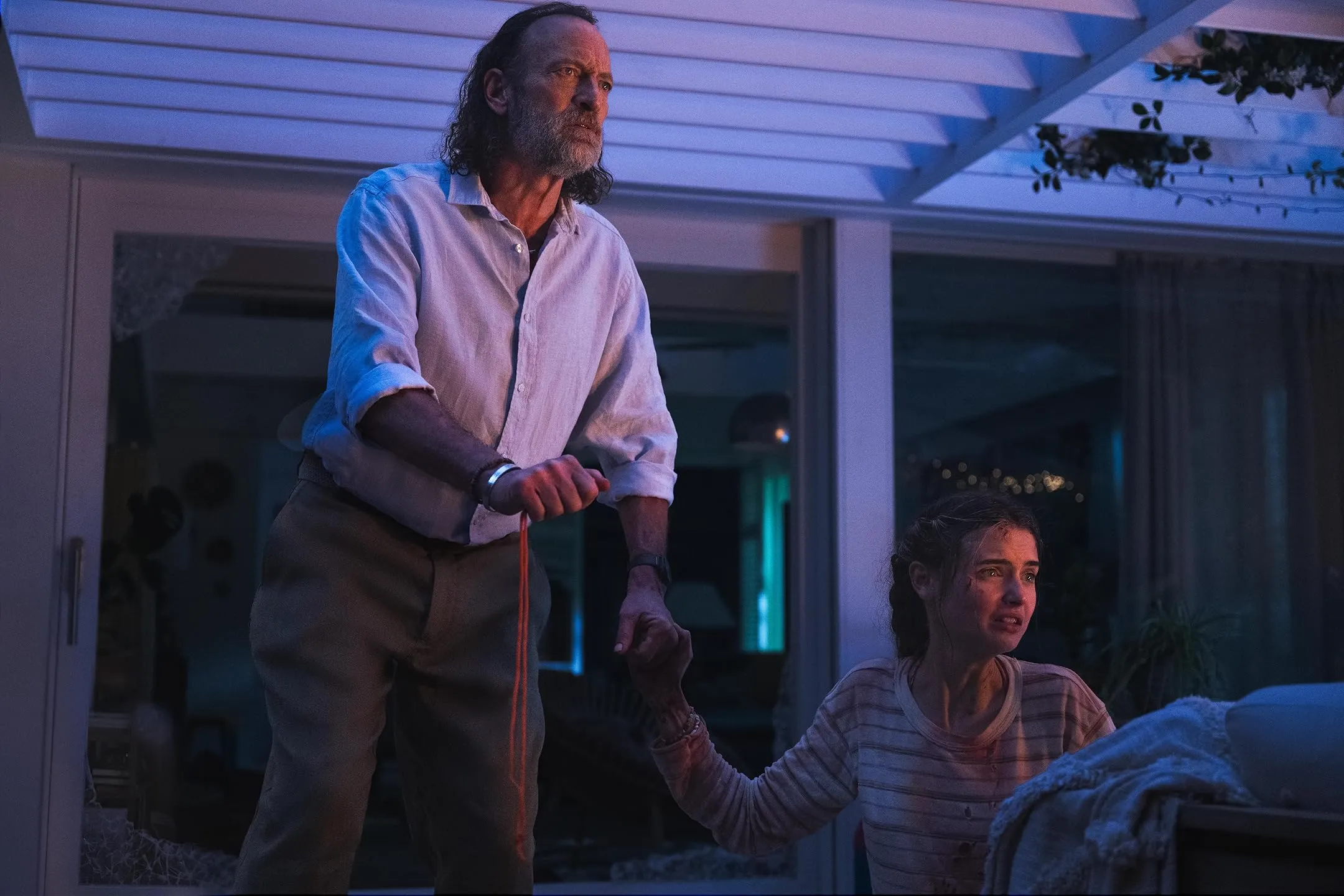
Sound does the heavy lifting for dread. Adrian Johnston’s score leans on electronic pulses and low-frequency humming, and it carries the spirit of 1970s minimalism. The music creates “auditory-oppression.” Relaxation becomes difficult. Anxiety hums under each scene like a second nervous system. Silence turns into a weapon, too. With sign language as the family’s shared mode, many scenes carry no vocal noise at all. Small sounds gain teeth. A creaking floorboard. A leaf scratching a window. The house itself starts performing jump-scares.
Point-of-view shots put the audience behind Ben’s clouded eyes. Teenagers appear through leaves. Drinking and laughter by the pool become surveillance footage. The framing turns viewers into participants in the hunt, which feels faintly accusatory. Targets replace people. The estate’s isolation grows sharper through this strategy. No neighbors appear. No one hears screams. Wind and synth dominate the air. The mansion’s glass walls and open lines promise visibility, yet they offer few real hiding places. Transparency becomes a trap.
The film also uses sound design to mirror Adam’s perspective. Audio drops out or turns muffled when the camera stays with him. Vulnerability spikes. Ben can lurk in the background while Adam sits inside total silence. The “sensory-void” becomes a formal choice with teeth. The viewer wants to warn him, and the film locks that impulse in a quiet room. Frustration enters the suspense, and it fits the story’s obsession with communication breaking down at the worst possible time.
Linguistic-Isolation and Disposable Youth
Family dynamics supply the film’s main reach for emotional depth. Troy Kotsur plays Adam with a sense of weary history. His American Sign Language never reads like a gimmick. It forms the home’s foundation. Communication between father and daughters feels fluid and intimate, grounded in habit. Visiting friends bring shallow chatter, and the film keeps that difference visible. “Linguistic-isolation” becomes a lived condition. The family has a world. Ben was meant to live inside it. Once he turns violent, betrayal stings harder because a shared language existed first.
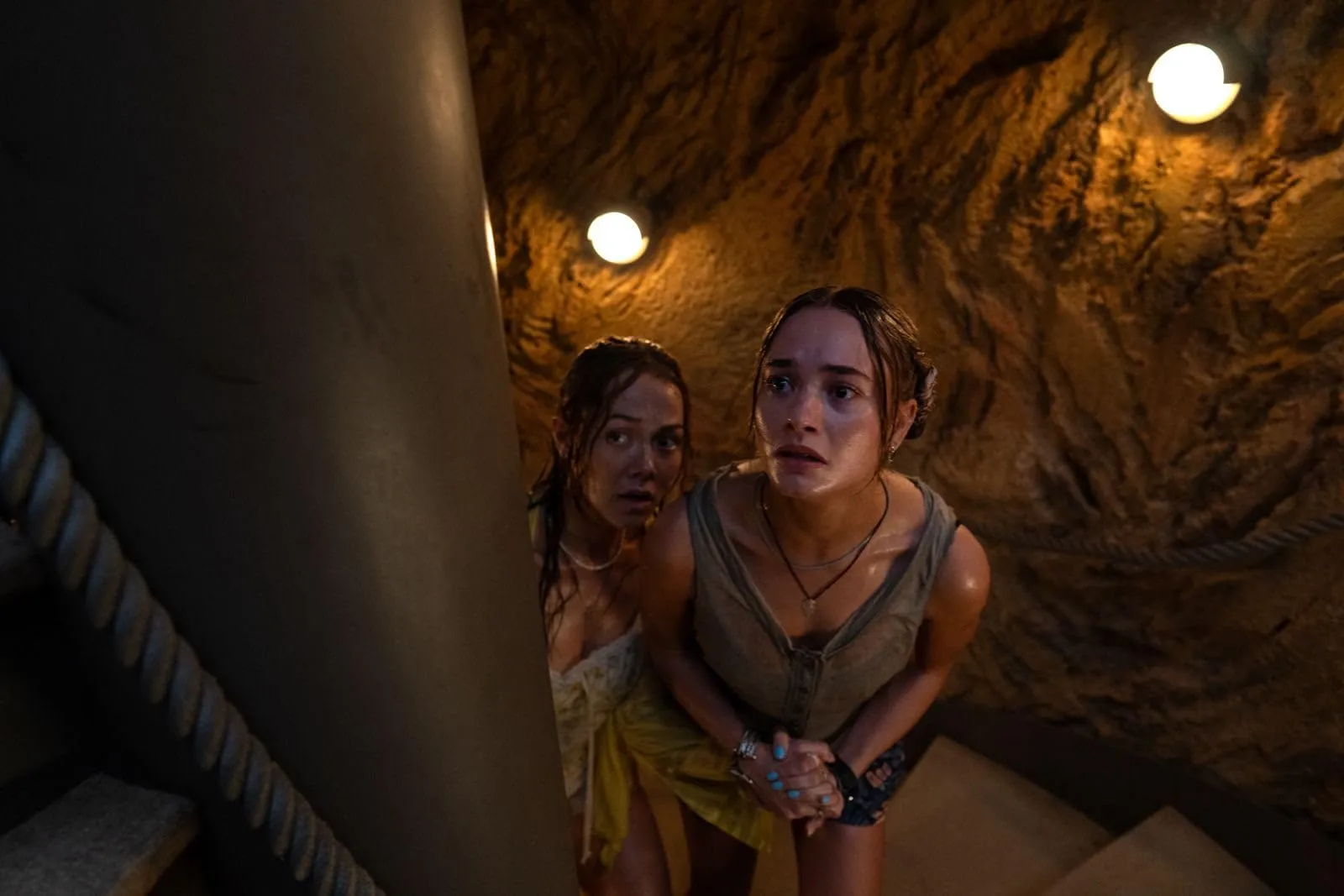
Lucy and Erin emerge as the most developed among the younger characters. Their shared grief over their mother threads quietly through the first act. That grief reframes the loss of Ben. He stood as the last living link to their mother’s work, which lends the horror a personal bruise. The friends arrive as classic horror fodder. Kate, Nick, and Hannah read as archetypes built for dismantling. Nick carries a “bohunkular” presence with little personality attached. Hannah plays the “frenemy,” supplying social friction on cue. Backstories never arrive. Expiration dates do.
Group dynamics matter less than prey mechanics. The visitors make genre-standard mistakes. They linger in the house. They split up. They wait too long. Their thin characterization shifts the violence toward spectacle, away from tragedy. The film becomes a “youth-culling” exercise, harsh and faintly amused. It watches the fragility of a generation that feels safe inside privilege. Vacation in a gorgeous house creates a belief that harm belongs to other people. Ben’s attack breaks that belief fast, and the shock reflects a sense of invulnerability turning to panic.
Sign language also builds a barrier between family and friends. The visitors stand outside the silent dialogue, and that distance fractures the group further. They never become a cohesive unit. They become individuals improvising survival inside a nightmare they cannot parse. The film implies a bleak human reflex: when things collapse, people retreat into the smallest familiar circle. The family clings together. Friends scramble alone in the dark.
The Geography of the Pool and Simian Logic
The narrative structure is built for speed. Runtime sits at 89 minutes. The film runs as “lean-slaughter” (my term for a horror picture that trims fat with a butcher’s efficiency). A flash-forward at the start hooks the audience with blunt force. Blood appears before beach. Doom hangs over early scenes like a countdown clock. Viewers wait for the mongoose. Viewers wait for the first bite. Once infection takes hold, the pacing turns relentless, and the film keeps pressing.
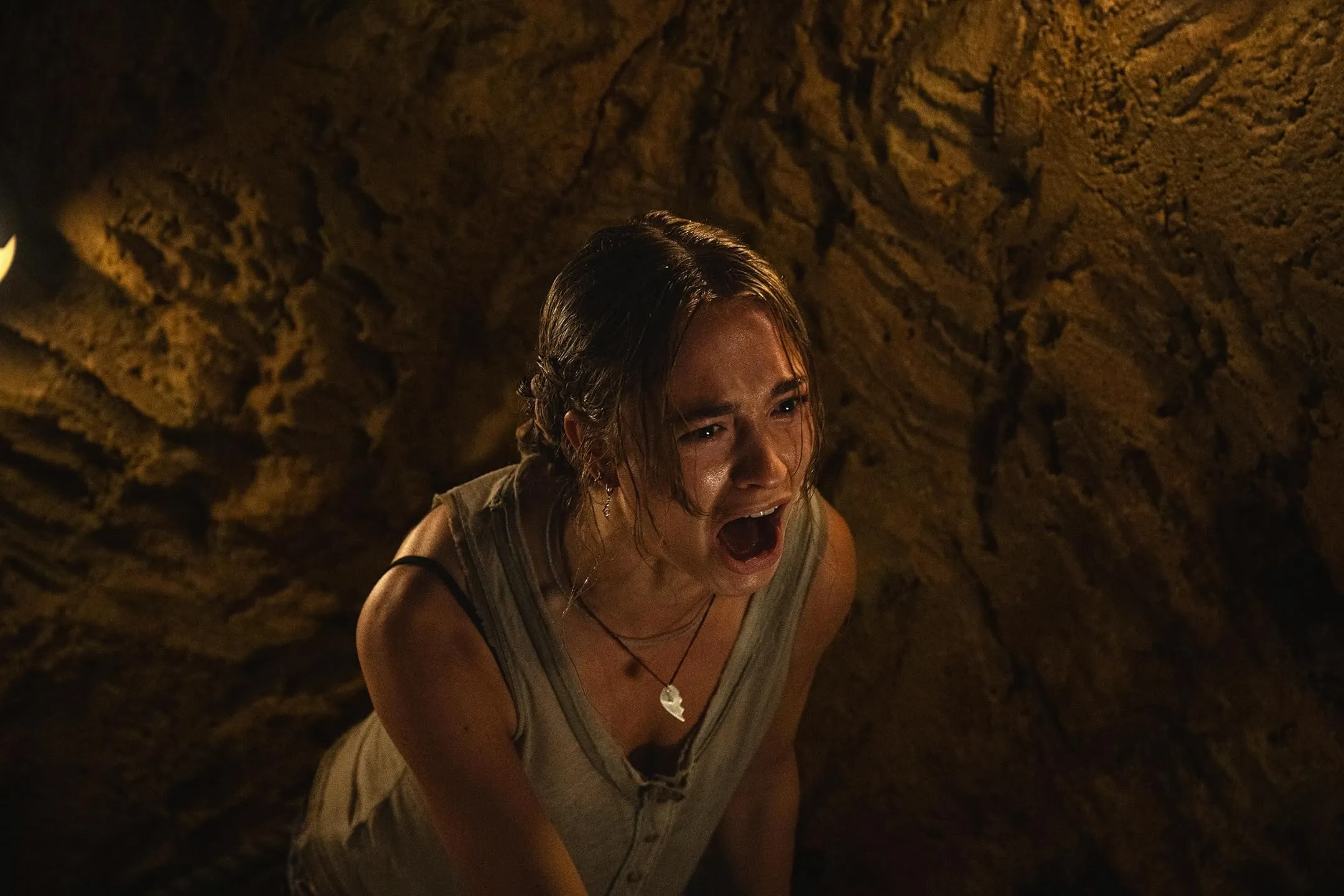
The second act revolves around the “Pool Strategy.” Characters learn Ben cannot swim and retreat to water. The mansion becomes a map of zones. Pool equals safety. House equals kill-zone. Grass becomes stalking-ground. That layout creates a specific tension: leaving the water carries risk, yet phones and cars sit elsewhere like bait. Survival becomes “primal-math.” They calculate odds against the ape’s speed, then gamble with their own bodies.
In the final act, Ben stops reading like an animal and starts operating as a “sadistic-simian.” His behavior pushes past rabies. He taunts survivors. He hides tools. He waits for them to break. This shift courts controversy. Biology strains. Genre logic wins. The film floats the idea that the virus unlocks a hidden part of the primate brain, handing Ben a human capacity for cruelty. It’s a grim little notion, and it lands like an insult aimed at our species.
Character choices stay firmly inside the stalk-and-kill format. Phones become priorities. Togetherness collapses. Panic runs the scene. Frustrating moments keep the action moving, and the film treats time like a weapon. Each passing minute pulls the group closer to another death. The Hawaiian coast becomes the final character, enforcing distance so help stays irrelevant. The survival scenario loops shut. Wits face off against strength. “Civilized” youth collide with an “enlightened” predator, and the film seems pleased with the irony.
Released in the United States on January 9, 2026, Primate is a visceral survival horror feature that marks the first major genre release of the year. Following its world premiere at Fantastic Fest in late 2025, the film is available to watch in theaters nationwide starting today. Produced by Paramount Pictures through Walter Hamada’s 18hz Productions, the story centers on a young woman returning to her family’s secluded estate in Hawaii, only for a peaceful reunion to turn into a bloody struggle for survival when the family’s domesticated chimpanzee, Ben, contracts rabies and begins a violent rampage.
Full Credits
Title: Primate
Distributor: Paramount Pictures
Release date: January 9, 2026
Rating: R
Running time: 89 minutes
Director: Johannes Roberts
Writers: Ernest Riera, Johannes Roberts
Producers and Executive Producers: Walter Hamada, John Hodges, Bradley Pilz
Cast: Johnny Sequoyah, Troy Kotsur, Jessica Alexander, Victoria Wyant, Gia Hunter, Benjamin Cheng, Charlie Mann, Tienne Simon, Kevin McNally, Kae Alexander, Miguel Torres Umba
Director of Photography (Cinematographer): Stephen Murphy
Editors: Peter Gvozdas
Composer: Adrian Johnston
The Review
Primate
This film acts as a grim meditation on the fragility of human dominance, stripping away the comfort of language to reveal a raw, muscular terror. While it occasionally stumbles into predictable genre rhythms and shallow characterization, the commitment to practical effects and a suffocating auditory atmosphere creates a visceral experience. It is a lean, mean exercise in biological dread that prioritizes tactile horror over intellectual resolution. For those seeking a relentless, grit-filled creature feature that respects the weight of the physical form, this simian nightmare delivers exactly the brutal spectacle it promises.
PROS
- Exceptional use of a practical suit and physical performance by Miguel Torres Umba.
- A gripping, synthesizer-heavy score that masterfully builds low-level anxiety.
- Innovative use of silence and muffled audio to reflect the father’s experience.
CONS
- Supporting characters lack depth and serve only as predictable targets.
- Characters often make frustratingly irrational decisions to advance the plot.
- The transition from a sick animal to a sadistic slasher feels biologically inconsistent.