






















Something strange happens when a story stops being about seizing power and turns immediately to its administration. Episode 3 lands one episode after the money shot, a city taken, a war supposedly finished, and refuses to enjoy any of it. What we get instead is three days. Not three days of vengeance or coronation pageantry. Three days of an empty vault, a priest who won’t do his one job, and rats. I want to call this an anticlimax. That’s the wrong word, and I’ll spend a paragraph or two figuring out why.
The Bottleneck
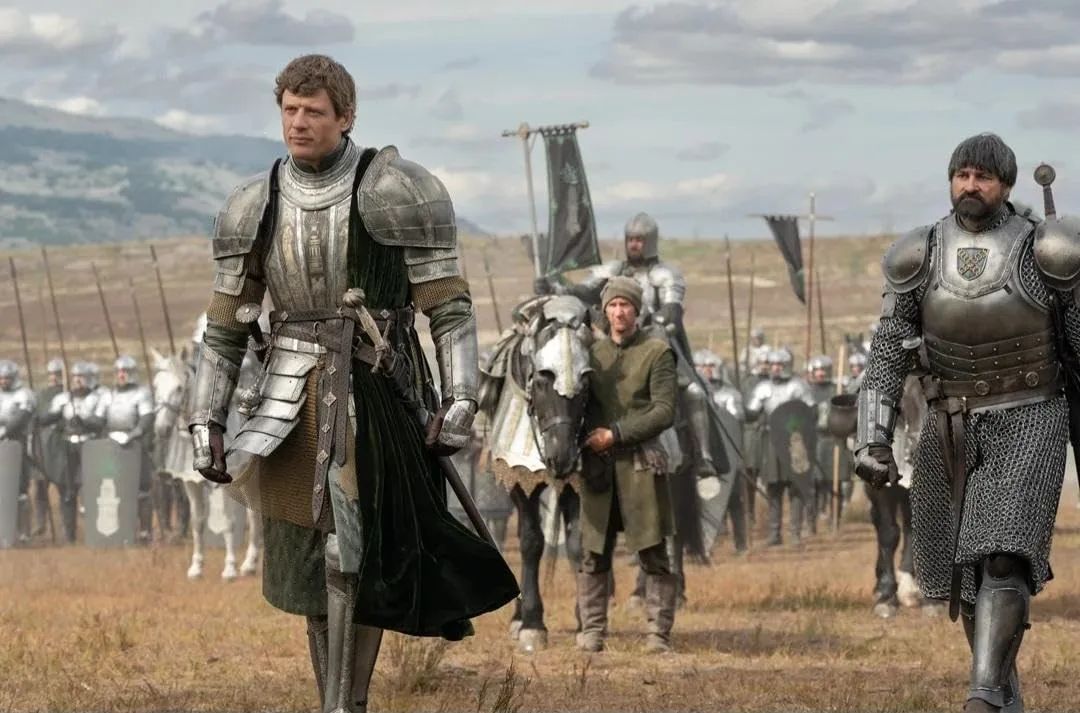
Here is the formal wager the episode makes: after two hours built on scale, a naval battle, a burning city, it shrinks its aperture to a single person and never widens it again, cold open excepted. That cold open carries weight its five minutes barely advertise. Daemon rides into the Reach to tell Lord Ormund that the war is over, flanked by two dragonseeds on borrowed dragons, and the scene rhymes, almost too neatly, with the show’s very first cold open: a child Rhaenyra narrating the Great Council that put her father on the throne. One council installs a king. One parley, decades later, is supposed to close the loop she opened by narrating it. I say “supposed to” because closing a loop and actually being finished are two separate things, and the episode knows it.
Once the camera locks onto Rhaenyra it stays there with an insistence that borders on claustrophobic. The sound drops out or thins into a drone whenever the walls start to feel closer than they are. Call this technique the administrative sublime: the sensation of being crushed not by violence but by scheduling, rendered with the same weight a battle scene usually gets. I did not expect a scene about candle requisitions to produce genuine dread. It does. The show has spent two seasons teaching us that catastrophe looks like fire. Here catastrophe looks like a line of servants with questions she cannot answer, and the education pays off precisely because we already know how to be afraid of the wrong thing.
Slowing down after spectacle is a risk. It mostly works. The title, “Rhaenyra Triumphant,” is doing something almost cruel to the hour it’s attached to, since nothing in the next fifty minutes resembles triumph so much as a woman finding out what winning actually costs.
The Empty Coffer
Here is where a philosopher gets to be useful for once: every crisis in this episode is, underneath its costume, a crisis of legitimacy, and the show is smart enough not to announce this out loud. Tyland Lannister emptied the treasury before he ever set sail, which means Rhaenyra inherits a throne with no money to prove it’s a throne. The High Septon refuses to anoint her because Aegon’s corpse hasn’t been produced by the Silent Sisters, which means her legitimacy is currently contingent on a dead man’s paperwork rather than her own claim. Even the rats infesting the Red Keep trace back to Aegon’s decision to execute the ratcatchers after the Blood and Cheese killing: an old king’s cruelty, still governing the halls of a new one.
Corlys Velaryon wants his bastard sons, Alyn and Addam of Hull, recognized as Velaryons. Rhaenyra knights them, gladly, and then refuses the name, citing the years her own sons spent absorbing the word “bastard” as an insult. Watch what she actually says to Corlys when he corners her over it. She doesn’t defend the decision. She goes quiet, and he fills the silence by naming her three sons as bastards to her face, one at a time, like reading a charge sheet. It’s the cruelest thing anyone says to her all hour, and it’s also, if I’m honest about the math, true. I don’t think the show wants us to side against Corlys here. I think it wants us stuck, the way Rhaenyra is stuck.
None of this is politics in the schoolbook sense of factions and armies. It’s closer to a question about what makes a ruler real, and the episode keeps answering it the same way: paperwork, not conviction.
The Body Ruling
Emma D’Arcy plays legitimacy as a physical fact this hour, not a legal one. Rhaenyra gets her period on the morning she has to hold court, and the show treats this the way it should be treated, as one more variable in a body already running on no sleep and a grief it hasn’t processed. She sees Jacaerys in a hallway, briefly, a boy who is not there, and the vision does something colder than sadness: it hardens her toward the hostage child she’d been leaning toward sparing a moment earlier. Grief here doesn’t soften judgment. It sharpens the blade.
The two scenes with Alicent are doing opposite work, and I think that’s deliberate. In the first, Rhaenyra interrogates her old rival about the missing gold, furious, and Alicent’s confusion plays as genuine because we watched her live through that betrayal blind, seasons ago. In the second, calmer scene, Rhaenyra all but asks Alicent how she ruled in secret for decades, and gets nothing back but a warning: that ruling means doing things she used to find unthinkable. Alicent offers no comfort because there isn’t any to offer. That’s the harder truth of the episode, arguably the one Rhaenyra hasn’t caught up to yet.
One detail I keep returning to: she cannot sleep in her father’s bed. She ends up in Daemon’s chamber instead, every night, a small and almost embarrassing fact about a queen who otherwise performs command all day. Power, it turns out, doesn’t come with a room of one’s own. It comes with borrowing someone else’s.
The Rat and the Mirror
Ramin Djawadi’s score spends the hour teaching the ear to distrust quiet. Strings shriek when Jace’s ghost appears in the corridor. A conversation with Corlys ends on a chord that refuses to resolve, hanging there the way an unanswered question hangs. None of this is subtle, and none of it needs to be. Subtlety would waste the effect.
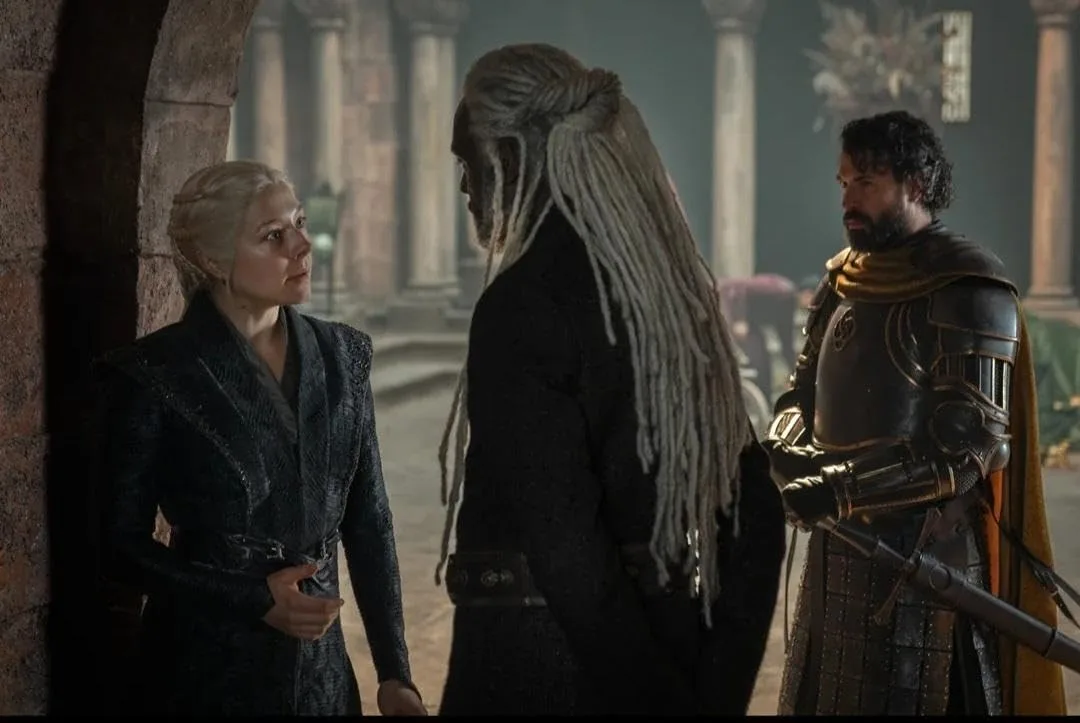
The rat feast is the episode’s thesis statement, staged as comedy and landing as something closer to a warning. Rhaenyra invites the city’s wealthiest families to dine, serves them cooked rats caught in her own infested castle, needles them with compliments that are actually accusations, then has the Gold Cloaks empty their storehouses for the smallfolk while dinner is still on the table. It’s funny. It’s also the most nakedly punitive thing she does all hour, dressed up as generosity toward the poor.
Here’s my hesitation, stated openly: the show frames this scene with a visual quotation of Daenerys Targaryen at her most triumphant and most doomed, same angle on the shoulders, same commanding posture facing a room of subjects. I want to read this as foreshadowing. I’m not sure it earns that reading yet, on one episode’s evidence. What I can say is that the show is aware of its own family tree here in a way it rarely allows itself to be, and it’s willing to let a joke about rats carry the weight of an inherited tragedy. Ser Torrhen Manderly, the one guest who seems to enjoy himself, points out that Rhaenyra’s own wartime blockade caused half this hunger in the first place. Nobody in the scene contradicts him. That’s the detail that convinces me this is an accusation the episode levels at its own protagonist, not simple satire of the nobility around her.
The Boy Who Wasn’t
The deception driving the plot, that “Daeron” handed over by Ormund is a fraud, a lowborn boy with dyed hair standing in for the real one, works less as a twist and more as a confirmation of everything the hour has already argued about legitimacy: that it can be manufactured, performed, handed across a battlefield and accepted at face value because accepting it is convenient. Rhaenyra catches the fraud not through cunning but through Alicent’s face, a flicker of confusion neither woman can fake. The truth arrives sideways, the way it does throughout this episode, never through interrogation, always through some involuntary tell.
Daemon spends the hour reminding his wife, with the tone of a man mentioning a dentist’s appointment, that the boy will need killing regardless of who he turns out to be. I find this funnier than I probably should, and also the bleakest line reading in the episode: casual cruelty as a kind of marital shorthand. By the time word arrives that Ormund’s forces have taken Tumbleton, and the real Daeron with it, along with his dragon Tessarion, the fake boy in the Red Keep has become almost beside the point. Somewhere in that town is Kat, wife to the dragonseed knight Hugh, caught on the wrong side of a war her husband thought was finished three days ago.
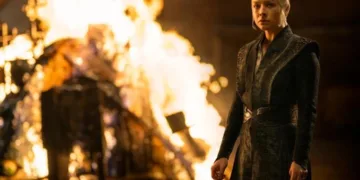
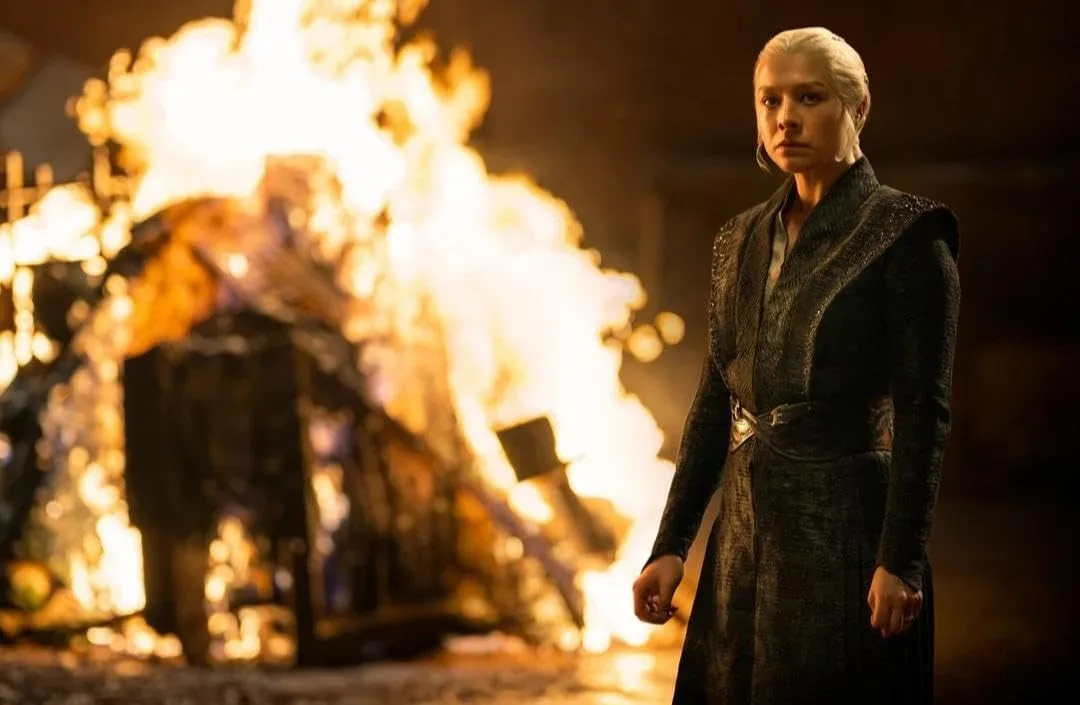
Rhaenyra ends the hour burning banners, her father’s bed among them, watching the fire the way you watch something that might be an ending or might just be the start of the next chapter. I said earlier this wasn’t an anticlimax. I stand by that, mostly, though the word keeps circling back to me, uninvited, every time the episode chooses a quiet room over a battlefield. Maybe that’s the trick. Maybe the emptiest room in the Red Keep was always going to be the loudest one.
“House of the Dragon” Season 3, Episode 3, titled “Rhaenyra Triumphant,” premiered on July 5, 2026, and is available to watch on HBO and its streaming platform, Max. Following the capture of King’s Landing, the episode explores the heavy reality of governance as Rhaenyra Targaryen struggles with an empty treasury, local unrest, and a deceptive political ruse involving a fake prince.
Where to Watch House of the Dragon S03E03 (Rhaenyra Triumphant) Online






Full Credits
Title: Rhaenyra Triumphant (House of the Dragon Season 3, Episode 3)
Distributor: HBO, Max
Release date: July 5, 2026
Rating: TV-MA
Running time: 60 minutes
Director: Clare Kilner
Writers: Sara Hess, George R.R. Martin
Producers and Executive Producers: Ryan Condal, George R.R. Martin, Sara Hess, Alan Taylor, Melissa Bernstein, Kevin de la Noy, Lonny Peristere
Cast: Emma D’Arcy, Matt Smith, Olivia Cooke, Steve Toussaint, Fabien Frankel, Matthew Needham, Sonoya Mizuno, Tom Glynn-Carney, Ewan Mitchell, Harry Collett, Phia Saban, Bethany Antonia, Phoebe Campbell, Jefferson Hall, Clinton Liberty, Kurt Egyiawan, Kieran Bew, Tom Bennett, James Norton
Director of Photography (Cinematographer): Alejandro Martínez
Editors: Catherine Reinhardt
Composer: Ramin Djawadi
The Review
House of the Dragon S03E03 (Rhaenyra Triumphant)
The episode's real subject turns out to be paperwork, and it makes paperwork terrifying. That's the trick, and it's a good one, even if the Daenerys quotation asks for patience one hour hasn't yet earned. Call it a bottle episode that mistakes bureaucracy for tragedy and turns out to be right about it. I walked in ready to call this a lesser, quieter hour. I was wrong, mostly, and I'm still working out what to do with that "mostly."
PROS
- Bureaucracy staged with the gravity of a battle scene
- D'Arcy's physical, unglamorous performance of exhaustion and command
- Djawadi's score turns silence itself into a threat
- The rat feast doubles as comedy and self-indictment
- The two cold opens rhyme across the entire series
CONS
- The Daenerys visual quotation reads as unearned foreshadowing so far
- The fake Daeron reveal lands as confirmation rather than surprise
- The pacing gamble never fully resolves its own doubt by the hour's end