






















The most unsettling choice in These Violent Delights is its refusal to give Romeo and Juliet somewhere private to exist. Scottish Ballet and Forest of Black compress Shakespeare’s tragedy into roughly 70 minutes, yet the sensation is less one of speed than suffocation. Christopher Hampson and Oscar Sansom direct the production as a fever dream caught between ballet and cinema, where bodies are rarely permitted to rest and affection is forever being watched, interrupted or physically redirected.
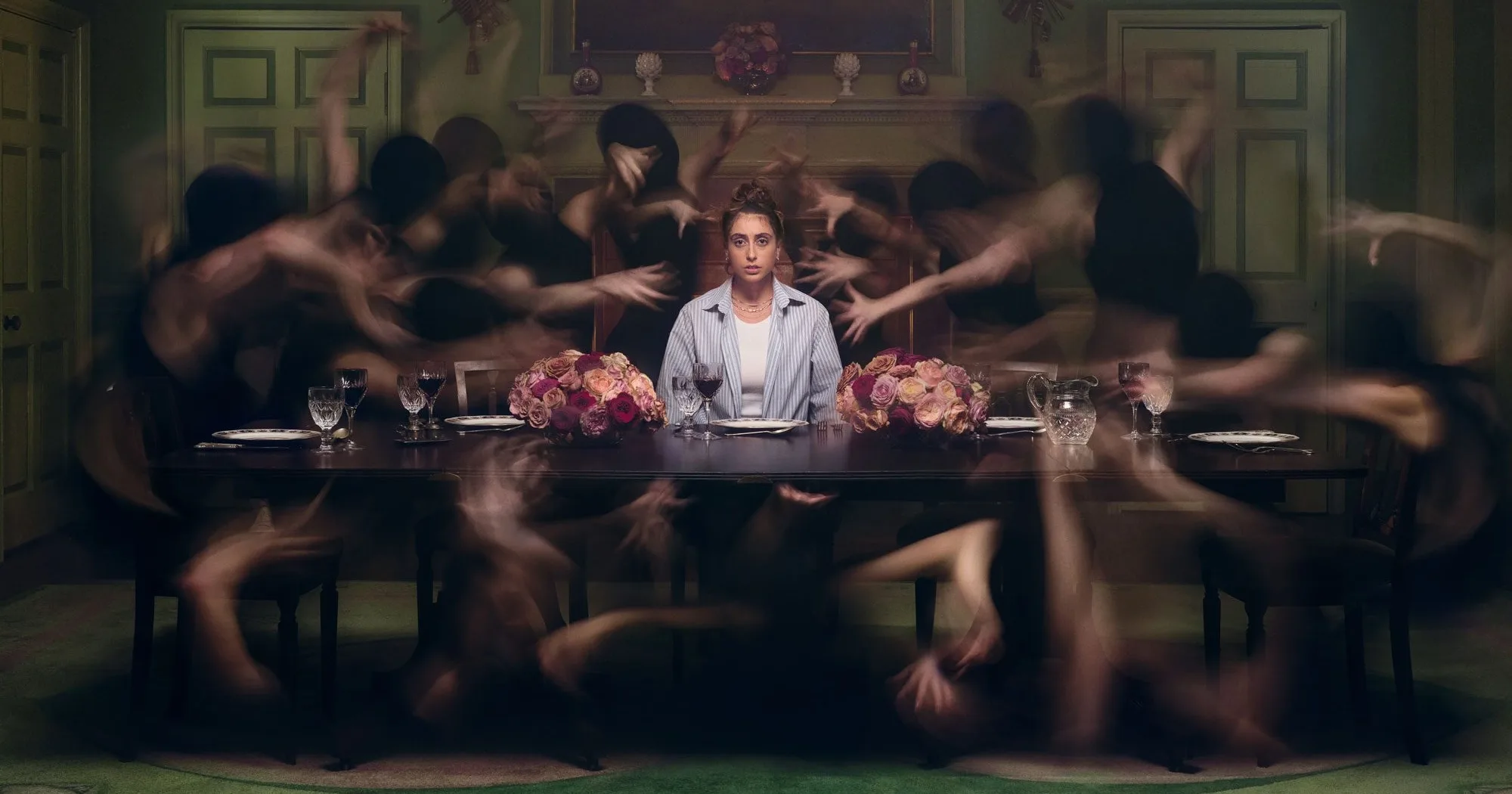
Kayla-Maree Tarantolo’s Juliet becomes the axis of that nightmare. She wakes among red sheets and scattered petals before strange limbs pull her back toward sleep, an image that establishes the film’s unstable relationship with reality. Later, she is dragged across grass by an unseen force. These repetitions make destiny feel brutally physical. Fate does not wait politely in the wings here. It grabs.
Much of Shakespeare’s familiar architecture has been stripped away, including the balcony scene. That absence proves decisive. The famous private space where two adolescents imagine an existence beyond their families simply does not exist. Here, youth is given desire without sanctuary.
Choreography as Argument
Dialogue disappears, so personality has to survive through posture, rhythm and touch. The choreography gives each character a physical grammar clear enough that arguments can unfold without a spoken word. Tarantolo’s Juliet contracts around her family. Her movements become smaller and guarded beside Lord Capulet and Paris, especially during the disturbing sequence in which the two men pass her between them like participants in some grotesque trust exercise.
Christopher Akrill’s Capulet barely needs theatrical fury because the choreography already defines authority as possession. Yuri Marques’ Paris participates in the same pattern of control, leaving Juliet suspended between expectation and obedience.
Her movement changes around Romeo. Ishan Mahabir-Stokes plays him as almost permanently unsettled, shifting direction and gliding away from fixed positions as though certainty itself makes him nervous. When Romeo and Juliet finally share freer movement, Tarantolo expands with him. Her body carries the rebellion the film has denied her elsewhere.
Their romance remains surrounded by people. Friends, parents, rivals and strangers continually invade the frame, turning love into something communal in the worst possible sense. Romeo and Juliet are watched into tragedy.
Other characters receive similarly precise physical identities. Tybalt’s stiffness makes aggression visible before violence arrives, while Mercutio and Benvolio move with a looseness that briefly breaks the oppressive family order. When Tybalt and Mercutio finally collide, the choreography loses its social polish. Bodies strike, recoil and accelerate, giving the confrontation the nervous ugliness of violence rather than the cleanliness of staged combat.
Shakespeare After Midnight
Hampson and Sansom understand that filming dance demands a different relationship with space. The camera refuses the safety of a fixed theatrical viewpoint. It rises with lifts, retreats as bodies advance and moves alongside dancers rather than observing them from a respectful distance.
The editing becomes especially volatile during moments of danger. Cuts arrive before the eye feels finished with an image, allowing Juliet’s memories, fears and physical surroundings to bleed into each other. An opened door may lead somewhere psychologically rather than geographically. That instability gives the film its dream logic without reducing events to abstraction.
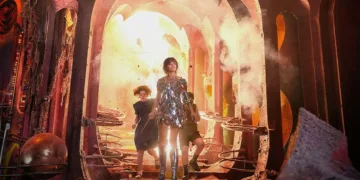
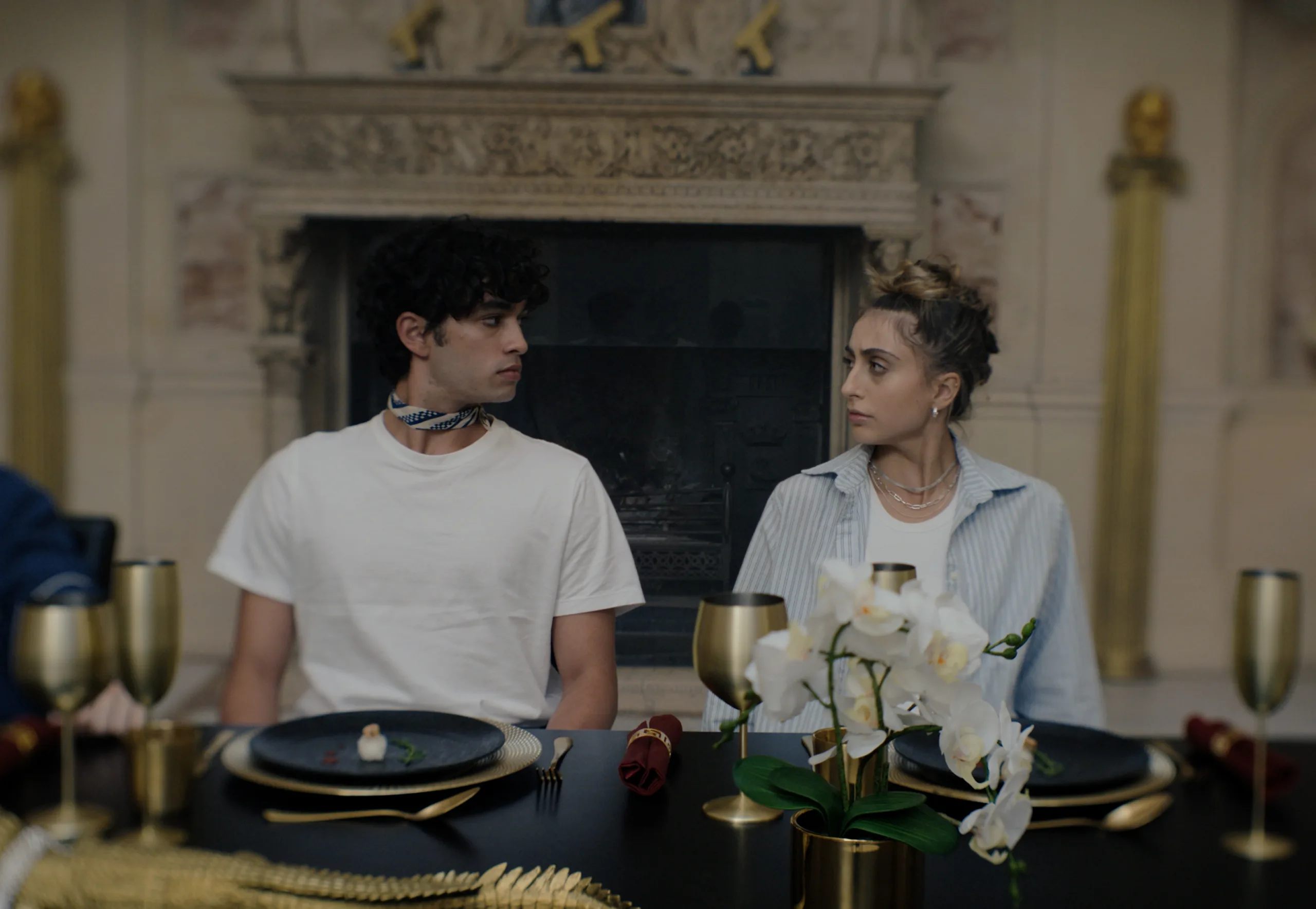
Sami Fendall’s production design keeps one foot in contemporary Britain and another somewhere far stranger. The wealthy domestic worlds of the Capulets and Montagues carry exaggerated colour and costume choices, from velvet tracksuits to carefully cultivated old-money styling. Then the film enters The Apothecary, a grimier nightclub where social order dissolves beneath fluorescent light, pounding bodies and chemical escape.
Friar Laurence becomes the cabaret figure Violent Delight, presiding over this nocturnal kingdom with religious language recast as performance. The decision reaches its delirious peak when Romeo and Juliet consume heart-shaped acid amid a cheering crowd. It is silly, sensual and ominous at once. Their romance briefly resembles transcendence, yet even this ecstasy requires an audience.
John Lemke’s score follows that instability. Brooding bass and percussion give the most frantic passages a pulse that seems attached directly to the dancers’ muscles. Some quieter ambient stretches feel less distinctive, temporarily loosening the film’s grip, but the harder electronic material restores its sense of approaching catastrophe.
These Delights Have Violent Ends
The tragedy acquires a different emotional shape once the balcony disappears and the lovers lose their customary pocket of privacy. Their deaths begin to feel connected to a wider condition of imprisonment rather than one disastrous misunderstanding.
Juliet spends much of the film being directed by other people. Her family arranges her future. Paris occupies the role selected for her. Even the Nurse, dressed with the clinical suggestion of institutional care, carries the faint implication that resistance might be treated as illness. Against that machinery, Romeo becomes less an escape route than the one person with whom Juliet can briefly move according to her own desires.
The altered final movement sharpens this reading. The double death can register as an anguished shared decision, two young people collapsing the distinction between passion and annihilation after every surrounding structure has narrowed their choices.
That is why the recurring image of Juliet being dragged away is so disturbing. The unseen force needs no identity. Family, fate, convention and despair have already learned how to move her body for her.
These Violent Delights premiered at the Edinburgh International Film Festival on August 14, 2026, with a wider release planned for UK and Irish cinemas starting October 21. This reimagining of Romeo and Juliet is a contemporary dance film that interprets the classic narrative through modern choreography and an evocative visual style.
Full Credits
Title: These Violent Delights
Distributor: Scottish Ballet
Release date: August 14, 2026
Running time: 70 minutes
Director: Simon George
Producers and Executive Producers: Catherine Cassidy, Christopher Hampson
Cast: Evan Loudon, Grace Horler, Thomas Edwards, Bruno Micchiardi, Marge Hendrick, Rishan Benjamin, Nicholas Shoesmith, Madeline Squire
- Composer: Sergey Prokofiev
The Review
These Violent Delights
These Violent Delights turns young love into something feverish, hunted and already half-buried. Juliet being dragged across the grass, the lovers swallowed by the Apothecary crowd, and the removal of the balcony’s private refuge all make tenderness feel temporary. Kayla-Maree Tarantolo gives that desperation a body, while the roaming camera and electronic score keep the world trembling around her. A few ambient passages lose the production’s sharper pulse, yet its darkest images linger like fragments from a dream interrupted too late.
PROS
- Tarantolo’s expressive Juliet
- Fierce, character-driven choreography
- Fluid cinematic camerawork
- Striking contemporary production design
- Haunting dream imagery
CONS
- Some weaker ambient scoring
- Compression sacrifices quieter intimacy
- Dream logic can become deliberately opaque