




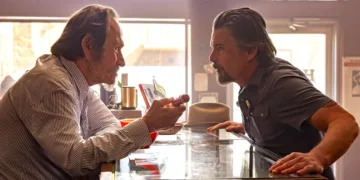
















Florin Șerban wastes little time establishing the social order of Reșița. Mahler’s Third Symphony plays over calm views of the Romanian city before masked teenagers on bicycles sweep through Roma neighborhoods, covering cars with “You Don’t Belong Here” stickers and smashing property with baseball bats. An elderly Roma man who confronts them is beaten to death.
The violence soon reaches Dr. Marius Călimănescu, played by Adrian Văncică, from two directions. Roma relatives arrive at the hospital morgue demanding the victim’s body, while Marius’s teenage son Ioan quietly visits his school nurse with severe bruising he claims came from a bicycle accident.
Șerban lets the audience connect those events early. The real suspense concerns what Marius will do once he reaches the same conclusion. He has spent years believing rules matter. The film gives him a particularly unpleasant opportunity to prove it.
Fathers, Sons and Useful Weakness
Marius runs his hospital with the confidence of somebody who has mistaken professional authority for proof of personal correctness. His worldview becomes clearest around younger doctor Tudor. After surgery, Tudor takes a moment to thank the nursing staff. Marius and his police-chief friend Silviu read the gesture as softness, revealing a philosophy in which respect moves downward and gratitude risks looking weak.
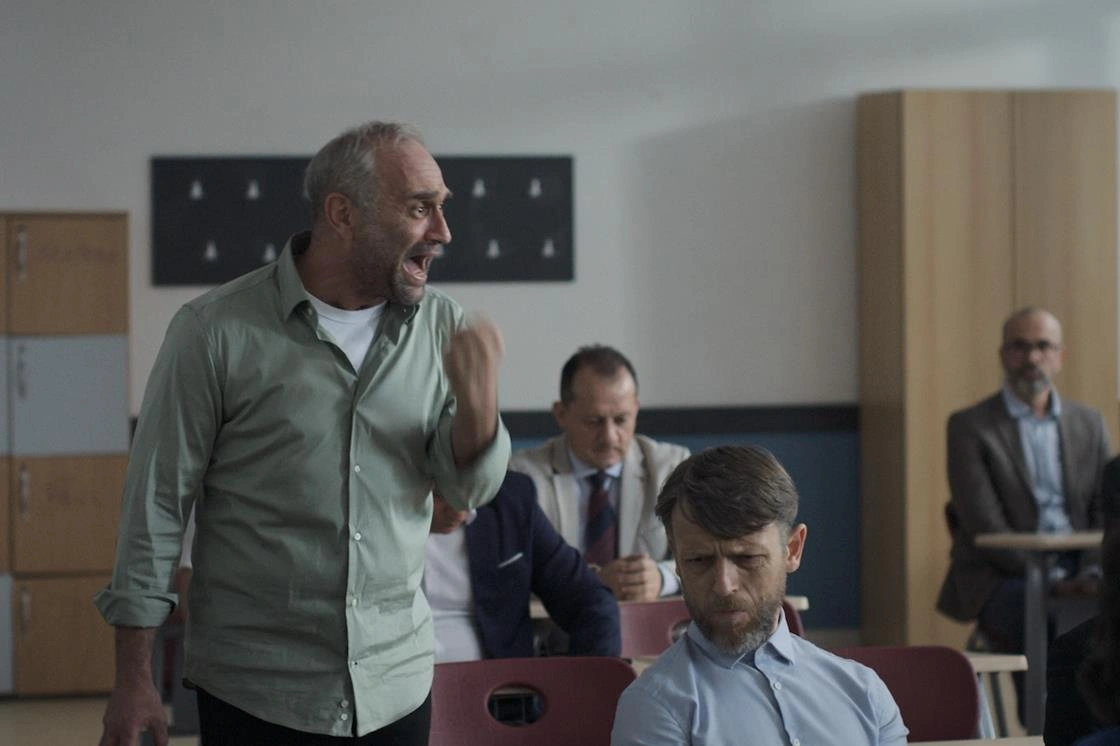
Şerban makes that philosophy explicit during Marius’s long conversation with his lover Dana. Marius explains that powerful men sometimes need to “be mean” so other people learn how to behave. Then comes the crack. He wonders aloud if he may not be as exceptional as he has always believed.
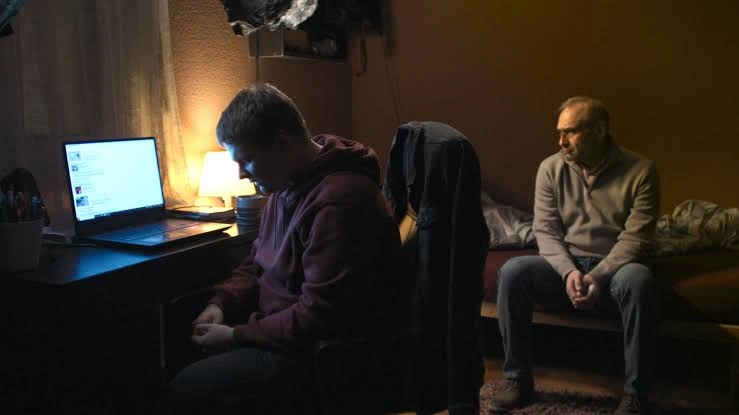
Văncică handles the contradiction carefully. Marius can sound certain while his face suggests that certainty requires constant maintenance. His declarations about Ioan being his entire world carry an uncomfortable hollowness because Şerban has shown so little warmth between them. Marius judges his son as passive, awkward and insufficiently ambitious. Affection appears to have been replaced by evaluation.
Ioan finds another measuring system. His nighttime gang gives him bicycles, masks, targets and a collective identity. Hatred supplies a role he understands. The bruises seen by the school nurse become especially telling once his secret life emerges: this is a teenager being physically initiated into one model of masculinity while failing another at home. The screenplay is strongest when it keeps those systems connected without turning Ioan into a simple victim of upbringing. He still chooses to participate. What Şerban traces is how resentment can become recruitable.
When Principles Become Personal
Marius’s moral code works perfectly while other people are paying for it. The murder investigation changes that arrangement. The dead man’s family is no longer an abstraction once his son confronts Marius directly, and Ioan’s possible involvement makes the case impossible to keep outside the household. As evidence accumulates, the father who prizes responsibility begins looking for ways to protect his child.
That reversal gives the film its cleanest dramatic spine. Marius has spent years insisting that weakness deserves correction, that hierarchy has value and that strong men preserve order. Faced with Ioan’s potential guilt, he discovers exemptions.
Şerban avoids making the hypocrisy theatrical. There is no sudden transformation into a different man. Marius applies the same confidence, connections and institutional authority he has always used, only now the purpose has changed. The machinery of respectability turns out to be wonderfully flexible when its owner needs it.
The title expands through that conflict. “You Don’t Belong Here” begins as racist intimidation aimed at Roma residents, yet exclusion runs through the household too. Ioan does not fit Marius’s definition of a successful son. The Roma community is treated as unwelcome within the city. Marius eventually finds his own social position threatened by the crime he assumed belonged to somebody else’s world.
The father-son relationship works because the film refuses an easy equation in which authoritarian parenting mechanically produces fascism. What passes between generations is less tidy: contempt for weakness, obsession with status and an idea of masculinity built around domination. Ioan gives those lessons a cruder uniform.
Distance as Method
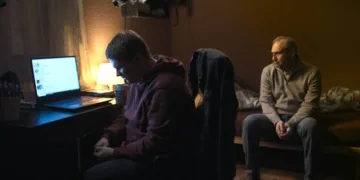
Şerban shoots much of the film in long takes, with Liviu Mărghidan’s camera keeping a conspicuous distance from the characters. Close-ups are scarce. Conversations unfold inside fixed frames, often with Marius occupying the visual position of authority.
There is a clear formal logic to this. Marius sees people according to roles, and the camera frequently treats them the same way. Doctors, nurses, police officers, lovers and sons appear inside spaces he assumes he controls. Cold natural light and subdued interiors strip those spaces of comfort.
The approach becomes less persuasive when silence turns into mannerism. Characters repeatedly leave unnatural gaps between lines, as though every sentence requires its own cooling period. A long take can expose shifts in power that editing might obscure. Repeating the same pause rarely gains similar value.
Ioan suffers most from the film’s visual reserve. Teodor Butănescu is frequently photographed from an angle, lowered into shadow or hidden behind a downcast posture. The choice preserves his opacity, yet it also leaves the film’s second most important character frustratingly inaccessible. Marius receives a fuller psychological map because Văncică’s face remains available as confidence gives way to fear.
At close to three hours, the severity accumulates. Some extended scenes earn their duration by forcing Marius to remain trapped inside conversations he cannot dominate. Others simply sit there. The final coda is the most damaging example of Şerban’s control slipping, introducing a late choice that feels strangely disconnected from the disciplined moral pressure preceding it. For a film about a man certain that somebody needs to impose order, the irony is hard to miss.
You Don’t Belong Here premiered at the Sarajevo Film Festival on August 15, 2026. This Romanian drama depicts the crisis of a provincial surgeon whose world is shattered when his son becomes the primary suspect in the murder of an elderly Roma man.
Full Credits
Title: You Don’t Belong Here (Nu e locul tau aici)
Distributor: Fantascope
Release date: August 15, 2026 (Sarajevo Film Festival)
Running time: 175 minutes
Director: Florin Șerban
Writers: Florin Șerban
Producers and Executive Producers: Florin Șerban, Cristian Mungiu
Cast: Adrian Văncică, Teodor Butănescu, Ofelia Popii, Mihaela Sârbu, Cristian Popa, Vlad Ivanov
Director of Photography (Cinematographer): Barbu Bălășoiu
The Review
You Don’t Belong Here
You Don’t Belong Here builds its strongest drama from Marius discovering that the moral rules he imposes on everyone else become negotiable the moment his son is implicated in murder. Adrian Văncică gives that collapse real weight, while Florin Șerban’s distant camera and extended takes turn family dysfunction into something almost clinical. The method can become punishing, particularly when deliberate pauses drain conversations of natural rhythm, and the final coda weakens a story that had been disciplined about consequences. Still, the father-son structure gives its portrait of inherited intolerance considerable bite.
PROS
- Văncică’s tightly controlled performance
- Strong father-son dramatic structure
- Precise long-take staging
- Sharp examination of inherited prejudice
CONS
- Overextended running time
- Artificial dialogue pauses
- Ioan remains emotionally remote
- Misjudged final coda