





























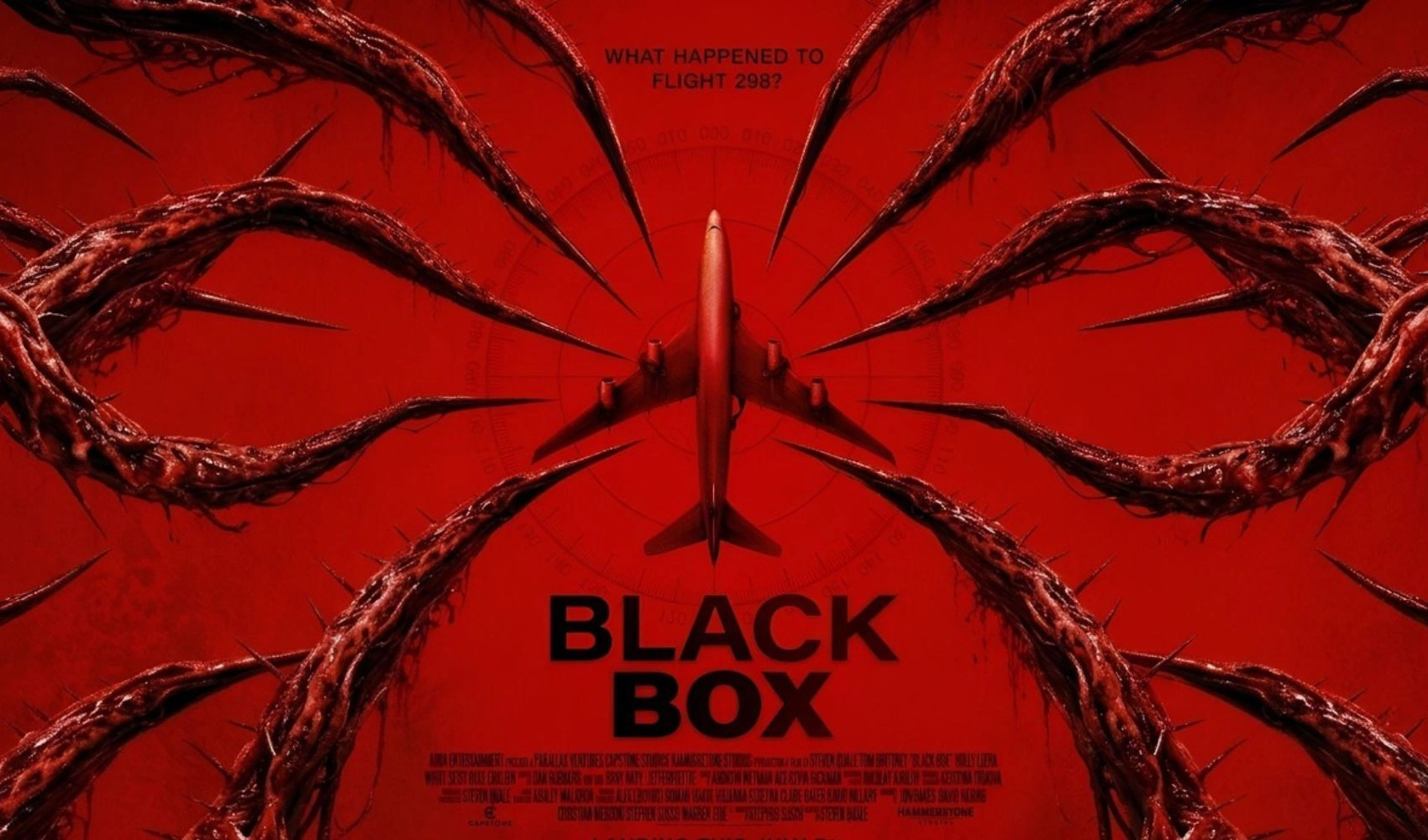

The passengers on Vero Airlines Flight 298 trust the aircraft because civilization has trained them to. The seats are numbered, the attendants smile, the pilots speak in controlled voices from some sealed administrative heaven, and the snacks arrive with the tiny ceremonial poverty of modern air travel. Then an old man coughs too long in the lavatory, the sky begins flashing in impossible colors, and Black Box starts asking a simple, nasty question: what if the machine was never safe, and politeness was only the first stage of denial?
Steven Quale’s sci-fi horror thriller, written by Stephen Susco, is at its best when it treats air travel as a collective hallucination of control. The film is set largely aboard Flight 298, a supposedly ordinary route between New Orleans and Seattle, though “ordinary” becomes a philosophical joke once the cabin lights, clouds, bodies, and passenger nerves begin conspiring against sanity. There is Jeremy, played by Tom Brittney, a grieving medical student moving through the world with the weary softness of someone recently emptied out.
There is Chloe, played by Molly Belle Wright, a sharp young passenger whose wit feels like a defense mechanism built by a child too familiar with adult disappointment. There is Emma, Holly White’s practical flight attendant, and Lauren, Boadicea Ricketts’ air marshal, both drafted into forms of authority that the film gradually renders useless. Authority is the first corpse here. The old man is merely the wettest.
The Call Bell Theology
The opening text claims that commercial flights lose contact with ground control at a rate the public does not fully understand. It is a smartly ridiculous device, the kind of conspiracy bait that sounds alarming until one remembers that most bureaucracies undercount their own weirdness by instinct. Still, the line does important work. It pushes the film away from ordinary turbulence and toward what might be called aviation dread: the terror that comes from being sealed inside a technological promise at 30,000 feet.
Quale understands the shape of that dread. Before the film shows too much, it lets symptoms replace information. The elderly passenger coughing in the lavatory could be ill, infectious, possessed, poisoned, or merely unlucky in the worst possible location. His collapse in the aisle, blood and discharge turning his face into a public disaster, gives the cabin its first point of rupture. People look, recoil, rationalize, then perform the sacred civic ritual of pretending that an isolated event has stayed isolated.
The film’s best early sequence arrives when Emma asks passengers showing symptoms to press their call bells. Suddenly, the cabin answers in chorus. That sound does what exposition cannot. It maps panic seat by seat, transforming the aircraft from a place full of individuals into a single sick organism. A horror film can spend ten minutes explaining infection, contamination, or shared delusion. Black Box needs a few bright buttons and a terrible little chime.
This is where the film’s outbreak disguise works beautifully. Jeremy’s medical training gives him the vocabulary of cause and symptom, but his grief makes him a poor guardian of certainty. When he notices lights outside the window, he seems both rational and vulnerable, a man trying to keep the universe from becoming personal. Chloe’s presence complicates him in the right way. Their early connection over graphic novels could have been a cheap humanizing trick. Instead, it gives Jeremy one living person to protect before the film starts tearing holes in the idea of protection itself.
Then there is the woman in the tin-foil hat, a joke the film almost turns into an argument. Her paranoia is funny because it is theatrical, the aluminum wrapping less a belief system than a costume department’s gift to the obvious. Yet once the plane passes into strange light and bodily failure, she stops being a gag and becomes the person everyone was too comfortable dismissing. Black Box does not make her wise. It does something less comforting. It makes her accidentally adjacent to reality.
Cabin Types, Human Beings
The passengers are built from disaster-movie stock, but some stock has lasted because pressure reveals it well. Danny Mac’s first-class businessman is engineered for audience resentment: smug, impatient, wedded to his schedule with the spiritual shallowness of a man who believes inconvenience is a moral offense. He gives the film its easiest pleasures. Watching him get humiliated, threatened, and placed near danger has the crude satisfaction of seeing bad manners meet genre justice.
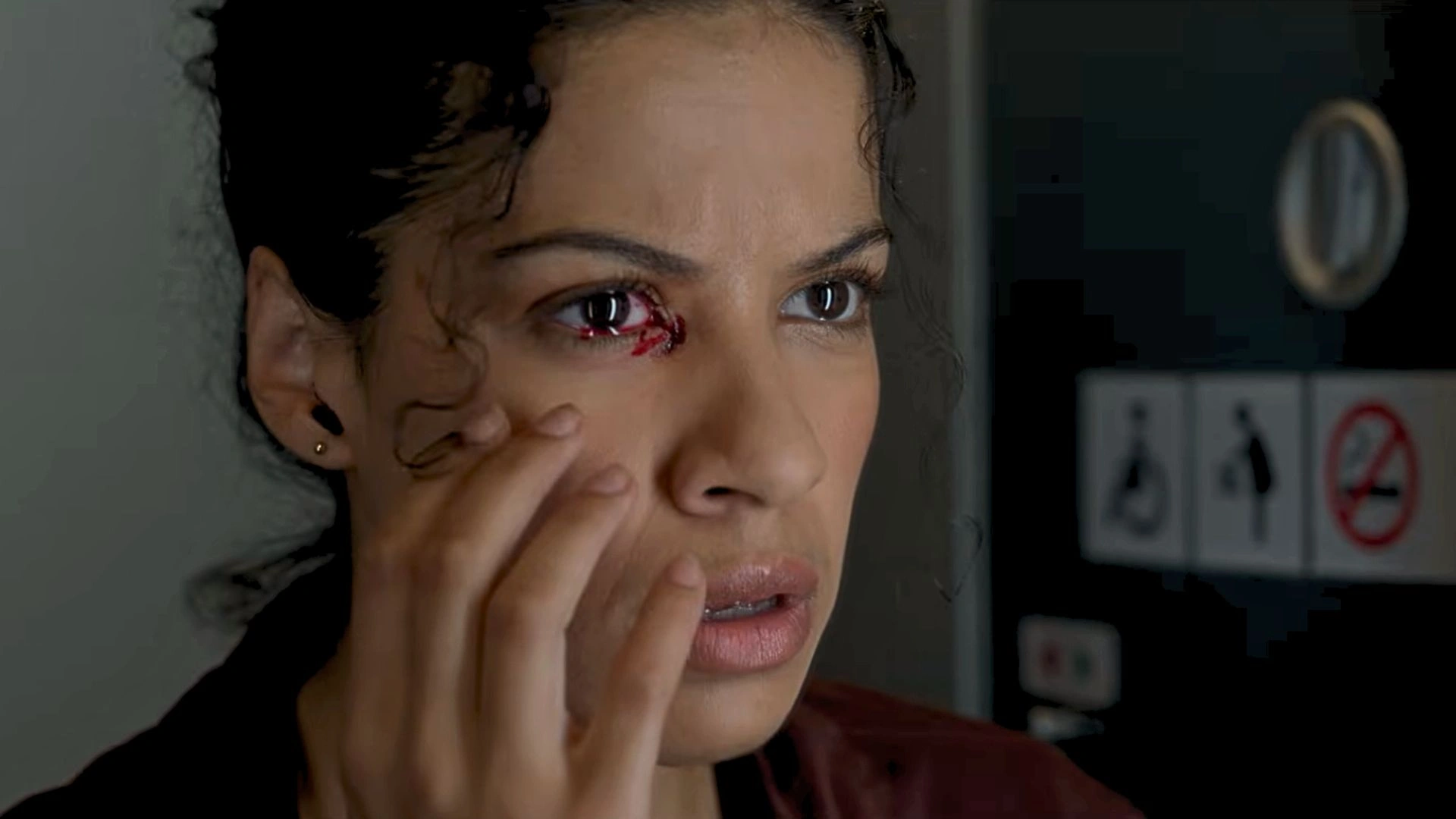
Brittney’s Jeremy is a quieter construction. He does not announce grief through speeches. He wears it as delayed reaction. His face seems slightly behind the present, as if part of him is still listening to an earlier room where his wife has not yet died. The performance works because it gives the film a human tempo slower than the plot. When panic accelerates, Jeremy still has that pause in him, the pause of someone who has already been through one impossible thing and cannot accept that the universe is greedy enough to send another.
Chloe could easily have become the little girl with scripted courage, one of horror’s most suspicious inventions. Wright avoids that by playing her humor with a bruised edge. Her jokes do not exist to charm the adults. They give her distance from them. Her bond with Jeremy matters because both characters understand retreat. He retreats into grief; she retreats into sarcasm. Their connection gives the survival story a small emotional hinge, and the film is better whenever it remembers that cosmic horror becomes sharper when it has someone specific to frighten.
Emma and Lauren are less fully drawn, yet they serve important dramatic functions. Emma turns procedure into compassion. When she tries to calm passengers, gather symptoms, and keep order in a cabin already turning irrational, her work becomes a kind of doomed choreography. Lauren, the air marshal, is effective against human stupidity and almost comic against the larger threat.
That limitation is useful. A gun, a badge, and trained posture mean something when the problem is an arrogant passenger. They mean very little when footsteps come from places the plane should not contain. This is one of the film’s better jokes, if one can call it that. Institutions are prepared for versions of reality that file paperwork.
After the Silence
The pivot from airborne outbreak thriller to extraterrestrial creature feature is both the film’s great gamble and its visible fracture. Quale prepares the shift with glowing skies, technological disruptions, and a storm cloud that appears less like weather than intention. The exterior effects sometimes carry the rubbery sheen of studio manufacture, but the idea remains potent: the plane is not passing through bad weather; it is being noticed.
The most effective moment in the second half is not a monster attack. It is the halt. Turbulence stops. Noise dies. Panic loosens. For a breath, the passengers believe the nightmare may have ended, which is exactly when Black Box becomes meaner. Relief, here, is a trapdoor. The question changes from “Will they survive the flight?” to “Where has the flight gone?” That is a better question because it wounds geography itself. A crash can be understood. A landing nowhere cannot.
The cargo hold sequence gives the film a strong physical reset. Jeremy, Chloe, Emma, Lauren, and the others move below the passenger cabin, surrounded by distressed dogs who understand the atmosphere before the humans can name it. The dogs are not decorative. Their barking turns instinct into sound design. They make the threat feel present before it has shape. Above, the cabin offers social panic. Below, the hold offers animal panic. Between them, the aircraft becomes a layered diagram of fear.
Once the creatures arrive in clearer form, the film trades suggestion for pursuit. The entities recall a familiar family of sci-fi predators: slick, invasive, hostile, motivated by needs the script does not fully articulate. Their vagueness can be defended as cosmic mystery, but I am only half convinced by my own defense (never trust a monster whose best feature is the critic’s generosity). The less the film shows, the stranger it feels. The more it shows, the closer it moves toward efficient genre mayhem.
That mayhem is not worthless. There is pleasure in the way steam, metal, shrieks, and cramped movement turn the plane into a hostile machine. Quale knows how to push bodies through narrow space. The film’s late action has force, especially when survivors are separated and the aircraft’s familiar zones become territories: cabin, hold, cockpit, window, impossible beyond. Still, the earlier dread had a cleaner metaphysical sting. A call bell ringing from every seat says: everyone is infected by the same unknown. A visible creature says: run from that. Both work. One is smarter.
Screens, Storms, and Fake Skies
The film’s found-footage inflections give it a modern nervous system. Early clips from passenger devices, vertical frames, and onboard recordings suggest a world where disaster is documented before it is understood. This is not merely a stylistic flourish. It changes the moral texture of the panic. The passengers are not only trapped; they are producing evidence that may never reach anyone. The black box is not just in the plane. It is in every hand, every pocket, every small glowing rectangle hoping to outlive the body holding it.
Quale shifts from those device images into a smoother, more polished horror grammar as the flight worsens. The cabin lighting takes on richer tones. Colored flashes outside the windows paint faces with an alien weather report. Footsteps echo from impossible locations. The call bells, barking dogs, sudden hush, and mechanical groans make the soundscape feel like a systems failure with a pulse. The film’s best craft choices work by making ordinary airplane noises turn traitorous.
The visual effects are less consistent. Some exterior shots carry the unmistakable smell of green screen, and the later spectacle occasionally asks the viewer to admire images that look less expensive than the dread they are meant to support. This creates a strange imbalance. The enclosed cabin set helps the film because claustrophobia forgives artificiality. The sky does not. Once Black Box reaches for awe outside the windows, the studio walls begin tapping politely from behind the clouds.
Yet the artificiality also suits the film in a crooked way. Airplanes already feel fake: pressurized tubes with smiles, safety demonstrations, sealed doors, and miniature rituals pretending to domesticate death. Black Box accidentally benefits from that unreality. Its stage-bound quality makes the flight feel like a metaphysical test chamber, a place where grief, paranoia, bureaucracy, and alien appetite have been loaded into the same experiment.
The final moments leave a residue of uncertainty around Jeremy’s perception and the true nature of Flight 298’s displacement, but the film has already committed too strongly to its creatures to fully return to psychological ambiguity. It wants the monster and the doubt. Greedy film. Still, its greed has energy, and its strongest passages understand that horror in the air does not need the plane to fall. It only needs the passengers to realize that the sky has stopped behaving like sky.
The sci-fi horror thriller Black Box premiered in U.S. theaters on June 17, 2026, and is scheduled for a digital and VOD release on platforms like Apple TV starting July 7, 2026. The film follows the terrifying supernatural and extraterrestrial events that plague the passengers of Vero Airlines Flight 298 during a domestic journey from New Orleans to Seattle.
Where to Watch Black Box: Flight 298 (2026) Online





Full Credits
Title: Black Box (also known as Black Box: Flight 298)
Distributor: Aura Entertainment, Capstone Pictures, Signature Entertainment
Release date: June 17, 2026 (Theaters), July 7, 2026 (Digital/VOD)
Rating: R
Running time: 1 hr 25 min
Director: Steven Quale
Writers: Stephen Susco
Producers and Executive Producers: David Hillary, Christian Mercuri, Roman Viaris-de-Lesegno
Cast: Tom Brittney, Holly Leena White, Betsy Blue English, Dane Whyte O’Hara, Kaja Chan, Asa Ali, Boadicea Ricketts, Ceallach Spellman, Georgina Leonidas, Molly Belle Wright, Hanneke Talbot, Danny Mac, Weronika Rosati
Director of Photography (Cinematographer): Steven Quale
Editors: Kenneth Duclos, Steven Quale
Composer: Raffertie
The Review
Black Box
Black Box is strongest while it mistakes illness for omen. Its later creature reveal bruises the ambiguity, yet Steven Quale’s sealed-cabin tension, the call-bell panic, Jeremy and Chloe’s wounded rapport, and that marvelous dead silence after the storm keep the film alive. It is uneven, sometimes visibly artificial, and occasionally too eager to explain its nightmare. Still, it understands the secret horror of flight: everyone is trapped inside a machine they pretend to trust. Poor machine. Poor us.
PROS
- Strong cabin suspense
- Effective call-bell panic scene
- Jeremy and Chloe’s rapport
- Sharp sound design
- Bold sci-fi horror turn
CONS
- Uneven visual effects
- Monsters reduce ambiguity
- Some thin supporting roles
- Studio-bound artificiality







