

















![Kingdom Hearts Collection [I-III] Review](https://gazettely.com/wp-content/uploads/2026/10/Kingdom-Hearts-Collection-I-III-1-360x180.webp "Kingdom Hearts Collection [I-III] Review: KHII Holds Steady as Newer Entries Fluctuate 37")





A soldier who can be backed up like software is a useful war-machine fantasy, mostly because it removes the final inconvenience of war: the dead staying dead. Rogue Trooper, Duncan Jones’ R-rated animated adaptation of the 2000 AD comic by Gerry Finley-Day and Dave Gibbons, takes that idea seriously enough to make it grim, then surrounds it with talking gear, regional insults, and a backpack with better comic timing than several living characters.
The setup is dense in the way old sci-fi comics often are, so the film chooses the blunt instrument: a long space-opera crawl. The Norts and the Southers are fighting over Nu Earth, a toxic planet of sulfurous haze, gray rock, and tactical stupidity. The Southers have created Genetic Infantrymen, blue-skinned soldiers who can survive the atmosphere and preserve their minds on chips. If the body dies, the chip can be placed elsewhere until a clone is ready. It is immortality with military paperwork.
Jones opens with a statement that no AI was used in the film, which matters because the movie’s entire premise is built around the difference between a person and a reusable file. That may be the cleanest joke in the picture, and one of the sharpest.
The Betrayal Gives the Story Its Spine
The opening mission sends Rogue, also called 19 and voiced with stern restraint by Aneurin Barnard, behind enemy lines with his platoon. The sequence is loud, violent, and intentionally disorienting, with bodies dropping before personalities can settle. That is partly a dramatic limitation and partly the point. These soldiers look similar because the system that made them values function over individuality. War has always liked uniforms. This war has improved the manufacturing process.
Once the platoon is wiped out after an apparent betrayal, the film finds its structure. Rogue pulls the memory chips from his fallen brothers and installs them into a helmet, a gun, and a backpack. From there, the movie becomes a chase, an investigation, and a road picture across a battlefield that seems designed by committees with unlimited weapons and no exit strategy.
The story works best when it stays attached to that betrayal. Rogue’s suspicion of his own command gives the action a clean motive, and his attempt to warn superiors before another disastrous attack keeps the plot from dissolving into pure vignette. The danger is that the film enjoys its weird side characters so much that the central thread can briefly feel like an excuse to visit them. A lesser version would lose the spine completely. This one bends it, then remembers where it was going.
The Dead Get the Best Lines
The film’s smartest character move is also its silliest. Rogue’s dead comrades become clearer personalities after they are reduced to equipment. Daryl McCormack’s helmet, Jack Lowden’s gun, and Reece Shearsmith’s malfunctioning backpack give the film its comic rhythm, sniping at each other through chip-to-chip chatter and turning battlefield grief into portable irritation.
That sounds like a gimmick. It is a gimmick. It also works. The banter gives Rogue someone to play against, which Barnard’s controlled performance badly needs. His stillness fits a soldier bred for purpose, yet too much of it would make the film emotionally flat. The gear solves that problem by externalizing the dead. Rogue does not deliver speeches about survivor’s guilt. He carries it on his back, argues with it, aims it, and occasionally has to listen while it complains.
The side characters are broad by design. Jemaine Clement and Matt Berry voice scavengers who see Rogue and his sentient kit as profit waiting to be packaged. Peter Serafinowicz’s French-accented sniper arrives with Edith Piaf and a planetary ego, a gag so obvious it almost loops back to funny through sheer nerve. Hayley Atwell’s Venus Bluegenes gives the final act a welcome jolt, especially when she starts tearing through robots with the calm enthusiasm of someone who has found her weekend hobby.
Some jokes land with the grace of ordnance. Others simply explode nearby. The important distinction is that Jones is chasing British bathos rather than superhero slickness. The jokes are sour, odd, and occasionally ungainly. At least they have a pulse.
A Beautifully Uneven Machine
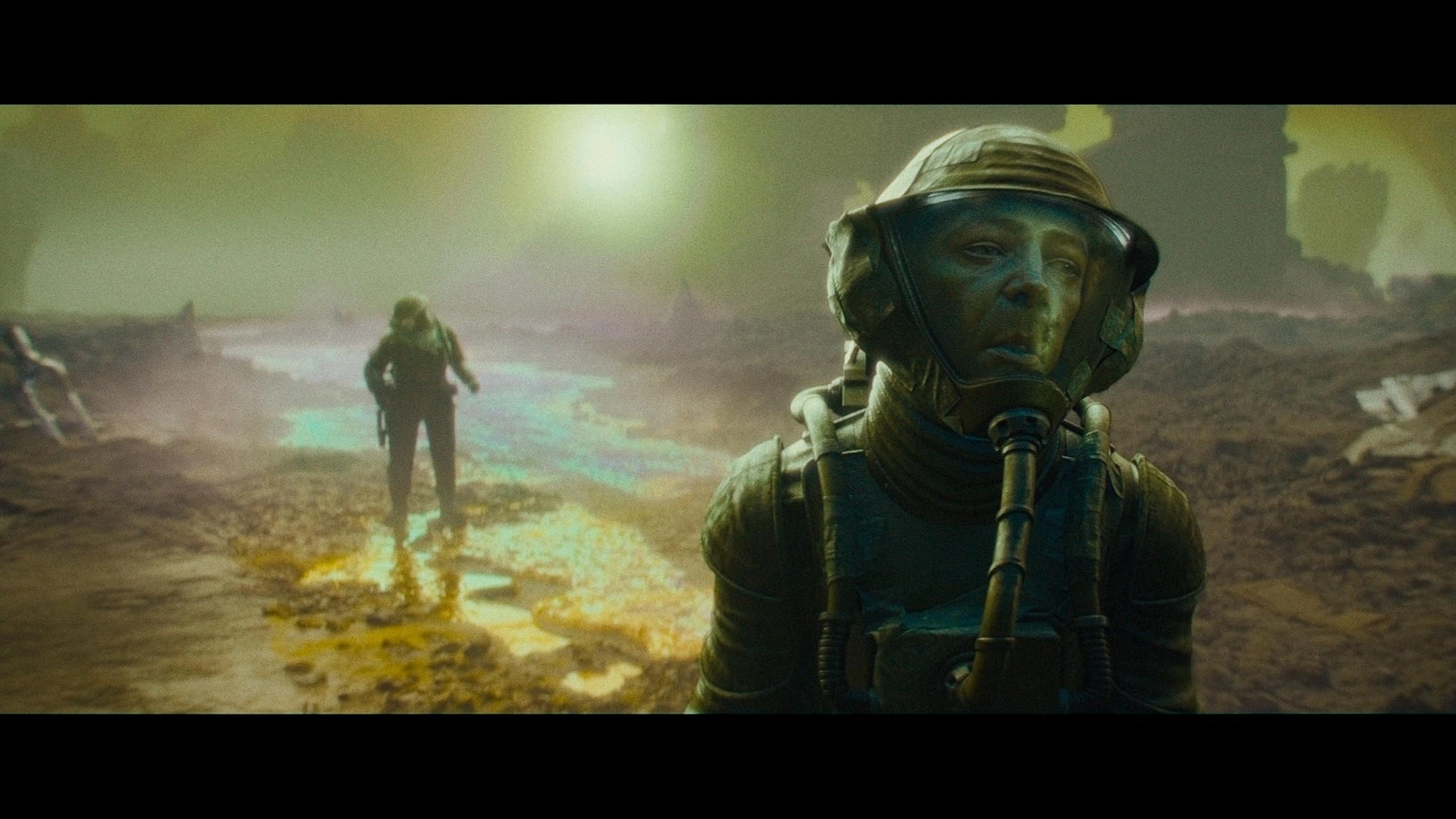
The animation is the film’s most visible gamble. Built with performance capture and Unreal Engine, Rogue Trooper often looks spectacular from a distance and uneasy up close. The landscapes have weight: toxic skies, jagged crystals, crashed ships, giant robots, and battlefields stuck in permanent halflight. Several wide shots could have been lifted from a 1970s sci-fi paperback cover, then fed through a heavy metal album sleeve for seasoning.
Faces are harder. The character designs sit in that familiar digital zone where skin has texture without warmth and eyes have detail without full life. Close-quarters fights can resemble expensive game cinematics, especially when bodies collide in full view. The film is at its weakest when it asks us to admire physical impact at close range. The tools are impressive, yet impact still needs rhythm, framing, and weight. Technology can render a punch. It cannot automatically make it hurt.
Jones is stronger with composition. The comic-book credit sequence, complete with black-and-white frames and a faux-jingoistic march by Bear McCreary, understands the source’s pulp bite. The third act leans into bold silhouettes, big machinery, and heroic absurdity, letting Rogue’s glowing eyes and blue figure become graphic shapes rather than merely animated anatomy. That is where the film looks most confident.
The opening crawl may test viewers before the film has earned their patience, and the two-hour runtime lets a few encounters hang around after their joke has peaked. Still, the structure has enough purpose, the world has enough invention, and the talking backpack, against several laws of taste, earns its place in the squad.
The adult animated military science fiction film Rogue Trooper celebrated its highly anticipated world premiere at the Annecy International Animation Film Festival on June 22, 2026. Directed and adapted for the screen by Duncan Jones, the independent, game-engine-produced film is currently seeking widespread commercial theatrical distribution after completing its initial festival circuit showcases. The story follows 19, a blue-skinned, genetically engineered super-soldier who becomes the lone survivor of a massive ambush on the toxic planet Nu-Earth and embarks on a brutal mission of vengeance to hunt down the traitor general who sold out his unit.
Full Credits
Title: Rogue Trooper
Distributor: Rebellion Developments, Liberty Films (No theatrical distributor attached)
Release date: June 22, 2026 (Annecy International Animation Film Festival World Premiere)
Running time: 125 minutes
Director: Duncan Jones
Writers: Duncan Jones, Gerry Finley-Day, Dave Gibbons
Producers and Executive Producers: Stuart Fenegan, Jason Kingsley, Chris Kingsley, Duncan Jones, Ben Smith, Ben Andac, Barrett Heathcote
Cast: Aneurin Barnard, Hayley Atwell, Jack Lowden, Daryl McCormack, Reece Shearsmith, Matt Berry, Asa Butterfield, Jemaine Clement, Sean Bean, Diane Morgan, Alice Lowe
Director of Photography (Cinematographer): Aaron Grasso (Lighting Consultant / Real-time Production Cinematographer)
Editors: Duncan Jones
Composer: Bear McCreary
The Review
Rogue Trooper
Rogue Trooper is scrappy, strange, and frequently smarter than its talking-backpack premise suggests. Duncan Jones builds a war satire with a clear narrative spine, then decorates it with pulp excess, grim jokes, and digital vistas that often look terrific from a distance. The animation falters in close combat, and the opening crawl asks for patience before the film has earned it, yet the dead soldiers trapped in gear give the story an odd, sharp emotional charge.
PROS
- Strong betrayal-driven structure
- Inventive war satire
- Funny sentient equipment
- Striking alien landscapes
- Sharp comic-book energy
CONS
- Uneven facial animation
- Stiff close-range fights
- Overlong opening crawl
- Some jokes misfire