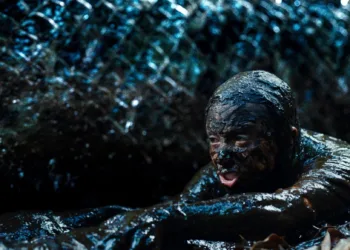



























A Mark IV tank should feel like a miracle until it stops moving. That is the simple, effective idea powering Landship, Callum Burn’s First World War drama about the F41 “Fray Bentos” crew during the Battle of Passchendaele. The film narrows the usual war-movie canvas to a single British tank, a nine-man crew, and a mission that goes wrong in the mud near German lines.
That choice gives the film its shape. Rather than trying to recreate the full sweep of 1917 Belgium, Burn builds a survival thriller out of confinement. The men are sent across No Man’s Land to destroy German bunkers, then their tank gets stranded in a crater. From there, the mission becomes a test of patience, discipline, thirst, fear, and how long human bodies can stay useful inside a machine that has stopped being useful.
The film’s best insight is mechanical before it becomes emotional. The Mark IV is powerful enough to absorb rifle fire and terrifying enough to draw enemy attention away from infantry, yet it is also slow, blind, hot, filthy, and awkward. Burn understands that contradiction. Early movement across the battlefield has a rough, grinding force, with the tank pushing forward like an industrial animal. Once it tilts into the mud, the same metal shell turns into a trap.
Command Under Pressure
Vin Hawke plays Captain Donald Richardson with a clipped, hard-set restraint that fits the film’s view of leadership. Richardson is not written as a grand inspirational figure. He is a man with orders, wounded men, shrinking supplies, and a crew starting to calculate survival in different ways. Hawke’s performance works because he keeps Richardson’s fear under the skin rather than pushing it into speeches.
His line, “Knuckle under, or I will bring the hammer down,” lands with the bluntness of a man who knows command has become performance. He has to sound certain because uncertainty would spread faster than gas inside that tank. Later, when pistols are drawn and the threat inside the hull begins to rival the threat outside it, the film finds its sharpest moral tension. Discipline may keep the crew alive. It may also grind them down.
Jack Sherlock’s Private Morrey gives that tension a human pressure valve. His resentment starts in mutters, then hardens into challenge. The film does not give him a grand mutiny arc, which is wise. Morrey’s anger feels practical, born from thirst, exhaustion, and the sickening belief that the men above him are still obeying a plan that no longer exists.
David Dobson’s 2nd Lieutenant George Hill and Matthew Canny’s Sergeant Robert Missen help fill out the crew dynamic, giving Richardson people to push against without turning every exchange into rank-and-file shouting. The film is less successful at separating every member of the nine-man crew. Some of the younger privates blur together, especially in the early stretch, where accent, rank, and facial hair do too much of the identifying work.
Smoke as Budget and Atmosphere
Burn has made several war films before, and Landship shows a filmmaker getting better at using limitation as form. The restricted set, the night exteriors, and the thick smoke clearly serve the production. They also serve the story. In a film about men who cannot see enough to make safe decisions, visual murk becomes part of the dread.
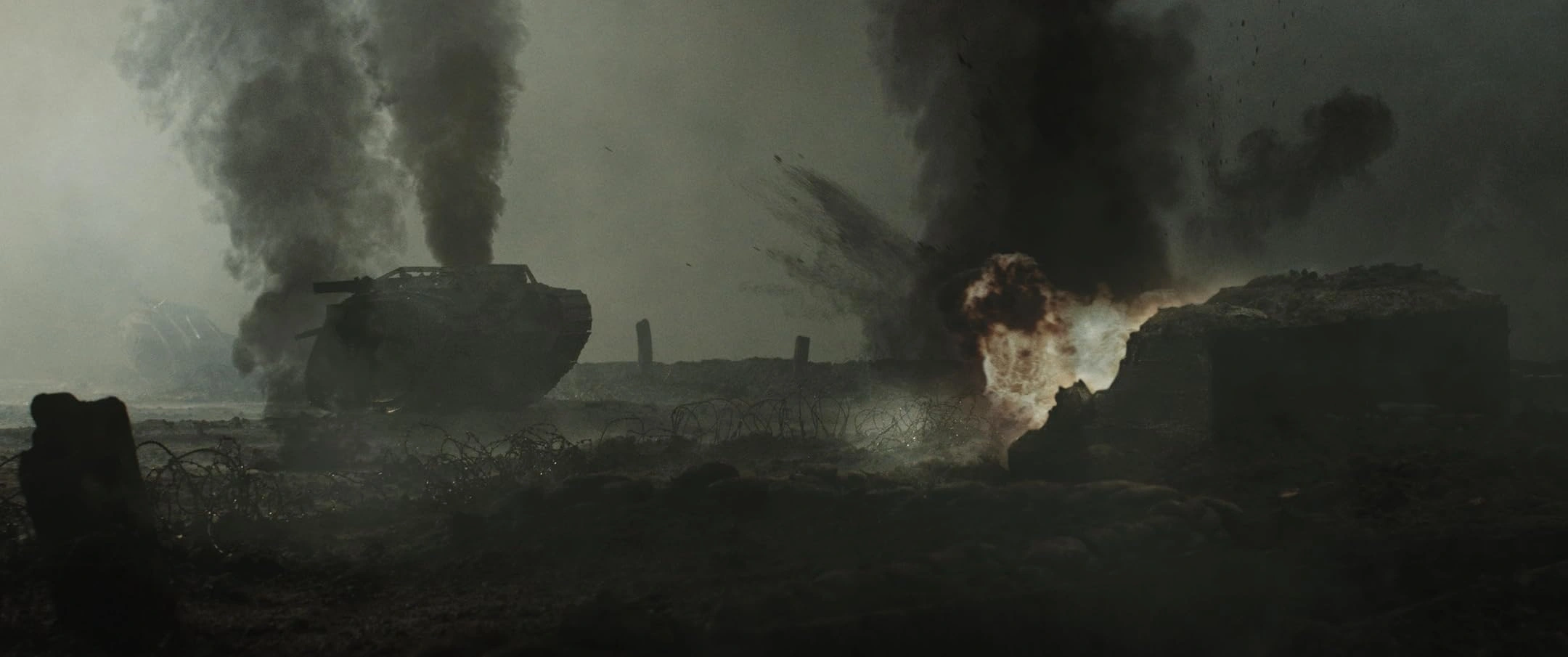
The opening image of Richardson moving through fog with a pistol drawn is especially strong. German soldiers in gas masks and carrying brutal close-range weapons appear like fragments of a nightmare, half seen before they strike. It is a smart lesson in scale. The battlefield feels large because the frame refuses to explain it.
Sam Parson’s cinematography gives the exteriors an ashen, bruised texture. Mud, smoke, and weak light flatten the land into something almost abstract. Inside the tank, the camera has less room to maneuver, so the film leans on faces, metal surfaces, and bodies pressed into corners. Andrew Burn’s production design does important work here. The tank interior feels cramped in a way that affects the performances; men do not merely stand in it, they endure it.
Ben Thatcher’s sound design may be the film’s most reliable craft element. The groan of the hull, the muffled violence outside, the sudden crack of gunfire, and the oppressive noise of the tank’s interior make the setting feel physical. I kept noticing how the sound closed space around the men, especially during quiet stretches when waiting becomes its own kind of combat.
Where the Pressure Slips
The confinement that gives Landship its identity also creates its main problem. At 89 minutes, the film is lean, yet the middle section still circles similar beats: panic, argument, silence, another threat, another argument. Some of that repetition is honest to the situation. Being trapped would be repetitive. Cinema still needs variation, and the script does not always find fresh angles inside the same crisis.
The dialogue carries a heavy load, and it can feel too plain for the amount of time spent in close quarters. Richardson’s sharper commands cut through, and Morrey’s resistance gives scenes a pulse, but several exchanges between the other men have the flat utility of exposition dressed in mud. When the film steps outside, it often finds stronger images than words: a figure vanishing into fog, a gun raised at a shape that may be enemy or imagination, the tank sitting helpless in blasted earth.
The final naming of the crew and their fates gives the story a needed historical weight without turning it into patriotic ceremony. That restraint matters. Landship works best when it treats survival as a series of small decisions made by frightened men inside failing machinery. Its flaws are real: some characters are thin, some interior scenes lose tension, and the smoke can obscure clarity along with danger. Its strongest moments have a stubborn force, because the film understands that a tank can be armor, coffin, weapon, and waiting room at the same time.
The claustrophobic World War I survival drama Landship celebrated its global debut at the 34th Raindance Film Festival in May 2026 before launching its widespread theatrical rollout across the United Kingdom on June 26, 2026. Distributed internationally by Kaleidoscope Film Distribution, the historical feature centers on the harrowing true story of a British Mk IV tank crew stranded in a massive shell crater during the brutal 1917 Battle of Passchendaele. Trapped just yards away from heavily fortified German lines, the exhausted nine-man unit must endure an intense, claustrophobic siege inside their iron hull as they mount a desperate fight for survival.
Where to Watch Landship (2026) Online
Full Credits
Title: Landship
Distributor: Kaleidoscope Film Distribution
Release date: May 2026 (Raindance Film Festival), June 26, 2026 (United Kingdom Theatrical Release)
Rating: 15 (BBFC)
Running time: 89 minutes
Director: Callum Burn
Writers: Andrew Burn, Callum Burn
Producers and Executive Producers: Andrew Burn, Callum Burn, Spencer Pollard, Robert Graham
Cast: Vin Hawke, David Dobson, Micky David, Jack Sherlock, Matthew Canny, Sam Dowdy, Ricky Oakley, Daniel Cornish, Jeffery Mundell, Nadav Burstein
Director of Photography (Cinematographer): Sam Venn-Parsons
Editors: Callum Burn
Composer: Ben Thatcher
The Review
Landship
Landship turns a stranded Mark IV tank into a tight, grim survival chamber, using smoke, metal, sound, and exhausted faces to make a small First World War episode feel immediate. Callum Burn’s direction gets strong value from limited resources, and Vin Hawke gives Captain Richardson a firm, strained center. The film loses some force in its repetitive middle stretch, and a few crew members remain sketchy, yet its best scenes understand war as waiting, fear, discipline, and machinery failing at the worst possible time.
PROS
- Strong confined setting
- Vin Hawke’s restrained lead performance
- Effective sound design
- Tense fog-heavy battlefield scenes
- Clear historical weight
CONS
- Repetitive middle section
- Some thin crew characterization
- Dialogue can feel plain
- Murky action clarity