
























![Kingdom Hearts Collection [I-III] Review](https://gazettely.com/wp-content/uploads/2026/10/Kingdom-Hearts-Collection-I-III-1-360x180.webp "Kingdom Hearts Collection [I-III] Review: KHII Holds Steady as Newer Entries Fluctuate 37")




Noam hears the word “gay” as if someone has called his name. His shoulders tighten, his eyes search the room, and Charlie Korman lets the pause stretch just long enough for us to understand how closely the teenager monitors every conversation around him. Living inside a Modern Orthodox Jewish community, Noam has learned that silence can look like safety.
Writer-director Jeremy Borison builds Unspoken around the moment that safety becomes unbearable. Noam’s grandfather, Opa, has recently died, leaving behind memories of Broadway songs, a beautiful singing voice, and an unusually close relationship with his grandson. While helping his mother search through Opa’s possessions, Noam finds a German letter signed “M,” a photograph of two men, and an engagement ring hidden inside a box.
He immediately constructs a story from those objects. Opa must have loved a man before fleeing Europe. The possibility gives Noam something he has never found at home or school: a queer person inside his own family history. Borison’s smartest narrative choice is allowing that belief to become both comfort and trap. Noam is investigating Opa, yet he is also searching for permission to name himself. Every clue feels personal because he needs it to be.
The History Outside the Classroom
Noam turns his family mystery into a school project about Holocaust remembrance. His teacher discusses the six million Jewish people murdered by the Nazis, and Noam raises the millions of other victims, including Roma people, disabled people, and gay men. Her irritated response reveals a contradiction inside the school’s lessons. Memory is treated as a sacred responsibility, yet some victims remain absent from the approved version.
Paired with his classmate Jonah, Noam begins researching men forced to wear the pink triangle in concentration camps. Their discoveries are among the film’s most effective educational passages. Homosexuality remained criminalized in Germany after World War II, meaning some gay prisoners liberated from camps were sent directly to prison. Borison presents this through the boys’ growing alarm rather than pausing for a classroom lecture. The history enters through their reaction to it.
The investigation moves through libraries, archives, photographs, and visits to people who may know the identity of M. Some of this detective work feels oddly analog for a present-day teenager. Noam repeatedly sneaks into offices or searches physical records when a phone could answer several early questions. Those scenes generate tension, though the screenplay occasionally seems to hide the Wi-Fi router for dramatic convenience.
The mystery works because it quietly teaches the audience to make the same mistake as Noam. Each new detail appears to support the story he wants, so the missing evidence rarely feels missing. Borison turns assumption into a form of editing, selecting the pieces that fit and leaving the rest outside the frame.
Reading Noam’s Face
Korman gives the film its emotional precision. Noam is bright enough to recognize the rules governing his community and young enough to believe he can outthink their consequences. His anxiety appears through small physical choices: a glance held too long, a rushed denial, a sudden change in posture when someone gets close to the truth.
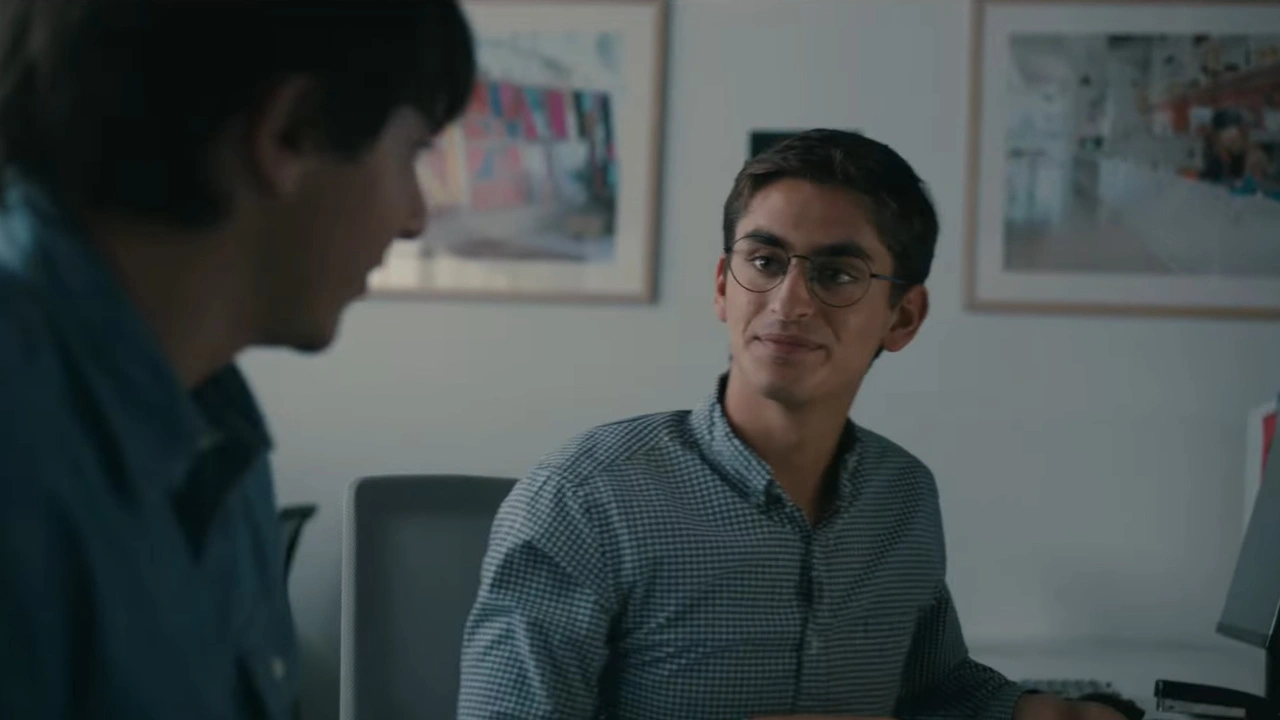
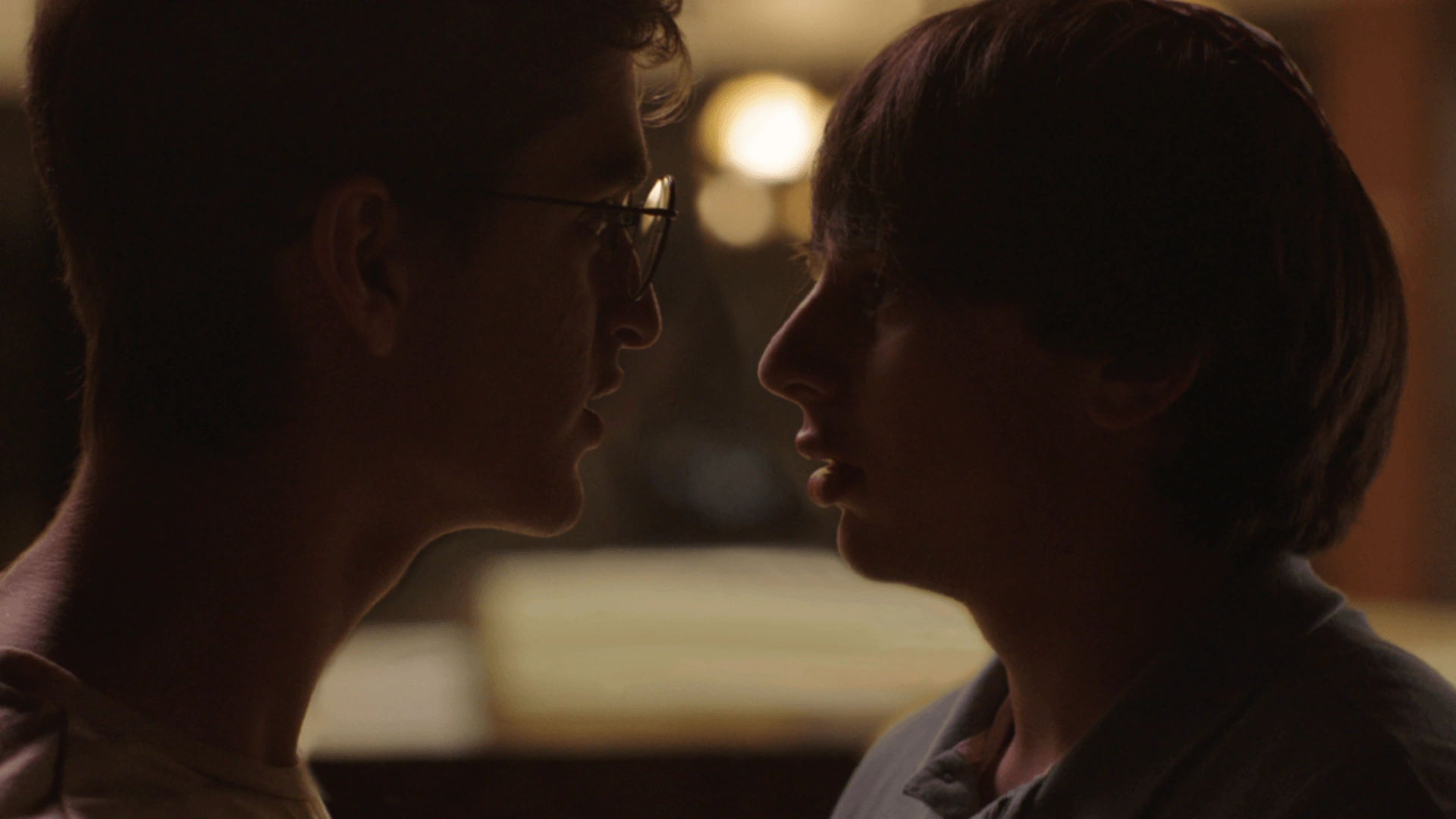
His attraction to Jonah develops through visual details rather than declarations. Borison relies on tight close-ups, lingering eye contact, and brief contact between their hands. A close-up limits what we can see around a character, forcing attention onto a face or gesture. Here, that technique places us inside Noam’s concentration. Jonah’s hand touching his becomes the only event in the room.
That closeness also exposes Noam’s capacity for selfishness. He abandons an old friend once Jonah becomes central to the project. He treats the school’s openly gay student as a source of answers rather than a person. Miriam, his longtime female friend, is pushed toward him by both families and reads their intimacy as romantic. Noam cannot return her feelings, yet he delays giving her the honesty she deserves.
These failures keep the character from becoming a spotless symbol of repression. Noam hurts people while trying to escape being hurt himself. Korman preserves our sympathy without asking us to excuse every decision.
The family conflict is less evenly written. Noam’s mother opposes his search through Opa’s past, and her severity supplies the plot with resistance. The film waits too long to give that resistance emotional detail, leaving her trapped in the role of obstacle through much of the story. Noam’s older sister, preparing for her wedding, offers a gentler counterpoint by listening without demanding that he explain himself perfectly.
The Song He Chooses to Sing
Borison keeps the film’s many subjects within a compact ninety-minute structure. Grief, religious pressure, first love, historical erasure, and family secrecy could easily crowd one another. The warm photography and intimate framing keep those ideas attached to Noam’s immediate experience. History matters because he is using it to survive the present.
The third act complicates the story Noam has built around Opa and M. Without reducing the mystery to a simple reversal, Borison shows how easily a person can confuse identification with understanding. Noam wants Opa’s past to mirror his own because a family connection would make queer history feel safer and closer. The truth asks him to value that history without claiming ownership of it.
Several supporting relationships receive limited repair after Noam’s obsession causes damage. The looseness fits a story about incomplete knowledge, though Miriam and Noam’s discarded friend deserved scenes that addressed what he took from them. The film is perceptive about his loneliness and less attentive to the loneliness he creates.
“Someone to Watch Over Me” carries what the dialogue cannot. Noam sings the Gershwin song after Opa’s funeral, inheriting his grandfather’s voice while keeping the female lyrics unchanged. When he sings it again near the end, the performance has changed. He is no longer using Opa’s life as evidence. He is standing before his community and allowing his own voice to mean exactly what it means.
Unspoken was released for streaming on August 4, 2026, and is available on digital platforms. The coming-of-age drama follows a closeted teenager in a religious community who discovers a vintage love letter written to his grandfather, prompting a journey to uncover hidden truths about his family and himself.
Full Credits
Title: Unspoken
Distributor: Freestyle Digital Media
Release date: August 4, 2026
Running time: 91 minutes
Director: Jeremy Borison
Writers: Jeremy Borison
Producers and Executive Producers: Nicolás Blanco, Jeremy Borison, Nikit Doshi, Zhenia Tananko
Cast: Charlie Korman, Katherine Kamhi, Elizabeth Richman, Catherine Bruhier, Jenna Herz, Michael Zapesotsky
Director of Photography (Cinematographer): Benji Dell
Editors: Kevin Birou
Composer: Michael Paraskevas
The Review
Unspoken
Unspoken gives its coming-out story a distinct emotional and historical frame, using Noam’s investigation into his grandfather’s past to examine how young people search for permission to understand themselves. Jeremy Borison occasionally forces the mystery’s research methods and leaves some supporting relationships underdeveloped, yet his warm direction and Charlie Korman’s finely observed performance keep the film grounded. The return of “Someone to Watch Over Me” joins grief, family memory, and self-expression in a finale that earns its sweetness.
PROS
- Charlie Korman’s vulnerable lead performance
- Thoughtful integration of queer Holocaust history
- Effective mystery and misdirection
- Warm, intimate visual direction
- Powerful use of “Someone to Watch Over Me”
CONS
- Some research scenes feel contrived
- Noam’s mother lacks sufficient nuance
- Supporting relationships need fuller resolution
- Occasional sentimental overstatement







