



















![Kingdom Hearts Collection [I-III] Review](https://gazettely.com/wp-content/uploads/2026/10/Kingdom-Hearts-Collection-I-III-1-360x180.webp "Kingdom Hearts Collection [I-III] Review: KHII Holds Steady as Newer Entries Fluctuate 37")




By the time a severed head becomes tetherball equipment, Ice Cream Man has already spent the shock it thinks it is still earning. Eli Roth keeps adding bodies, tools, fluids, and punchlines, as though quantity can recover the sensation created by the first truly nasty image. It cannot. Call this gore inflation: each new mutilation lowers the value of the next.
The premise is clean enough to survive such excess. Bayleen Bay is photographed like a memory assembled by someone who has only seen American childhood in cereal commercials. The sunlight is syrupy, the lawns are obedient, and a Little League game appears to be the most serious public event in town. Then a blue-and-white truck rolls in, ringing its cheerful jingle while children abandon the field and rush toward flavors with names such as Locust Lick and Serpent Swirl.
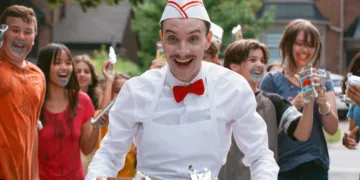
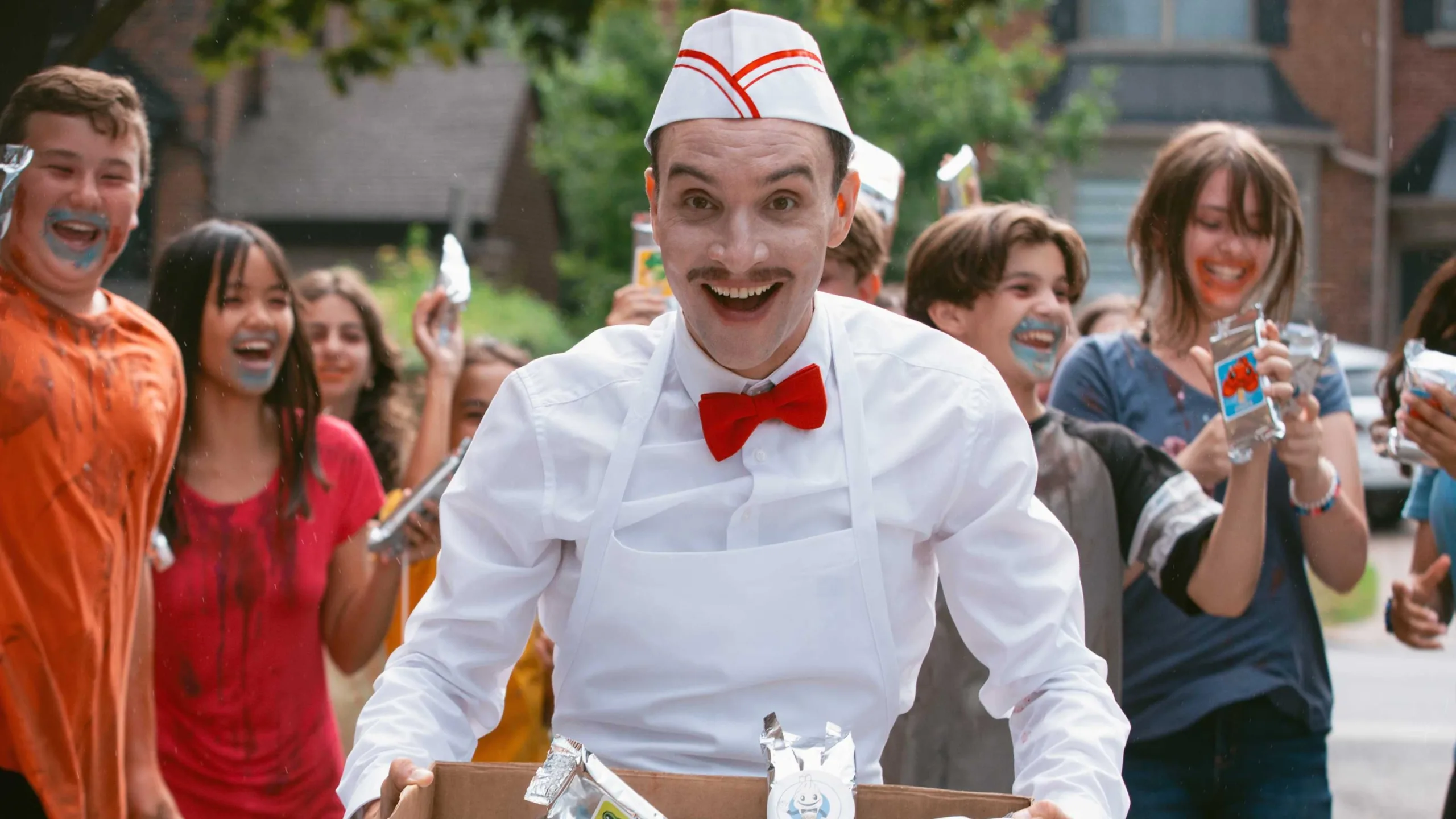
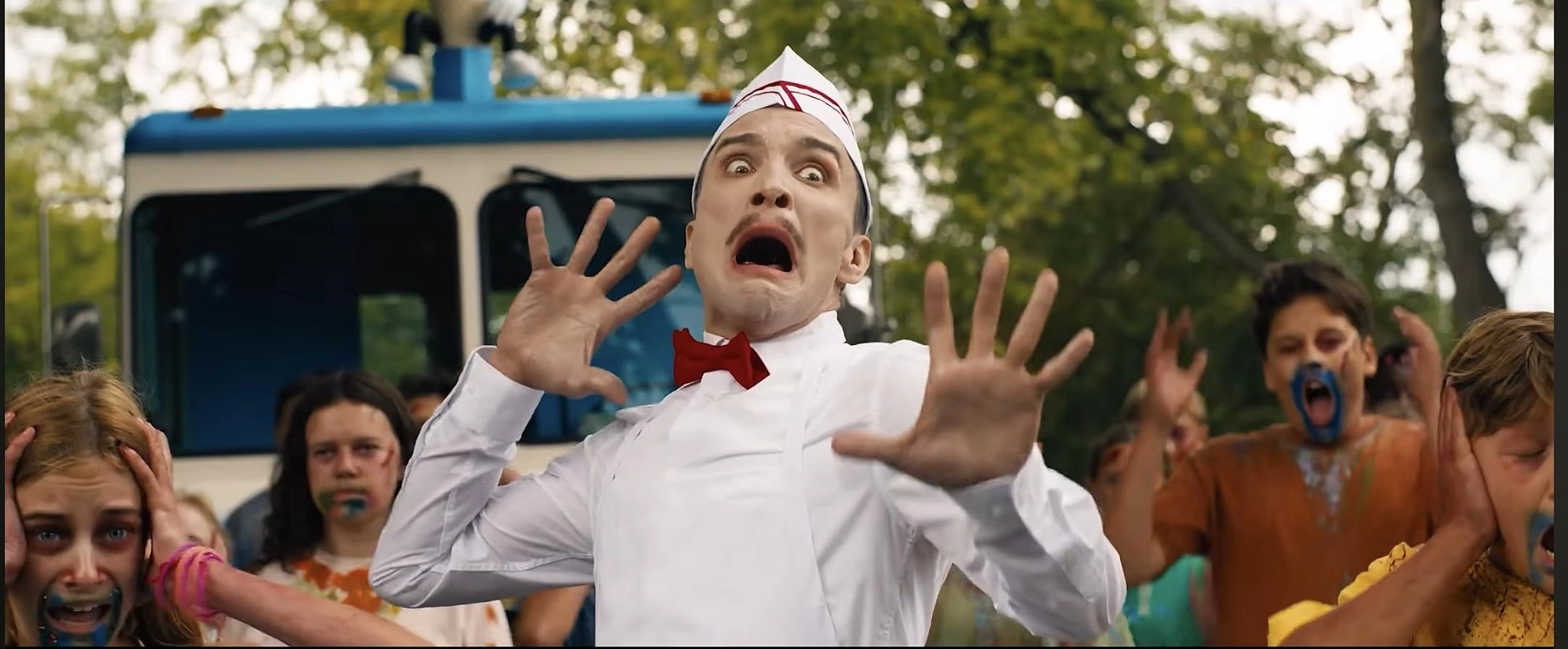
The driver, played by Ari Millen, is a strong piece of visual design. His white uniform is spotless, his hat belongs to a vanished soda fountain, and his narrow mustache gives his smile a slightly contaminated politeness. He does not speak. He serves. The children eat, return home, and turn on their parents with hacksaws, bats, drills, and whatever else suburbia has stored in the garage. Jared survives because he is lactose intolerant. This is funny for about fifteen seconds, which is still longer than several characters survive.
Welcome to Class
Roth’s best sequence begins when the infected children arrive at school with blue syrup, chocolate, and sprinkles smeared around their mouths. Their faces are blank, yet their bodies move with purpose. A teacher responds to this procession with a weak joke about zombie behavior, which captures the film’s strange social order: every adult must be too foolish to recognize danger, since intelligence might interfere with the death schedule.
Once the attack begins, the film acquires a brutal rhythm. A microscope becomes a weapon. A hidden blade turns an ice cream scoop into a surgical device. One victim has the top of his skull removed before his brains are scooped out and fed back to him. Garden shears, an electric sander, a garbage disposal, baseball equipment, bricks, a ladder, and a fire extinguisher are drafted into service. The rock music treats the sequence like a victory lap, and for a while the energy is hard to resist.
The practical effects give many of these deaths a weight the film’s characters lack. Flesh tears, heads deform, and limbs separate with the ugly resistance of physical material. Roth still understands the pleasure of showing the mechanism. A digitally erased body part can disappear too cleanly; a prosthetic head must be struck, crushed, or split. That labor registers.
Then the sequence begins consuming itself. A child jumps rope with intestines. Another game uses a severed head. A mother’s head is carried around like a comfort object. The film keeps insisting that the next image is the forbidden one, yet prohibition needs scarcity. Once everything is allowed, nothing feels especially dangerous.
This is where the children’s presence should create unease. Their size, dependence, and ordinary vulnerability could make each attack feel morally disorienting. Roth mostly uses them as delivery systems for adult-designed gore. They glare, march, and swing tools. Their aggression feels programmed by the plot, which is appropriate to the curse and fatal to the horror. The film wants corrupted innocence. It settles for bloodstained choreography.
The Lactose Loophole
Jared is small, awkward at baseball, and mocked as “Jarhead” by his older sister Lizzie. Sebastian steals his bike. Mia is positioned as the girl he likes. Tommy joins the small group of children who avoided the ice cream. These details resemble the first pages of a children-against-the-world adventure, yet the script treats personality like a queueing system. One child is the hero, one is the crush, one is the bully, one is the sister. They are assigned places before the massacre and rarely move far from them.
Jared’s intolerance saves him through biology rather than decision. He does not refuse the truck because he senses danger, protect someone from eating, or make an early mistake that requires repair. His digestive system chooses the plot for him. That can work as absurdist comedy, but the film later asks him to carry fear, family grief, and inherited responsibility without giving him an arc strong enough to hold them.
Charlie Zeltzer gives Jared a nervous physicality that fits the role. He looks perpetually half a second from fleeing, which helps during the school escape. Sarah Abbott brings sharper force to Lizzie, especially once irritation gives way to protection. Kiori Mirza Waldman’s Mia receives far less to play. She is present during danger, delivers information, and remains emotionally defined by Jared’s attention.
The early family dinner is the rare scene where Roth permits people to exist before deciding how to kill them. Jared and Lizzie tease each other, their parents answer with familiar patience, and the table briefly creates a household worth fearing for. The scene is modest, but it exposes the film’s larger error. Sympathy did not require a detour. It required another two minutes.
Most adults receive no such allowance. Teachers are stooges, parents are targets, and authority figures speak in lines designed to age badly on contact. A Mitt Romney joke lands from another decade. Insults meant to sound current expose the script’s ventriloquism, an older voice straining to reproduce middle-school cruelty. The children are supposed to sound feral. Too often they sound focus-grouped.
A Villain Left in the Truck
Millen’s Ice Cream Man has the outline of a durable horror figure. He arrives with a signature vehicle, a recognizable costume, a sound cue, and a ritual. His silence gives him theatrical control. He can stand beside the truck, hold out a cone, and let the smile complete the threat.
Yet he rarely acts. He distributes the contaminated dessert and watches the children perform the murders. The title character becomes a supervisor of violence, which drains him of authorship. Art the Clown becomes legible through the particular cruelty of each routine. Michael Myers’ presence changes the geometry of a room. This Ice Cream Man mainly waits for the camera to remember him.
That absence grows stranger when the film reaches its later mythology. Jared and the other survivors end up in a walk-in freezer with a priest who explains a history involving wrongful blame, a Catholic abuse scandal, a curse, a necromancer, and Jared’s family. Benjamin Byron Davis delivers the material with grave precision, which makes the instructions briefly funny. Kill the siren.
Remove the necromancer’s head. Keep the ceremonial hood in place. Force the Ice Cream Man to look into the correct eyes. Horror exposition becomes an assembly manual written during a fever. The joke works because the film finally recognizes the ridiculous labor required to explain a simple monster. Then it keeps explaining him.
The synthetic imagery used for the hypnotic cartoon and later flashback material deepens the problem. Its false textures and unstable faces clash with the film’s practical effects. Handmade splatter invites us to admire construction, timing, and physical ingenuity.
The generated images erase those qualities at the precise moment the villain needs history, specificity, and human presence. Roth builds crushed skulls by hand, then gives memory to a machine. The contradiction is almost philosophical. The film trusts matter when destroying a body and distrusts it when creating a past.
The Sundae Collapses
The final act shifts attention from pursuit to procedure. The school massacre moved through clear spaces with immediate threats. The freezer sequence pauses for lore, the necromancer plot introduces new rules, and a heavily signposted reveal waits long past the point of surprise. The film has already shown its largest set piece, so every explanation feels like a smaller room.
Practical questions begin causing trouble. Characters remain functional inside a commercial freezer. People vanish whenever they move outside the frame, then return when a gag needs another body. The Ice Cream Man loses further ground to the machinery surrounding his curse. A film named after him treats him like a ceremonial object that must be positioned correctly before someone else can finish the ritual.
Roth appears aware of the absurdity, but self-awareness is not a pardon. It can sharpen a bad joke. It cannot supply character, suspense, or structure. Thanksgiving understood that ridiculous kills work best when desire, rivalry, and grievance keep pushing people into danger. Here, the violence arrives first and the story fills out paperwork afterward.
The Snoop Dogg end-credit rap returns to the old “I scream, you scream” line, which is exactly the sort of expensive punchline this movie would choose. By then, the children have murdered parents, teachers, and language itself. The truck can keep playing its tune. The town stopped listening long ago.
Ice Cream Man is scheduled for theatrical release in the United States on August 7, 2026, distributed by Iconic Events Releasing. The horror film follows a suburban town that plunges into chaos after children eat treats from an ice cream man that transform them into killers.
Where to Watch Ice Cream Man (2026) Online




Full Credits
Title: Ice Cream Man
Distributor: Iconic Events Releasing
Release date: August 7, 2026
Running time: 86 minutes
Director: Eli Roth
Writers: Eli Roth, Noah Belson
Producers and Executive Producers: Eli Roth, Kate Harrison Karman, Raj Brinder Singh, Christopher Woodrow
Cast: Ari Millen, Charlie Zeltzer, Shiloh O’Reilly, Kiori Mirza Waldman, Sarah Abbott, Benjamin Byron Davis
Director of Photography (Cinematographer): Simon Shohet
Editors: Matt Lyon
Composer: Brandon Roberts
The Review
Ice Cream Man
Ice Cream Man mistakes multiplication for escalation. Call it gore inflation: each severed head lowers the value of the next. The school massacre briefly works through tactile effects, propulsive editing, and the obscene comedy of children turning ordinary tools against adults. Then the film traps itself inside freezer lore, synthetic flashbacks, and a villain who watches his own movie from the sidelines. Eli Roth creates a memorable costume, several vicious kills, and almost nothing capable of surviving once the sugar rush fades.
PROS
- Inventive practical gore
- Strong school massacre sequence
- Ari Millen’s unsettling appearance
- Benjamin Byron Davis’ comic exposition
CONS
- Thin characters and relationships
- Repetitive, numbing violence
- Underused title villain
- Distracting AI-generated imagery
- Cluttered final-act mythology