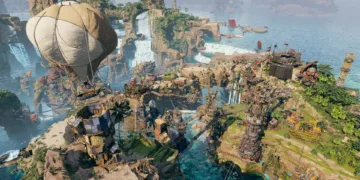































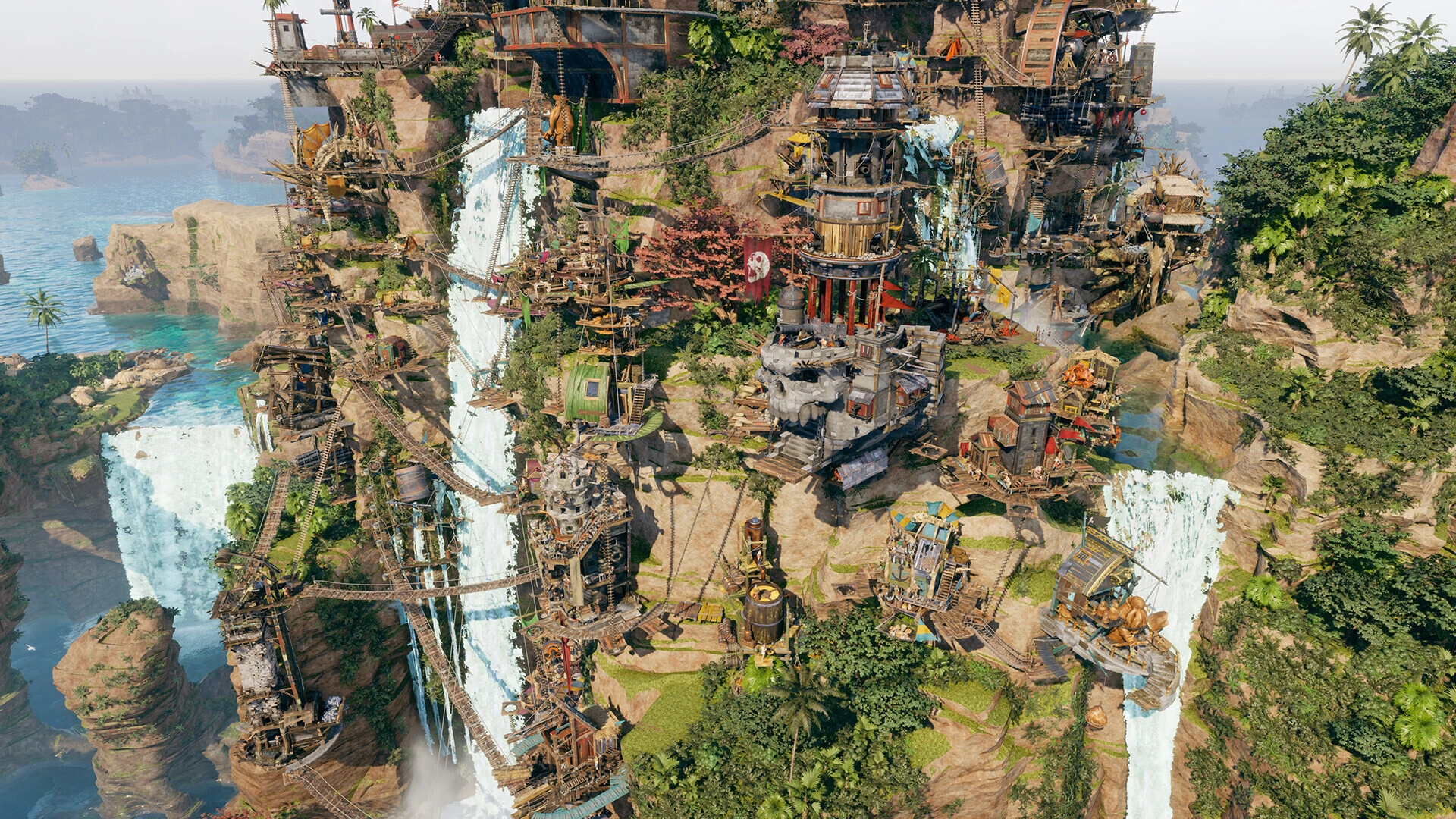
Corsair Cove turns a shortage of flat land into its strongest design idea. Limbic Entertainment’s pirates escape captivity, occupy an island beneath a skull-shaped mountain, and discover that building paradise requires a worrying amount of rope. Workshops cling to cliffs. Taverns sit across chasms from their breweries. Ziplines carry timber downward while elevators drag workers back up.
The studio’s history with Tropico 6 is visible in the bright presentation, mischievous politics, and constant pressure to keep an unruly population satisfied. Its closest ancestor is Tropico 2: Pirate Cove, yet this is no reskinned sequel. The island’s vertical shape changes how every familiar city-building task works.
A tavern lacking ale might be connected to a distant warehouse through several slow paths. The player can build a zipline, add a second supply route, or order the tavern to collect directly from the brewery. Selecting the building reveals its incoming paths through color-coded efficiency indicators, turning a broad economic problem into a readable physical network.
That clarity places Corsair Cove somewhere between the approachable rhythms of Fabledom and the logistics puzzles of Whiskerwood or Factorio. Production chains remain simple, yet the terrain makes their arrangement interesting. The challenge lies in connecting building A to building B without sending every crate on a sightseeing tour around Skull Rock.
Rope and Rum
Every developed colony becomes a record of its own problems. Bridges stretch between plateaus, paths crawl along rock walls, and elevators intersect with ziplines at improbable angles. A functioning settlement can resemble the work of a spider that discovered rum halfway through construction.
The physical expression of logistics gives expansion a satisfaction that road-heavy builders often lose. When a bottleneck disappears, the solution remains visible across the island. Timber drops down a new zipline. Ale follows a shorter bridge. Pirates stop hauling supplies through three residential districts because someone finally connected the tavern to the correct warehouse.
The pathing system occasionally undermines that pleasure. Certain harvesting structures, including guano shacks, can refuse valid connections. Wooden paths overlap or clip through each other, while workers cross awkward joints without acknowledging the geometry. These defects carry unusual weight because route construction serves as both the central tool and the colony’s main visual reward.
The settlement still has personality when its planks misbehave. Pirates dance inside taverns, slide between cliffs, and gather around buildings packed with small comic details. One tavern animation has a pirate spinning a pig across a table, apparently without either participant developing fatigue or judgment. It fits a game interested in piracy as communal chaos rather than muddy historical simulation.
Life Offshore
The sea introduces a second management layer built around a shared workforce. Drifters can staff workshops or crew ships, so every expedition removes labor from the colony. Loading a vessel with the strongest pirates may improve its combat statistics while leaving food, stone, and ale production dangerously thin.
That connection gives the sailing system its sharpest consequence. One poorly balanced expedition can lower camp satisfaction, trigger Outrage, and begin draining Cohesion. A ship may return with treasure while finding the settlement close to dissolution because nobody stayed behind to operate the brewery.
Captains add individual abilities through cards, with the Blackbeard-inspired Teach among the recognizable figures. Missions include treasure hunts, smuggling runs, chases, stealth operations, gambling, whaling, and attacks against Crown forces. Combat cards damage ships or crews, protect the vessel, and recover supplies spent during previous actions. Other encounters use the same framework for pursuit or infiltration.
These missions remain brief, which helps the card-and-dice system avoid overwhelming the city builder around it. Higher-tier voyages reward preparation and crew composition, yet random rolls can still decide that a sensible plan deserves ruin. Some encounters leave so little room for recovery that reloading feels less like cheating and closer to correcting a coin toss.
The event art and animated sequences give the voyages character, particularly during whaling missions. Their mechanical depth cannot match the colony systems, partly because players select from assigned cards rather than building a personal deck. The sea works best as an economic gamble tied to home, not as a separate strategy game.
Four Principles
Progress follows four Principles: Empire, Notoriety, Seafaring, and Wealth. Each contains deeds linked to a style of rule, replacing the usual research tree with a Compass. Efficient routes advance one path. Population targets, sea battles, treasure hunts, and commercial milestones advance others.

This structure improves on research systems powered by an abstract currency. Unlocking larger homes or stronger production buildings reflects actions the colony has performed. New ships and resources arrive through the same logic. The game records the ruler the player has demonstrated through play, rather than the ruler selected from a menu.
Problems begin when every Principle receives equal attention. Each path introduces fresh quests, pirate classes, buildings, and resource demands. Pursuing all four can leave eight or ten objectives open while the settlement struggles to produce boots, food, housing, and ale for several worker types.
Cohesion keeps that ambition under control. It begins at 100, falls during crises and event decisions, and ends the colony when it reaches zero. New drifters may arrive through events that demand a Cohesion payment, creating an awkward early-game cycle where the camp needs workers to stabilize production and stability to accept workers.
Later upgrades reduce that waiting, and most shortages allow several chances for correction. A camp at 20 Cohesion does not need a grand speech about leadership. It needs ale, workers, and one route that is ten seconds shorter.
The Review
Corsair Cove
Corsair Cove borrows the cheerful colonial rhythm associated with Tropico, then finds its own identity in settlements stitched across cliffs by bridges, elevators, and ziplines. Its strongest moments come when an ale shortage can be traced through color-coded routes and fixed through several practical layouts. Sea missions add brisk card-and-dice diversions, though random rolls and limited deck control sometimes flatten their tactical promise. Pathing bugs hurt a game built around physical connections, yet the Compass progression and linked colony-fleet economy keep its pirate experiment moving.
PROS
- Inventive vertical city construction
- Readable supply-route diagnostics
- Flexible solutions to bottlenecks
- Strong colony and fleet interplay
- Characterful pirate presentation
CONS
- Unreliable building connections
- Harsh maritime RNG
- Limited card customization
- Slow early drifter growth