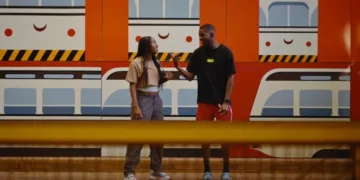



























Reza Dahya’s feature debut, Boxcutter, drops the viewer into the tense, workaday grind of an aspiring artist. Rome, played by Ashton James, is a talented Toronto rapper whose fiercest obstacle comes from his own paralyzing self-doubt and fear of failure. The story locks this internal resistance to an external emergency. His apartment is robbed, and a laptop holding his entire recorded album vanishes. The timing hits hard. A major break sits within reach because producer Ritchie Hill (Rich Kidd) is in town and open to an introduction.
The film compresses its action into a single day, and Rome’s scramble to recover tracks from producers around the city becomes a time-pressured pursuit with clear goals and rising stakes. Jenaya, portrayed by Zoe Lewis, joins him. She is a visual artist and a steady friend whose presence grounds the panic. The frame reads like an urban survival piece centered on creative labor and decision-making rather than a music-industry chronicle.
The Sound of Silence in Narrative Design
Boxcutter’s emotional engine rests on Rome’s insecurity. His reluctance to share his work blocks his path forward, and the film shapes that tension through a striking formal choice. The audience never hears Rome’s music. In a genre that commonly showcases soundtracks, this silence carries the largest weight.
The absence pulls the viewer into Rome’s subjective space and keeps attention fixed on his doubt. When characters praise his songs, the film amplifies his anxiety and invites the same question from the audience. The story locates value in the artist rather than the product, and the missing album becomes a device that measures confidence, trust, and readiness.
The single-day structure functions like a carefully gated level in a classic adventure design. It supplies urgency, locks objectives to locations, and prevents drift. Each step creates a micro-goal that moves Rome closer to a decision about himself.
The pacing stays tight, so the narrative about stalling never stalls. The film also sketches pressure points between creative integrity and the money side of music. Rome refuses to pay for stage time, a choice that reveals his stance on transactional hurdles while underlining the cost of every hour in this compressed timeline.
Toronto as a Setting and Social Mirror
Toronto operates as a living system that shapes each beat. Boxcutter commits to non-tourist spaces and everyday textures, which gives the film a strong sense of place. Dahya treats the city as an active component.

The cinematography supports this approach with a balance of close, intimate coverage and wider city frames that read as polished indie craft. The setting is affectionate and practical at once. It carries the rhythms of work, travel, and conversation rather than postcard surfaces.
The film threads in real pressures tied to the city. Gentrification and displacement appear at the margins of scenes through a sketchy landlord and through Jenaya’s mural contract struggle. These details situate Rome’s task inside a larger environment that changes around him.
The human network sustains him within that shifting map. Rome’s bond with Jenaya provides an essential counterweight to his pessimism. Their dynamic spotlights a platonic friendship that runs on effort, candor, and patience. The relationship emphasizes community as a practical support structure for creative progress, and the film treats that support as labor with real stakes.
Strong Performances Anchor a Subtle Direction
The performances carry the emotional load with precision. Ashton James gives Rome a quiet, lived-in vulnerability that keeps the viewer aligned with his conflict even when frustration flares and strains the help he receives.
He captures the tension between ambition and fear with small choices in posture, gaze, and timing. Zoe Lewis gives Jenaya an easy charisma and a focus that makes her feel central to the film’s motion. The rapport between Lewis and James builds credibility for the friendship and strengthens every scene that hinges on trust.
Dahya’s direction shows clear affection for music culture while maintaining control of tone and pace. He lets moments breathe without flattening the momentum of the day. Light comic beats sit alongside stress without tipping into caricature, and the city remains functional to the story rather than a decorative backdrop. The measured approach keeps attention on Rome’s decisions and on the process by which he confronts, evades, or delays them.
Boxcutter works because the design choices align with the character study. The unheard album concentrates attention on emotion and process. The single-day structure shapes clear objectives and sharpens pacing. Toronto provides a working map for movement, pressure, and support.
Within that framework, Ashton James and Zoe Lewis locate a relationship that feels generous and specific, and Dahya’s steady hand ties the elements to Rome’s internal clock. The result is a grounded, affecting portrait of creative hesitation and the small, necessary steps that carry an artist toward action.
Boxcutter is a Canadian drama film that tells the story of Rome, an aspiring rapper in Toronto who faces a crisis when his laptop, containing his entire album, is stolen. The theft occurs right before a potentially life-changing meeting with a Grammy Award-winning producer. The film follows Rome’s frantic, one-day quest across the gentrifying streets of Toronto to recover his music and overcome his self-doubt. The movie, which premiered at the Atlantic International Film Festival on September 15, 2024, is considered a love letter to the Toronto hip-hop community and has been recognized for its authentic portrayal of the city’s artists and changing landscape. It was distributed by Game Theory Films.
Credits
Title: Boxcutter
Distributor: Game Theory Films
Release date: September 15, 2024 (AIFF Premiere)
Rating: NR (Not Rated)
Running time: 94 minutes (or 1 hour 34 minutes)
Director: Reza Dahya
Writers: Chris Cromie
Producers and Executive Producers: Reza Dahya, Soko Negash, Alison Almeida, Kirthiga Rajanayagam, Rodrigo Bascunan (Executive Producer)
Cast: Ashton James, Zoe Lewis, Viphusan Vani, Clairmont The Second, Rich Kidd, Matthew Worku, Shomari Downer, Chelsea Braam-Carew
Director of Photography (Cinematographer): James Klopko
The Review
Boxcutter
Boxcutter succeeds as a refreshingly grounded character study that smartly uses its one-day constraint to amplify Rome's internal battle against self-doubt. Director Reza Dahya establishes a deeply authentic sense of Toronto community, using the setting as a backdrop for the universal tension between artistic creation and the crippling fear of exposure. Bolstered by compelling performances from Ashton James and Zoe Lewis, this film offers a moving look at the courage required to finally share one's work. It is an honest, well-paced experience that deserves attention.
PROS
- Unique narrative choice of never hearing the protagonist's music.
- Strong, authentic sense of Toronto as a setting.
- Excellent, grounded lead performances by James and Lewis.
- Effective pacing driven by the one-day quest.
- Thoughtful exploration of self-doubt and artistic integrity.
CONS
- Plot can feel circular due to the focus on stalling.
- Some supporting character arcs (like Sid's) are underutilized.
- Subtle social commentary could have been explored with more depth.