






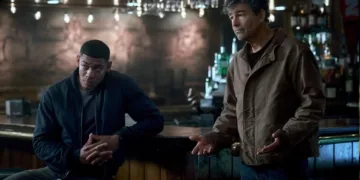



















Italian giallo traditionally transforms Rome, Turin, or Milan into cities of seductive danger, where polished surfaces conceal violence and every staircase seems designed for pursuit. Past Life transports that cinematic language to Manchester and Stockport, replacing Mediterranean glamour with damp pavements, modest studios, and narrow residential streets. The relocation gives Simeon Halligan’s psychological thriller its strongest identity.
Journalist Jason Frey carries a different sort of foreign imprint. Six years after being captured in Syria, where he witnessed the murder of a colleague and suffered a devastating hand injury, he remains caught between domestic stability and the desire to return to conflict reporting. His pregnant wife, Claira, sees the cost of that impulse with far greater clarity. A night at a celebrity hypnotist’s live appearance appears to offer distraction. Instead, it joins Jason’s trauma to another history of violence.
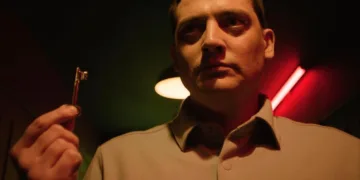
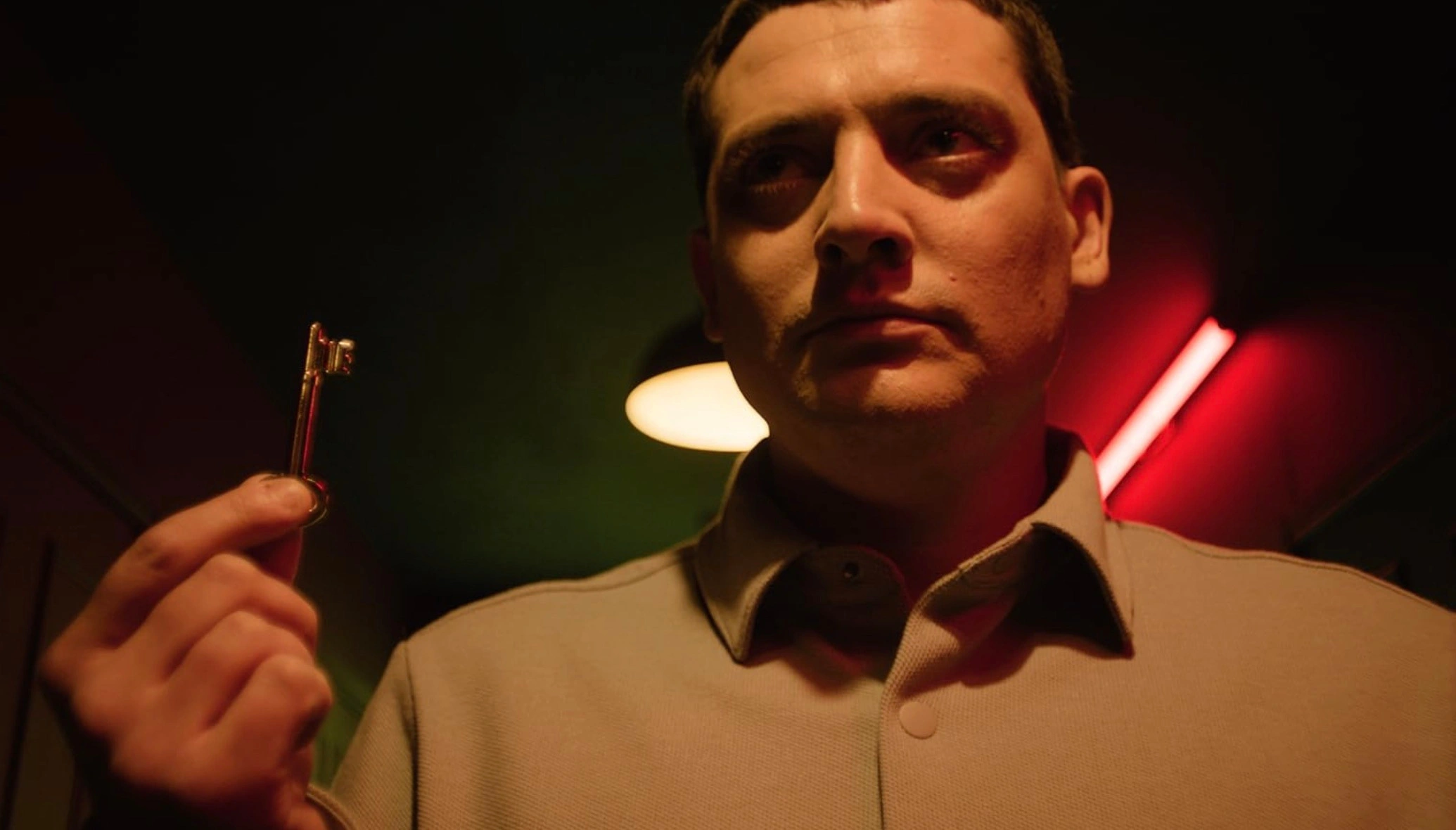
Celebrity hypnotherapist Timothy Bevan invites volunteers to explore previous lives. Jason raises his hand to challenge what he considers nonsense. Under hypnosis, he enters a scarlet corridor lined with doors and witnesses a woman being murdered through the eyes of a black-gloved killer operating during the 1980s. The film’s cultural collision begins there: a British story of war trauma adopts the ritual objects of supernatural horror, then filters Italian genre imagery through the practical tools of modern investigation.
Memories for Sale
Halligan, writing with Ray Bogdanovich and Dean Lines, makes Bevan both guide and entrepreneur. Jeremy Piven plays him with polished certainty, speaking as a man accustomed to selling private mysteries to public audiences. His interest in Jason’s experience carries a useful impurity. He may want to help, yet he also recognises the professional value of a patient who appears to remember serial murders.
The uneasy partnership gives the middle section its investigative rhythm. Jason returns for further sessions, moving through the corridor as each door reveals another victim, location, or fragment of the killer’s identity. Outside hypnosis, internet searches and true-crime podcasts convert these visions into evidence. Retired journalist Elliot Reed supplies names and historical details, while psychology lecturer Peter Howard enters the case as its hidden architecture begins to show.
This mixture of occult ritual and digital research marks the film as a distinctly contemporary British thriller. Earlier gialli often placed truth inside photographs, paintings, newspaper clippings, or half-remembered melodies. Here, Jason and Bevan search databases and online archives, then carry those findings back into a trance. Technology has changed the detective work. The obsession has not.
Jason’s injured hand becomes one of the film’s sharper visual connections. His compression glove resembles the murderer’s leather covering, collapsing the distance between witness and attacker before the screenplay confirms any relationship. That image questions the clean division Jason wants to maintain between the violence he has suffered and the violence he may have committed in another existence.
Manchester Through a Red Filter
Halligan’s best sequences occur inside the regressions. Pendulums, metronomes, changing light, and the red corridor create a clear passage between consciousness and memory. Cuts move Jason from Bevan’s studio into Syria, then into 1980s murder scenes without granting the viewer a stable border between them. A blues musician’s howl announces several psychic disturbances, later returning through a poster in Reed’s home. The repetition plants suspicion without pausing to explain itself.
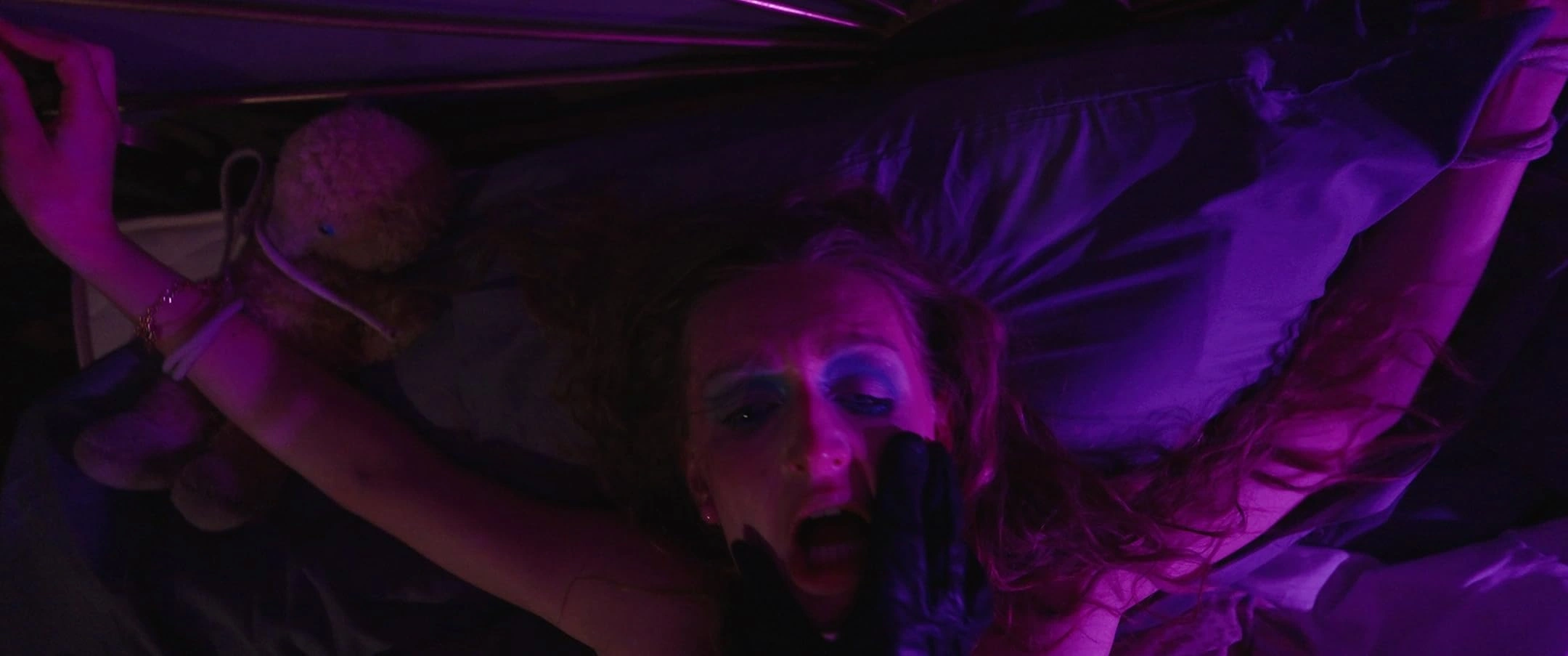
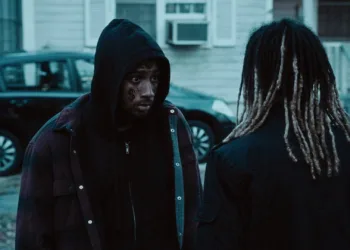
The prowling point-of-view shots and black gloves come directly from Italian giallo, yet Manchester resists full imitation. Its night streets lack the ornate architecture and feverish colour associated with Dario Argento’s work. Halligan uses that limitation productively in places. Mangle Street, wet roads, cramped interiors, and anonymous houses turn the killer’s history into something embedded within ordinary British geography.
The film’s budget keeps its Hitchcock and Brian De Palma ambitions at a distance. Some murder scenes need stronger compositions, and the visual palette cannot always sustain the heightened atmosphere promised by the corridor. The score frequently supplies the menace that the images cannot reach. During Jason’s waking visions, sound begins altering the space before the camera reveals what has entered it, letting the audience hear the rupture first.
Violence Crossing Generations
Aneurin Barnard gives Jason a tight, brooding physical presence. His best moments arrive early, when the thought of returning to Syria exposes the contradiction between his professional identity and domestic responsibilities. Once the regression mystery takes control, his performance narrows into agitation and fixation. Several reckless choices feel driven by the screenplay’s need to move him toward danger rather than by the man established in the opening scenes.
Pixie Lott finds greater emotional variation in Claira. Her frustration during the argument over Syria, her cautious support for a second hypnosis session, and her later fear of Jason’s deterioration trace a believable movement from concern to self-protection. The character is thinly written, yet Lott makes the pregnancy matter as a daily physical fact rather than a convenient stake attached to the climax.
The repeated murders suggest violence moving across countries and decades, passing from Syria to Manchester and from unknown women in the 1980s to Claira’s home. Jason believes that uncovering the killer will correct an old injustice. His investigation instead imports that violence into his marriage, forcing his wife to live beside the obsession he calls responsibility.
The final stretch weakens this idea through hurried connections, montage, and convenient discoveries involving Howard. The screenplay has raised the possibility of reincarnation, false memory, and trauma-driven projection, then gradually closes off the most unsettling options. Its revelations deliver movement, yet certainty proves less disturbing than the scarlet corridor, where every door once seemed capable of opening onto a different truth.
Past Life is a psychological thriller film that premiered at the Grimmfest film festival on October 9, 2025, before receiving wide cinematic and digital releases in early 2026. The film follows a traumatized former war journalist who undergoes a hypnotherapy session, unexpectedly unlocking the memories and crimes of a 1980s serial killer. Viewers can watch the film on various digital platforms including Apple TV and Amazon Prime Video.
Where to Watch Past Life (2026) Online






Full Credits
Title: Past Life
Distributor: Miracle Media
Release date: October 9, 2025
Running time: 96 minutes
Director: Simeon Halligan
Writers: Ray Bogdanovich, Dean Lines, Simeon Halligan
Producers and Executive Producers: Michael Laundon, Kristopher MacNeill, Rachel Richardson-Jones, Pierre Romain, Samu Csernak
Cast: Aneurin Barnard, Pixie Lott, Jeremy Piven, Nicholas Farrell, Tim McInnerny, Lucinda Sinclair, Shannon Whetnall, James Bain, Elizabeth Boag, Natalie Martins, Lisa Kay
Director of Photography (Cinematographer): Ali Asad
Editors: Mark McKenny
Composer: Samu Csernak
The Review
Past Life
Past Life carries Italian giallo iconography into Manchester’s rain-darkened streets, trading Mediterranean theatricality for British grime and psychological unease. Simeon Halligan’s regression sequences, black-gloved imagery, and prowling camera create a persuasive dialogue between two horror traditions. The mystery loses force once coincidence replaces uncertainty, and Jason’s narrow characterisation leaves Pixie Lott and Jeremy Piven carrying much of the dramatic weight. Still, its regional identity and pulpy confidence give familiar materials a distinct local accent.
PROS
- Atmospheric Manchester locations
- Effective hypnosis transitions
- Strong giallo imagery
- Pixie Lott’s grounded performance
- Well-placed misdirection
CONS
- Contrived final revelations
- Limited psychological ambiguity
- Thin central characterisation
- Uneven supporting roles
- Familiar genre mechanics