





























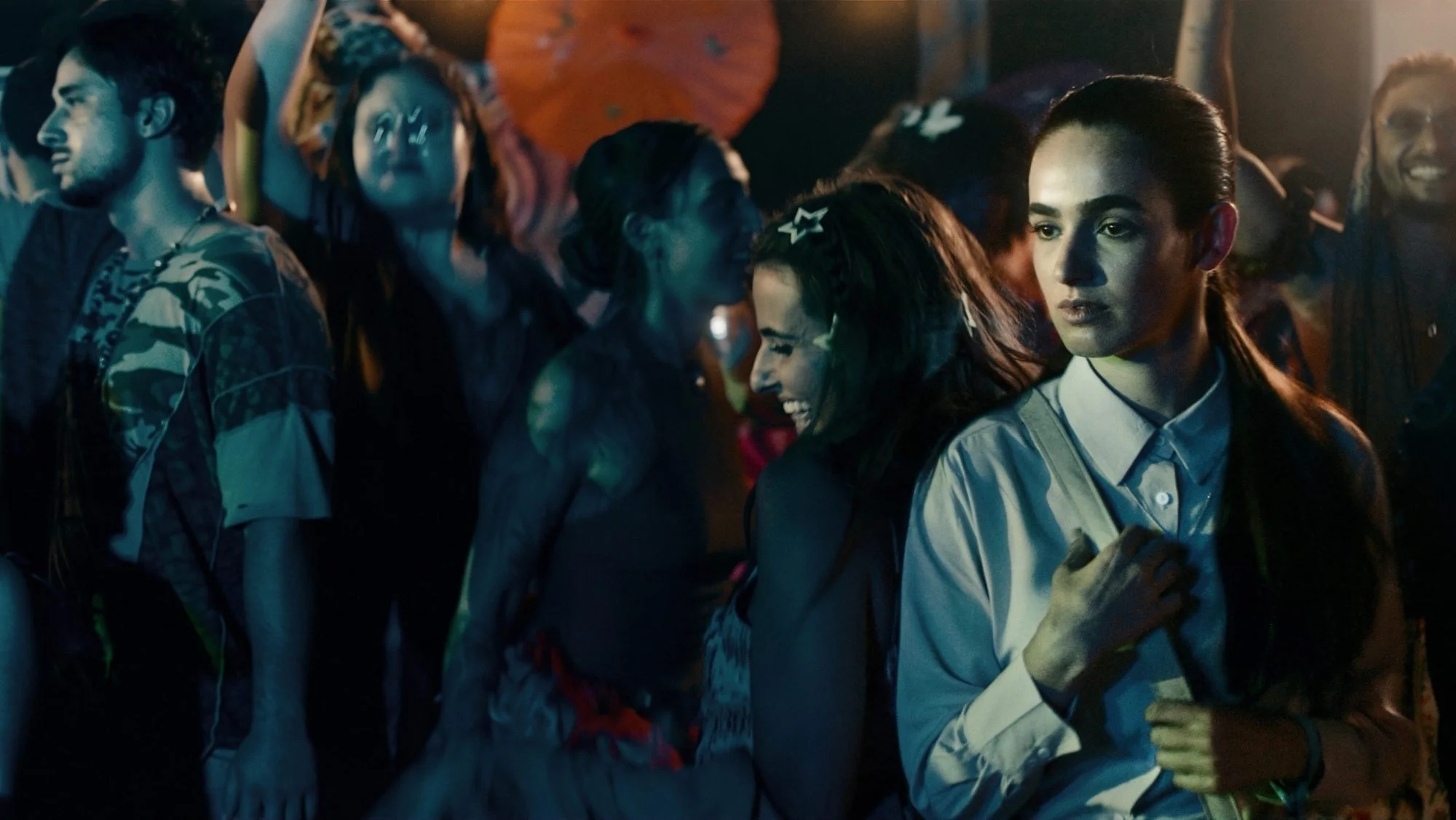

Shabi wants his son to testify against his mother, and his daughter Liri wants little to do with him. When the October 7 attack begins, his determination to reach Liri gives the former policeman a purpose that the custody dispute could never have supplied. Avi Nesher’s Our Loves allows a difficult father to act courageously without first making him agreeable. It also asks how much a rescue can repair. Those are different questions, even when a frightened daughter is waiting for him.
Sapir faces a danger that no amount of resolve can make legible in advance. Recently rejected by her fiancé and uneasy at the Nova music festival, the religious young woman wakes after taking drugs and marvels at the sunrise. A Code Red alert follows.
The sequence turns her own reading of the morning against her: what she receives as a gift becomes the last moment before flight. Daniel Gimpel gives Sapir a particularly affecting place in the ensemble because her beliefs, her unfamiliar surroundings, and her immediate need to survive remain in tension. The alarm does not resolve any of them.
Nesher has assembled several lives around the days before the attack. Milly (Magi Azarzar) is preparing to introduce her partner Sandra (Hadas Yaron) to her traditional mother, while Liri (Noa Cohen) is trying to put distance between herself and Shabi (Shalom Michaelshvili). Their crossings at a concert establish the film’s network before the violence reaches it.
This design gives the audience an uncomfortable advantage. We know the date’s significance while the characters are occupied with a family meal, a breakup, or an argument they expect to resume tomorrow. Nesher can make those concerns painfully immediate, though the tidy intersections also reveal how firmly he has arranged his cast for the coming ordeal.
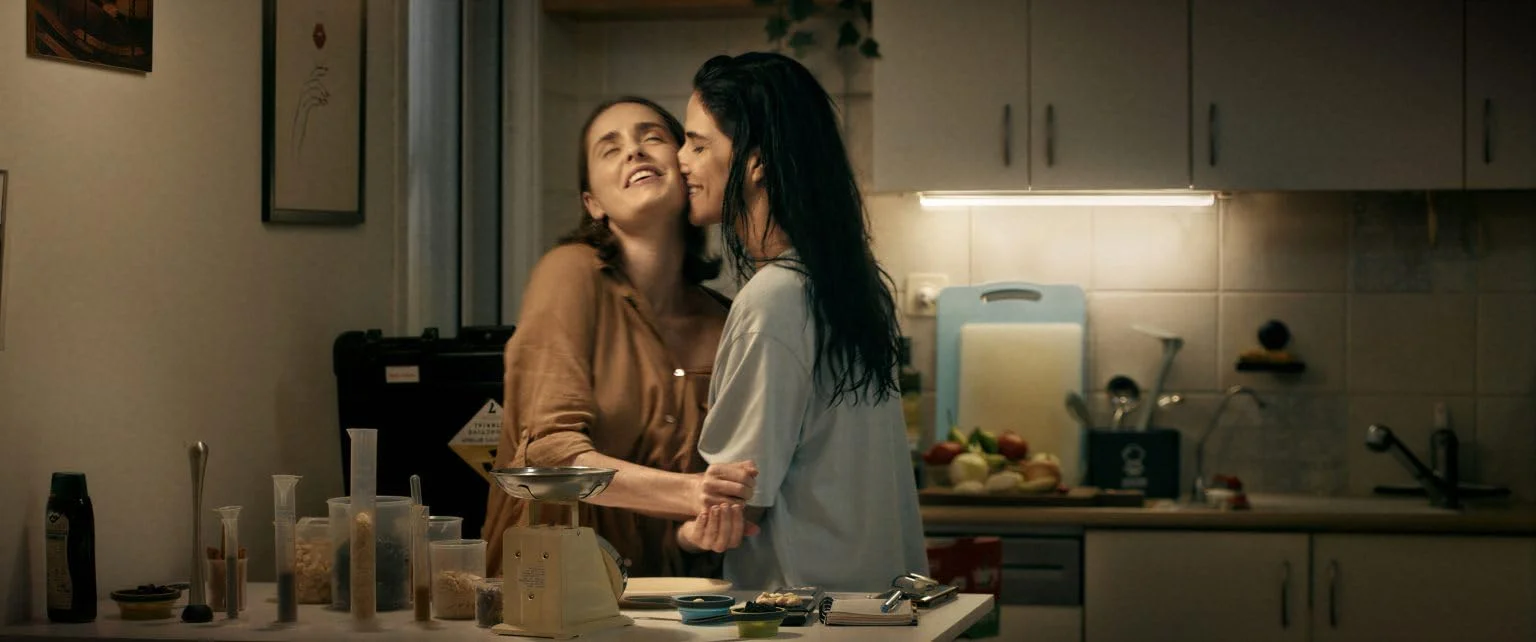
Milly’s story shows what the film can gain by staying with an ordinary decision. Sandra wants a future with her and takes care over the meal for Milly’s mother. Milly, so practiced at projecting authority in her work, cannot bring the same openness home.
The attack changes the scale of her fears without making the earlier fear imaginary. Here Nesher’s interest in love has substance: Sandra has been asking for recognition before either woman knows how little time a decision might be given. Their relationship matters because it already had a shape, rather than because danger has made them suddenly exemplary.
The survival sequences demand a different kind of attention. People flee gunfire at the festival and in border communities; armed attackers on motorbikes and explosions give the violence the visible force of a thriller. Such images establish the reach of the threat, but spectacle changes the viewer’s position.
With Sapir at sunrise, we inhabit the gap between her perception and what is about to happen. Once the film follows the armed pursuit, danger becomes easier to track as action: an attacker, a route of escape, a chance to fight back. The shift supplies urgency while narrowing the uncertainty that made her morning so disturbing.
Shabi’s rescue effort sits at the point where those modes meet. His willingness to enter danger for Liri is an action she can witness, and it deserves its emotional weight. Their reconciliation in an ambulance is harder to accept as settlement for what preceded it.
A father can save his daughter and still owe her an account of how he treated the family. Nesher seems drawn to the hope that extreme circumstances strip people down to their truest selves. Shabi’s case suggests a less comforting possibility: pressure can reveal courage without erasing a pattern of conduct. The film has room for that contradiction, then hurries past it.
Sapir’s escape with Yoyo, a religious scholar turned drug dealer, offers a livelier version of the same impulse. Their unlikely alliance unsettles the categories through which she has understood acceptable company and a suitable future. There is room for humor in that mismatch, and Gimpel keeps Sapir from becoming merely a device for an uplifting surprise. Yet the prospect of a new romantic connection also shows Nesher’s tendency to find an answer to a personal wound inside the disaster. He gives his characters possibilities at the moment when uncertainty might tell us the most about them.
The film’s perspective is similarly deliberate. A line blaming Israeli leaders for believing Hamas was deterred permits criticism of the government, while the stories remain centered on Israelis caught in the attack. A sympathetic Arab-speaking doctor appears only briefly.
Nesher is entitled to choose whose experiences this film follows; intimacy requires a point of view. Still, the choices of what to show and whom to carry forward shape the meaning of its appeals to unity. The government criticism points toward a larger failure, but the film’s strongest energies go to immediate survival and private repair.
Our Loves is most persuasive when Nesher lets those private lives resist the catastrophe’s dramatic demands: Milly’s planned introduction, Sapir’s mistaken confidence at sunrise, even the discomfort that should survive Shabi’s bravery. Its move from danger to reunion can make violence seem capable of clarifying relationships that were difficult for good reasons. The ambulance gives Shabi a chance to save Liri; it gives Liri little time to decide what that rescue changes.
Our Loves world-premiered at the Toronto International Film Festival on September 13, 2026, ahead of its theatrical release in Israel. The drama follows five individuals navigating personal turmoil and relationships in the critical period leading up to the October 7 attacks.
Full Credits
Title: Our Loves
Distributor: Fox Entertainment
Release date: September 13, 2026 (Toronto International Film Festival) / October 15, 2026 (Israel)
Running time: 1 hour 54 minutes (114 minutes)
Director: Avi Nesher
Writers: Avi Nesher
Producers and Executive Producers: Danny Cohen, Leon Edery, Moshe Edery, Guilhad Emilio Schenker, Gideon Tadmor, Shari Redstone, Len Blavatnik
Cast: Hadas Yaron, Magi Azarzar, Evelin Hagoel, Lena Fraifeld, Amir Banai, Yaniv Biton, Noa Cohen, Shalom Michaelshvili
Director of Photography (Cinematographer): Amit Yasur
Editors: Isaac Sehayek
Composer: Neomi Aharoni Gal, Tom Oren
The Review
Our Loves
Our Loves finds its strongest moments in the lives its characters led before October 7: Milly’s guarded family life, Sapir’s faith, and the distance between Shabi and Liri. Daniel Gimpel gives Sapir particular warmth and credibility. Yet Avi Nesher repeatedly steers danger toward reconciliation, asking hopeful outcomes to carry the weight of a catastrophe that remains unresolved. The film’s empathy is real, though its narrow perspective and reassuring turns limit its reach.
PROS
- Daniel Gimpel’s affecting performance
- Specific, engaging domestic tensions
- Quiet moments that preserve the characters’ individuality
CONS
- Reconciliations arrive too neatly
- Ensemble connections feel carefully arranged
- The wider perspective remains limited







