
























A conversation in Lacey Schwartz Delgado’s Re/Pair can begin with one pair of speakers, move to another, and finish with a third. The people have not gathered around the same table, but the editing lets their thoughts meet. With 38 participants arranged in 19 paired conversations over 101 minutes, this is the documentary’s most consequential choice. It gives a large, difficult subject the momentum of an exchange that keeps finding new voices.
The joins between those voices matter. Some participants are longtime friends, some have worked together, and others are meeting for the first time. Those are different conditions for an honest conversation: an old friend may know which question to ask, while a new acquaintance may need time to establish trust. I sometimes wanted the film to make those relationships clearer. Its editing is good at connecting ideas across rooms, though knowing what each pair brings into its own room would make the connections richer.
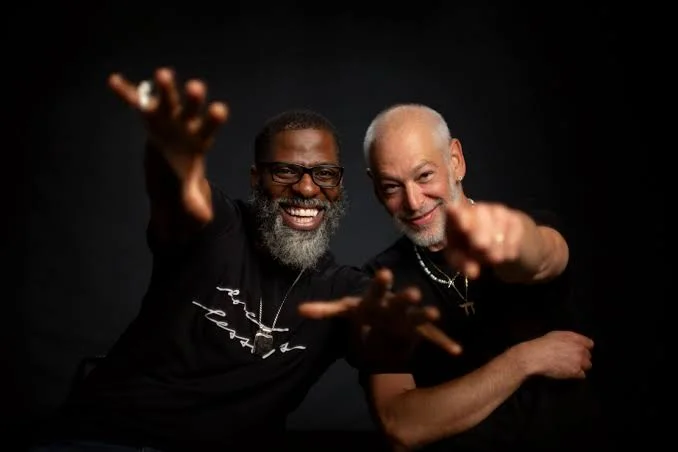
Schwartz Delgado frames the project with Martin Luther King Jr.’s words about fear growing when people do not know or communicate with one another. She then makes communication the film’s method. The interview spaces are simple, with chairs against a dark background, and cinematographer Adam Uhl lights the speakers with care. There is little in the frame to compete with them.
When the film cuts away from one pair to continue a subject elsewhere, we can follow the idea; when it stays with two people who know each other, we can consider the relationship behind their words. That shift in scale is what keeps the format from feeling like a procession of interviews.
Patrisse Cullors and Rabbi Susan Goldberg offer one of the clearest reasons to stay with a pair. Goldberg was once Cullors’s camp counsellor, so their respectful debate rests on a connection formed long before these cameras arrived.
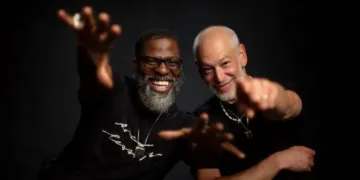
Harry Lennix and David Schwimmer, friends since their time at Northwestern, address the temptation to compare the suffering of Black and Jewish communities as if one history could cancel out the other. The familiarity in these pairings gives their discussions a dimension that a statement delivered straight to the lens would lack: each person has someone specific to answer.
The film grows especially interesting when its two-part arrangement cannot neatly describe a participant’s life. Ashley Jackson’s conversion to Judaism sits alongside discussion of her father Jesse Jackson’s “Hymietown” remarks. Her experience brings a painful piece of public history into a family relationship.
Other participants identify as both Black and Jewish, and their accounts challenge any easy picture of two separate communities looking at each other from opposite sides. Schwartz Delgado’s own Black and Jewish background gives her a personal stake in making room for that complexity, but the people speaking supply the film’s strongest evidence for it.
Not every conversation asks the same kind of question. Matisyahu and Che “Rhymefest” Smith discuss musical appropriation and authenticity, a subject shaped by what artists borrow, make, and claim. Elsewhere, the disagreements reach toward Israel and Gaza, where attentive listening cannot by itself settle a political dispute. The movement between such subjects gives Re/Pair range. It also exposes the cost of moving quickly: a difficult point may need another question, and the next pair is already waiting.
That cost becomes harder to overlook as the interviews accumulate. Some of the 19 pairings receive little time, and a few are represented largely through one speaker. A film built around dialogue loses something when we barely hear the reply.
The historical footage provides background, but only in brief strokes; a viewer unfamiliar with the events behind a reference to Jesse Jackson’s remarks, for instance, may understand its personal weight here without grasping the full history. The film is better equipped to show how people speak across an existing divide than to explain every event that made the divide.
I admire the clarity with which Schwartz Delgado turns separate interviews into an ongoing discussion. The exchanges about Israel and Gaza left me wishing she would sometimes resist the cut and give the same pair enough time for a second difficult question.
Re/Pair world-premiered at the Toronto International Film Festival in September 2026. The documentary feature explores the complex history, shared values, and modern tensions shaping the relationship between Black and Jewish American communities.
Full Credits
Title: Re/Pair
Distributor: Independent / Festival Release
Release date: September 2026 (Toronto International Film Festival)
Director: Lacey Schwartz Delgado
Writers: Not publicly specified
Cast: David Schwimmer, Harry Lennix, Che ‘Rhymefest’ Smith, Jordan Carlos, Ashley Jackson, Mathieu Bitton
The Review
Re/Pair
Re/Pair turns 19 separate conversations into a discussion that feels shared. Lacey Schwartz Delgado’s editing gives the film energy, while friendships and Black Jewish participants bring depth to questions that could have stayed abstract. I wanted more time with some pairs, especially when a difficult claim called for a follow-up, and the brief historical context may leave newcomers behind. The film shows the value of listening; its strongest exchanges make me wish it listened a little longer.
PROS
- Editing connects separate conversations
- Longstanding relationships give exchanges depth
- Black Jewish voices complicate easy divisions
CONS
- Some pairs receive too little time
- Difficult claims sometimes need follow-up questions
- Historical context is brief