































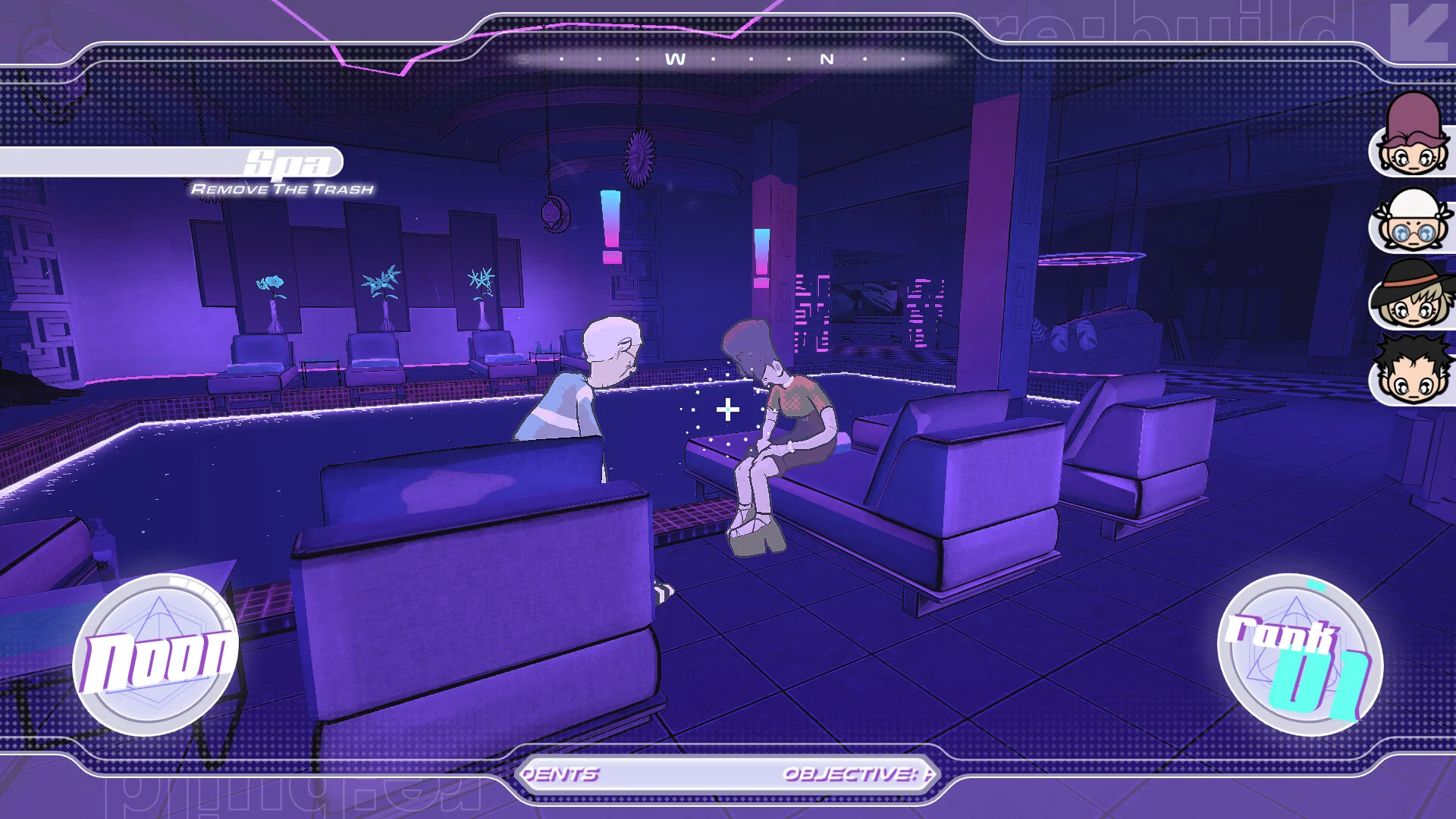
The bar can be empty in the morning and busy at night. Visiting it at the wrong time costs part of a day, since moving between areas advances the clock. Your nameless character is treated as the resort’s remaining employee, sent to find a chair, deliver medication, or carry a note. That small scheduling problem explains much of the pleasure in Roman Sands RE:Build: you learn where people will be, work out which errands fit together, and return the next morning with a better route.
Night sends you back to the beach, where completed work earns experience before the day resets. Upgrades such as faster movement and additional time segments give you room to improve your plan. The guests repeat themselves, but you retain what you learned. Early on, that difference makes each loop productive.
The setting gives your efficiency a peculiar purpose. The sun threatens to consume the world, yet the guests remain occupied with their comforts. You can see the absurdity of fetching a favorite chair under those conditions, then catch yourself choosing the fastest route to fetch it. Roman Sands gets its joke and its unease from the same system. The rewards encourage you to become very good at a job whose priorities make no sense.
Its time loop has a limit, though: once you know where the chair is, retrieving it again proves little. Giving Betty her pills or delivering Bulk’s note can require another familiar trip and another exchange of familiar dialogue. Some repetitions build knowledge of a guest’s routine or open access to a new part of the resort. Others consume time before anything changes. Dialogue skipping helps with the latter, but it cannot make a solved route interesting to plan again.
That friction matters because the resort holds a better reason to pay attention. Tentacles appear where they should not; unusual paintings and drawings suggest ways past the ordinary workday. A routine that initially teaches you to track guests also teaches you to notice what falls outside their schedules. Searching an overlooked object can become more enticing than collecting another round of experience. The game is strongest when that change in priorities comes from your own growing familiarity with the place.
A second setting changes the demands on that attention. In a decaying research facility, you encounter a dead cow, a voice over the radio, and a parasite threatening the station’s systems. The question of what removing it might cost gives maintenance a different weight from the resort’s errands.
Here, progress depends less on fitting jobs into a day and more on inspecting spaces and connecting clues from objects and conversations. The game leaves the relationship between the facility and resort for you to investigate, and spelling it out would rob those discoveries of much of their force.
The shift can also leave you unsure of what the game expects you to do. At their best, its puzzles let a detail you noticed earlier become useful without announcing its purpose. At weaker moments, another cryptic hint makes it hard to tell if you have missed a clue or simply need to keep looking. Roman Sands asks for trust from the player, and that trust is easier to give when observation produces a clear next step.
Presentation helps distinguish the kinds of attention each place asks for. The resort’s bright colors, busy interface, and music that veers between relaxed and frenetic make service feel increasingly overstimulating. The facility draws you into quieter, emptier spaces, where industrial sounds and the radio voice make stopping to listen part of exploration.
Rough textures and visual glitches suit a game in which even a familiar room may be worth inspecting again. These changes give the second setting a different rhythm to play through, rather than simply a darker appearance.
Roman Sands RE:Build makes a convincing case for learning through repetition whenever a new route, clue, or question emerges from a return visit. When it asks you to fetch something you already know how to find, you can see what that time might have bought among the resort’s paintings and drawings.
The Review
Roman Sands RE:Build
Roman Sands RE:Build turns a resort work schedule into an absorbing puzzle, then makes its apocalyptic absurdity playable: you learn to serve guests efficiently even as their demands grow harder to justify. Its research facility rewards a different kind of attention, though cryptic clues sometimes make progress difficult to read. Repeating solved errands wears down the resort’s strongest idea before the mystery is finished with it.
PROS
- Guest schedules make route planning satisfying
- Service tasks give the apocalypse a playable absurdity
- - The research facility changes how you investigate
CONS
- Solved errands must be repeated
- Familiar dialogue wears thin
- - Some clues leave the next step unclear