















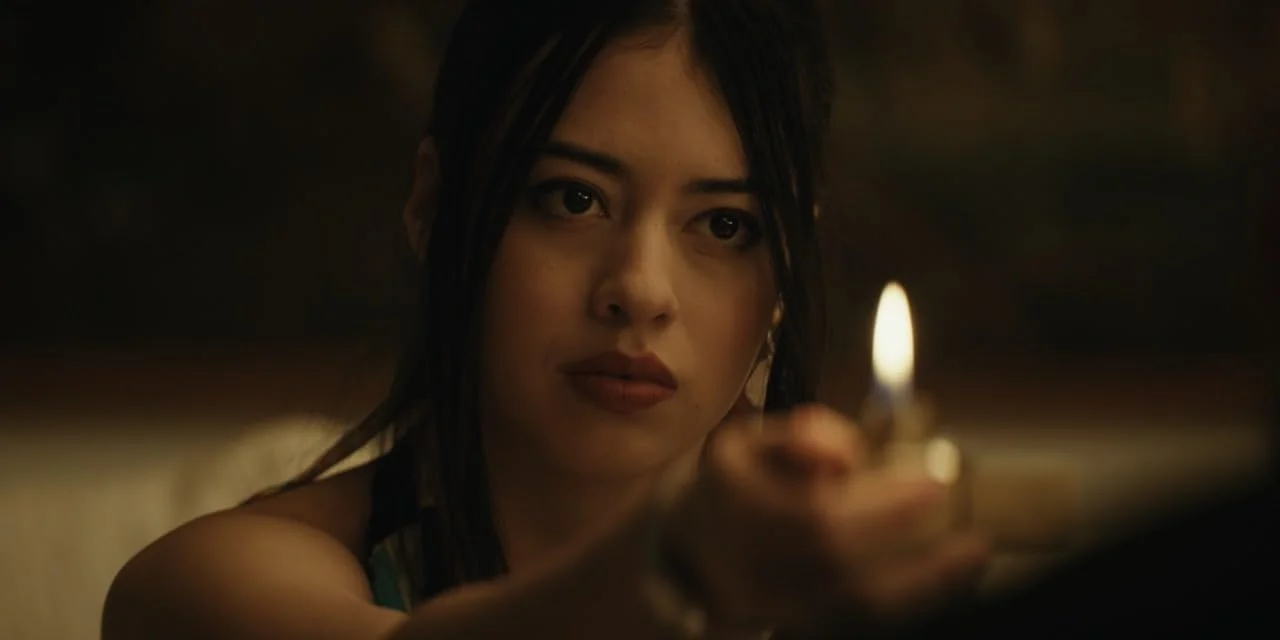

Jessie has become a doctor. She helps people at a free clinic, has a profession, and appears to have found the stability denied to her sisters. A system could point to her as proof that its intervention worked. The trouble with that account is the price hidden inside the word worked: adopted by white parents, Jessie grew up apart from her family and her Indigenous heritage. Amber Midthunder gives her determination without making it look like an uncomplicated victory.
Her sisters expose other ways that survival gets mistaken for consent. Miranda wants to act, but a director suggests she could “pass” as white if she shed her Indigenous identity. The same industry hesitates to cast an Indigenous woman in an Indigenous role in a Western. Alyssa Wapanatâhk plays Miranda’s ambition as something real enough to make the proposition dangerous. She has reason to want the work. The absurdity belongs to an audition process that asks her to disappear in order to be seen.
Marie Clements traces this logic back to a promise made before the sisters had any say in their future. In the 1950s, their mother, Angela, moves them from Oklahoma to Los Angeles after government advertisements offer Indigenous families work and housing. They arrive at an unfurnished home, where a notice Angela cannot read tells her she has been given food stamps instead of employment. The advertisement offered a choice; the notice reveals how little choice survived the journey. After Angela’s death, the girls are separated in foster care.
It is tempting to read the adult sisters as a diagram of what followed: Jessie for assimilation, Miranda for conditional acceptance, Janey for abandonment. I initially thought the film had arranged them too neatly. Janey, who passed through many foster homes, is picked up by police during a psychiatric crisis. She mourns a child, though the account of that child remains uncertain. Set beside Jessie’s clinic and Miranda’s audition, her story can look like one more case placed before us for judgment.
Isabel DeRoy-Olson makes that reading harder to sustain. Janey’s distress is immediate, while its cause remains difficult to pin down. The distance between what she feels and what anyone around her can establish matters. She cannot present a tidy explanation of herself at the point when others have the power to decide what to do with her. Jessie, too, becomes less legible as a success story once her determination is held beside what adoption took away. The performances give the sisters lives that resist the film’s neatest arrangement of its ideas.
Clements’s writing does not always grant them the same room. Miranda’s director is an effective figure of institutional absurdity: he doubts the value of casting an Indigenous actress to play an Indigenous character while offering whiteness as her route to employment. His suggestion is so blunt that it leaves little for the scene to uncover. Elsewhere, the film’s attention to policies that harmed Indigenous women can make a sister’s experience feel momentarily assigned to a historical point. Those points deserve to be made. The dramatic question is how long the characters get to live inside their consequences before the film explains them.
The three separate paths are the film’s strongest answer. Jessie’s medical work, Miranda’s audition, and Janey’s encounter with the police do not yield the same kind of life or the same kind of wound. Separation has left the sisters without one another’s knowledge of what happened after their mother died. Bringing them back toward the last place they shared cannot give them those years back. Clements understands the pull of reunion, but the actors keep its promise from becoming too easy.
Near the end, a storm floods the city and reaches a shrine to the oppression of Indigenous peoples. The film’s magical realism finds its fullest expression there. The image gives accumulated harm a physical presence, though its force arrives late enough to feel partly detached from the more closely observed lives that precede it. A flood can make history impossible to ignore; it can also suggest a cleansing the film has no reason to trust. After the water reaches the shrine, Jessie still has her upbringing, Miranda still has that audition, and Janey’s grief remains hers.
How We Stand world-premiered at the Toronto International Film Festival on September 13, 2026. Blending elements of magical realism, the drama follows three Indigenous sisters in 1970s Los Angeles who reunite following a childhood tragedy tied to a government relocation program.
Full Credits
Title: How We Stand
Distributor: Photon Films, Myriad Pictures
Release date: September 13, 2026 (Toronto International Film Festival)
Running time: 1 hour 47 minutes (107 minutes)
Director: Marie Clements
Writers: Marie Clements
Producers and Executive Producers: Marie Clements, Trish Dolman, Christine Haebler, Steven Thibault
Cast: Amber Midthunder, Cara Jade Myers, Alyssa Wapanatâhk, Isabel DeRoy-Olson, Eric Johnson, Gary Farmer, Gil Bellows
The Review
How We Stand
How We Stand is most persuasive when its sisters complicate the tidy accounts institutions might give of their lives. Amber Midthunder, Alyssa Wapanatâhk, and Isabel DeRoy-Olson make survival feel distinct for each woman. Clements sometimes states her argument too plainly, and the storm’s symbolism arrives late. The people remain harder to reduce than the film’s occasional explanations of them.
PROS
- Three strong lead performances
- Distinct paths for the separated sisters
- - A sharp depiction of the relocation promise’s failure
CONS
- Some dialogue spells out its point
- - Magical realism gains force too late