





























Mark Sowerby once treated relentlessness as an identity; the ocean forces him to test what remains after that identity collapses. Jeff Tseng’s Don’t Be Prey follows the Australian businessman through the Oceans Seven, a sequence of channel crossings spanning the English Channel, the North Channel, Catalina, Molokaʻi, Cook Strait, Tsugaru Strait and Gibraltar. The distances are punishing. The more revealing measurement concerns the space between Sowerby’s public confidence and his private collapse.
His business success with Blue Sky Alternative Investments turned him into the kind of executive who could describe himself as a “relentless animal” without hearing the warning contained in the phrase. Sowerby admits that he was “turning into a bit of a dick,” which is unusually candid language for a film that later treats him with considerable caution. When his reputation disintegrated, confidence followed. Depression and suicidal thoughts replaced the certainty he had built around work.
Call this the achievement trap: the point where accomplishment stops confirming identity and starts devouring it. Sowerby responds by choosing an arena indifferent to his résumé. The sea does not care how many people once followed him into a boardroom. It barely cares that he can swim.
Putting Yourself in the Food Bowl
The Oceans Seven challenge resembles mountaineering’s Seven Summits, except water refuses the reassuring fiction of stable ground. Each crossing introduces a separate vocabulary of danger. The North Channel and Japan’s Tsugaru Strait expose Sowerby to progressive hypothermia, described by one doctor as everything slowly becoming worse. The clinical phrasing is almost funny. Your organs are failing, your judgment is dissolving, and medicine offers the verbal equivalent of a disappointed shrug.
Molokaʻi supplies the film’s most marketable threats. Tiger sharks inhabit the channel, while cookiecutter sharks rise from below and remove circular plugs of flesh. Lion’s Mane jellyfish, pulmonary oedema and violent currents carry less promotional glamour, yet the film’s testimony makes them feel equally hostile. During night swims, Sowerby and the support crew use red lights that marine predators struggle to detect. Waves can still hide him from the nearby boat.
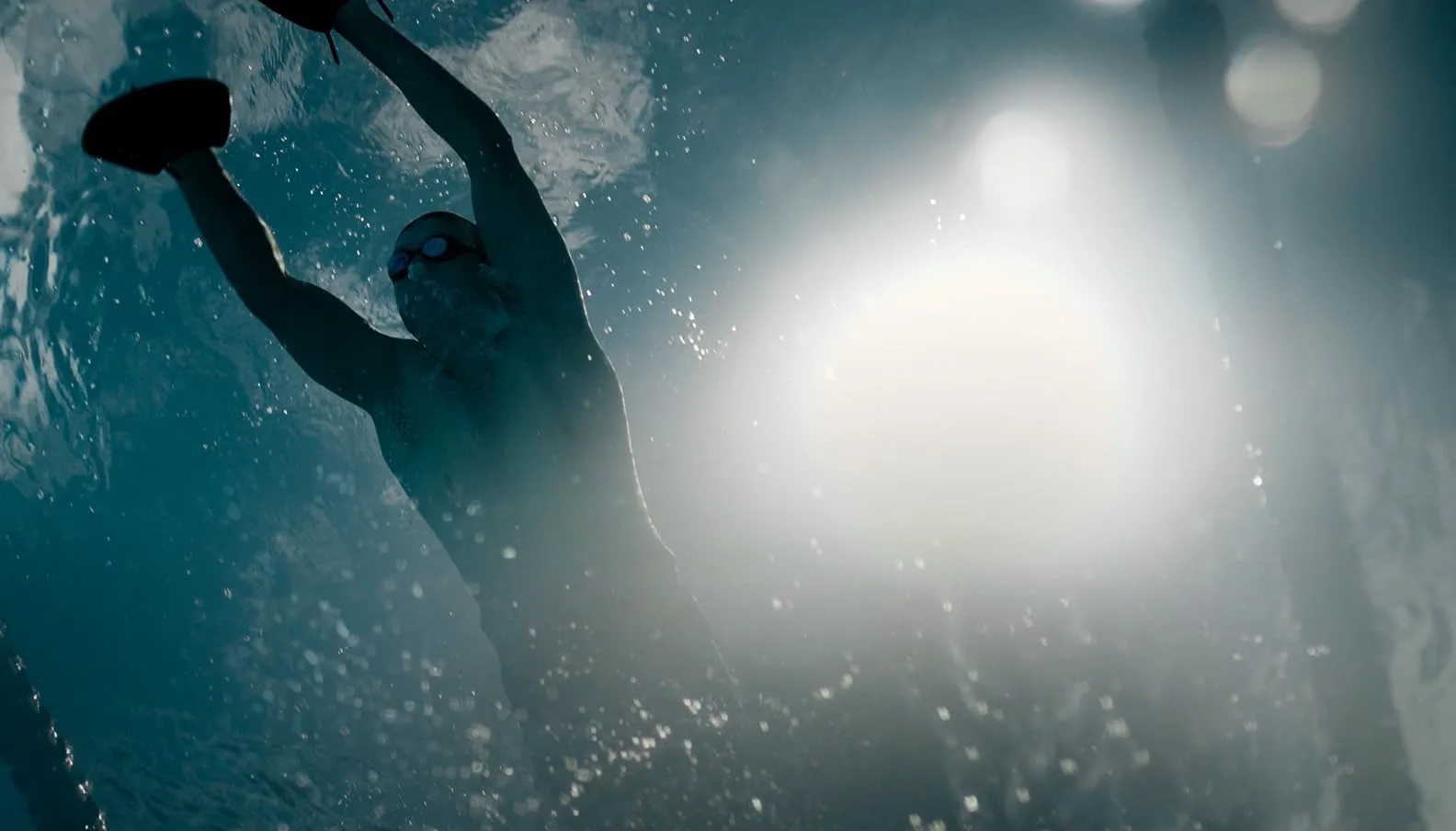
Tseng captures this scale best from above. Drone shots reduce Sowerby to a moving speck, his arms repeating the same motion against an expanse with no visible interest in his survival. Underwater photography gives the ocean a deceptive clarity. Nothing seems to be happening, which is precisely what makes it unnerving. Human beings have an old habit of interpreting visibility as safety. Sharks did not sign that agreement.
The financial cost receives briefer attention. Boats, coaches, permits and international travel place the Oceans Seven far outside most people’s reach, while bad weather can erase an expensive attempt with hours of notice. Sowerby’s endurance is real. So is the economic platform beneath it.
Empathy Without Sympathy
The Catalina Channel provides the film’s strongest passage because the water finally becomes secondary. Swimming through darkness, Sowerby falls into a cycle of intrusive thoughts and self-loathing. His body keeps moving while his mind turns every stroke into an accusation. The scene gives depression a physical rhythm: repetition without visible progress, effort without assurance, another breath taken because stopping feels worse.

Coach Tim Denyer becomes essential here. His method is built around “empathy, but not sympathy,” a distinction that sounds harsh until the responsibility aboard the support boat becomes clear. Denyer must recognize suffering without confusing it with fatal danger. He decides when Sowerby needs encouragement and when the attempt must end. That decision carries the memory of Denyer’s own former coach, whose death shaped his code.
The documentary’s richest relationship exists in this narrow space between trust and authority. Sowerby knows Denyer will not flatter him. Denyer knows Sowerby will continue past the point where ordinary motivation has any use. Their bond is less sentimental than the familiar coach-athlete partnership. It is closer to a temporary transfer of judgment. One man enters the water. The other guards the border between courage and self-destruction.
Sowerby’s wife carries a quieter version of the same burden, travelling with him and absorbing the uncertainty that each crossing creates. Fellow marathon swimmers share stories of stings, failed attempts and shark bites. Their community recognizes an experience outsiders cannot easily translate, though the film occasionally wanders into their stories when Sowerby’s interior life needs closer examination.
The Safer Redemption Story
Sowerby presents Tseng with a difficult subject: wealthy enough to pursue a decade-long global challenge, self-aware enough to confess his arrogance, yet still shaped by the executive appetite that caused part of his crisis. The documentary introduces this contradiction, then gradually retreats from it.
His swims are framed as personal recovery, but the film rarely presses him on the difference between healing and replacing one consuming identity with another. The boardroom demanded control, performance and measurable victory. The Oceans Seven demands those same qualities in colder water. Sowerby may have escaped one version of himself by constructing a tougher version nearby.
The title’s advice comes from surviving shark-infested water: lower the heart rate, steady the breath, avoid frantic movement. “Don’t be prey” becomes a useful philosophy for fear, shame and depressive thought. It can also become another command issued by a man accustomed to defeating weakness through discipline. The film believes in this maxim so completely that it barely examines the violence hidden inside it.
Tseng’s editing often favors inspirational momentum. Interviews signal survival before the crossings can generate sustained uncertainty, while repeated accounts of sharks and hypothermia create dangers the footage seldom makes immediate. The ocean remains magnificent, cold and indifferent. Sowerby remains partially protected by the film built around him.
One aerial shot places him beside the support canoe with no shore visible in any direction. It expresses isolation with startling precision. The camera can see the distance. It never quite reaches the wound.
Don’t Be Prey is a documentary feature film that premiered on March 4, 2026. The film follows an endurance athlete taking on the dangerous Oceans Seven marathon swim challenge to overcome personal trauma. Viewers can rent or purchase the film on digital streaming storefronts like Apple TV and Amazon Prime Video.
Full Credits
Title: Don’t Be Prey
Distributor: PixelFrame
Release date: March 4, 2026
Rating: M
Running time: 91 minutes
Director: Jeff Tseng
Writers: Steven Sander, Jeff Tseng
Producers and Executive Producers: Caitlin Johnston, Jeff Tseng, Lucas Thyer
Cast: Mark Sowerby, Tim Denyer, Steven Munatones, Heidi Sowerby, Bengisu Avci, Jamie Mackay, Paul Leonard, Joanne Norman
Director of Photography (Cinematographer): Brian Loewe, Jeff Tseng
Editors: Steven Sander
Composer: Daniel Harley
The Review
Don’t Be Prey
Don’t Be Prey finds its sharpest idea in the instruction to remain calm while surrounded by predators. Jeff Tseng turns that survival advice into a philosophy of resisting panic, shame and self-destruction. The sea footage gives the idea scale, especially when drone shots reduce Mark Sowerby to a speck beside the support boat. Yet the film protects its subject too carefully, leaving his privilege, arrogance and psychological recovery in shallow water. A demanding athletic record becomes a less searching redemption story.
PROS
- Striking aerial and underwater photography
- Detailed account of open-water hazards
- Strong coach-swimmer dynamic
- Effective Catalina Channel sequence
- Thoughtful central metaphor
CONS
- Overprotective treatment of Sowerby
- Limited psychological examination
- Danger rarely feels immediate
- Inspirational editing dulls tension
- Other swimmers distract from his arc