




























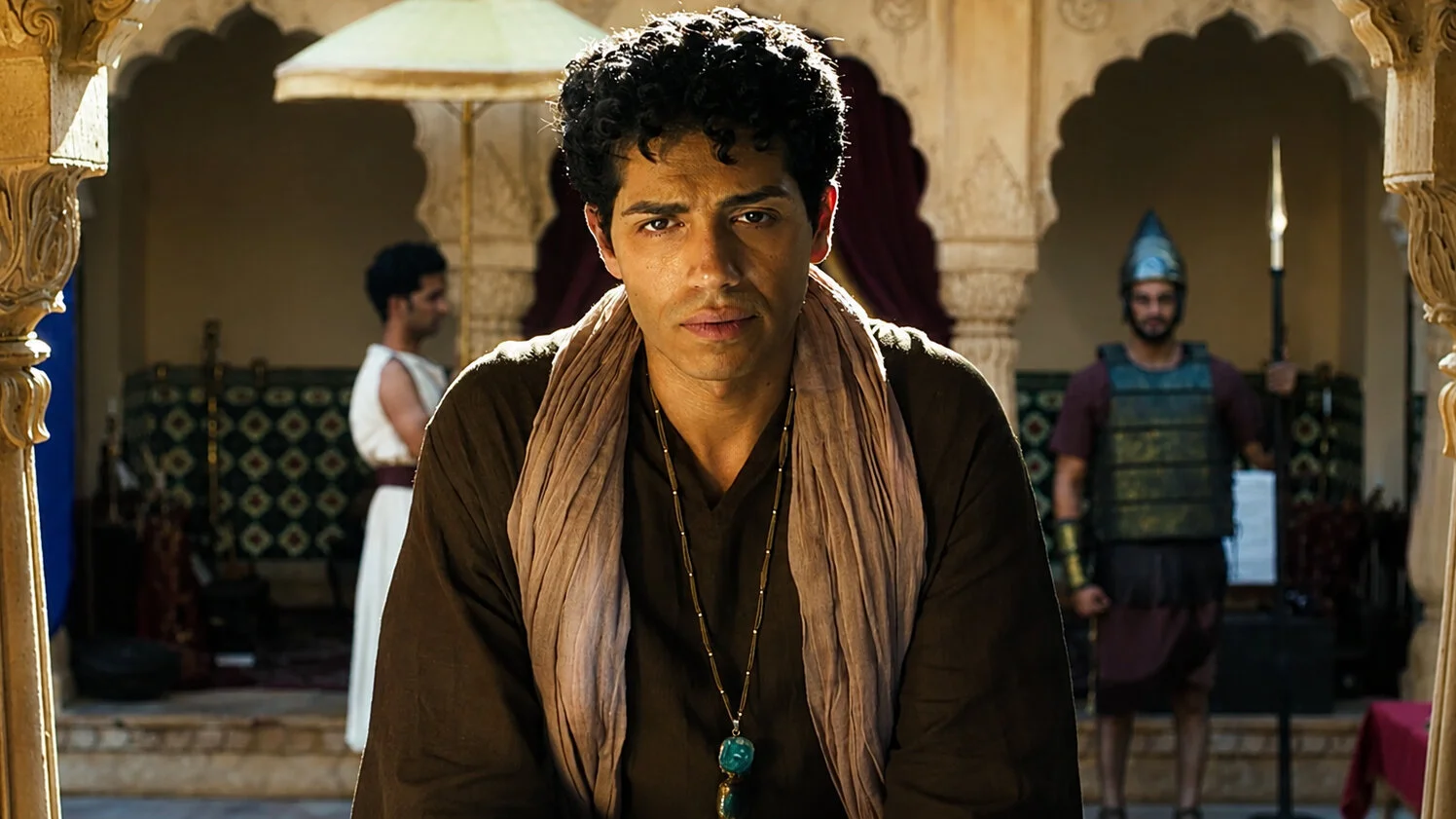

Three men standing while an entire court bows should be enough. It is a simple image, easy to understand before anyone explains its religious meaning, and it gives Daniel and the Fiery Furnace one of its most effective pieces of visual storytelling. The Kooman brothers spend much of their film reaching for the scale of a biblical epic, with armies, palaces, prophetic visions, giant statues, lions, and supernatural fire. Curiously, their movie becomes strongest whenever all that machinery gets out of the way.
Daniel and his friends Hananiah, Mishael, and Azariah are carried from Judah into Babylon after Nebuchadnezzar’s conquest. They are renamed Belteshazzar, Shadrach, Meshach, and Abednego, enter the king’s service, survive the crisis surrounding Nebuchadnezzar’s mysterious dream, and eventually face the command to bow before his image. Anyone raised on these Bible stories will recognize the basic landmarks. The film’s ambition comes from how much extra road it builds between them.
Daniel and Matthew Kooman connect the opening chapters of Daniel with Jeremiah, the exile of Judah, Habbakuk, the Magi, and an explicitly Christian interpretation of the mysterious fourth figure inside the furnace. Jeremiah appears before the Babylonian invasion and continues encouraging the exiles from afar. Susanna is inserted into Daniel’s circle. A traveling storyteller frames the narrative, with his identity eventually linking events in Babylon to the birth of Jesus.
There is an appealing idea behind this approach. The movie wants viewers to see Daniel as part of a continuous biblical history rather than a collection of disconnected Sunday-school episodes. The trouble is that every connection demands screen time. The siege, Jeremiah, Susanna, Habbakuk, the storyteller, Daniel’s rise inside the court, jealous Magi, Nebuchadnezzar’s dream, the statue, and the furnace keep competing for space. The film becomes dramatically clearer whenever it narrows its attention to Daniel and Nebuchadnezzar.
Elijah Alexander gets the richest character to play. His Nebuchadnezzar can be brutal, vain, religious, insecure, curious, and strangely affectionate toward Daniel, sometimes within the same stretch of the story. After Daniel interprets his dream, the king does not suddenly become enlightened.
He hears about a future eternal kingdom and wonders how it might connect to his own dynasty. A later conversation gives Alexander stronger material still. Nebuchadnezzar speaks about wanting his father’s approval, while Daniel tries to explain the devotion he and his friends feel toward God. Alexander lets the arrogance drop enough for us to see the need underneath it.
Mena Massoud works well opposite him because Daniel’s calm contrasts with Nebuchadnezzar’s volatility, though Daniel himself is less fully formed. His faith rarely seems to place him in serious internal conflict, so Massoud is often asked to project certainty rather than development.
The screenplay briefly finds something richer when Daniel helps design Nebuchadnezzar’s enormous image and his friends challenge him over the decision. Daniel believes he can serve the king without worshipping him. His friends are less comfortable with the distinction.
That disagreement gives the film exactly the kind of dramatic problem it needs. It turns an abstract question about obedience into conflict between people who care about one another. How far can participation go before it becomes submission? The movie raises the question, then moves on before the argument can change these characters much.
Shadrach, Meshach, and Abednego suffer even further from that lack of individual attention. The actors occasionally give them different textures, with fear, humor, and defiance emerging in flashes, but the screenplay rarely develops those differences into sustained personalities. The climax asks us to care deeply about three men choosing death rather than worship, yet the film has spent too little time making those men distinct from one another.
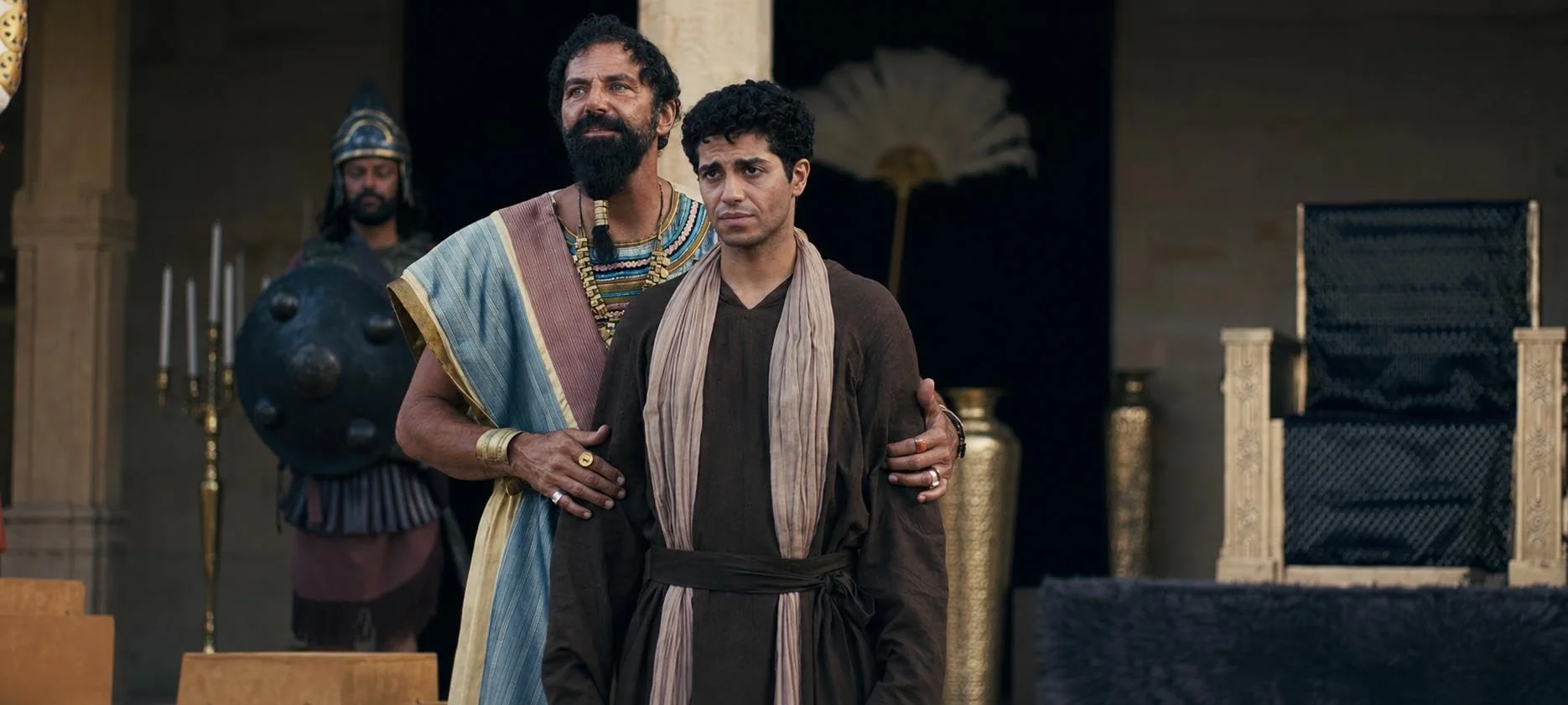
The production faces a similar conflict between ambition and resources. Period epics are expensive because every wide shot can require costumes, architecture, crowds, props, animals, extensions, and effects. One common solution is the establishing shot, an image that shows us the scale and geography of a place before the camera moves closer to the characters. Daniel and the Fiery Furnace appears to rely heavily on digital imagery, including material that looks AI-assisted, to create Babylonian cities, armies, crowds, and supernatural events beyond the reach of a modest independent production.
That resourcefulness occasionally works. The golden statue needs to dominate the ceremony around it, and the larger Babylonian environments help sell that scale. Elsewhere, the digital imagery becomes so noticeable that the viewer starts examining the effect instead of inhabiting the scene. Uneven fight choreography, inexpensive-looking costumes, inconsistent supporting performances, and occasional sound problems make the production limits harder to ignore.
The furnace sequence contains both versions of the movie at once. Nearly everyone bows while three men remain upright. Their restraints burn while their bodies do not. A bolt of heavenly fire enters the furnace, and a fourth figure appears among them. The conception is bold. The rendering of that supernatural figure is far less convincing, and the digital unreality arrives at exactly the moment when the scene needs the audience to stop thinking about technique.
Visual effects work best when they disappear into consequence. We should be watching Nebuchadnezzar’s face, the three men’s reaction, and the impossible survival taking place before the court. When the effect itself becomes the object of attention, awe turns into inspection.
That problem explains why the quieter scenes leave a stronger impression. Daniel fighting a lion gives him an action-hero introduction, but sitting across from Nebuchadnezzar tells us considerably more about him. Jerusalem’s destruction provides historical scale, but the argument over the statue makes faithfulness personal. Long prayers announce devotion, while the fear surrounding the furnace lets us see what devotion costs.
The closing frame reveals how expansive the Koomans’ conception really is. The storyteller’s destination links Daniel’s Babylon to the Magi and the birth of Jesus, while the figure inside the furnace makes the filmmakers’ Christian interpretation explicit. Viewers approaching Daniel from another religious tradition may read that construction very differently, but cinematically the intention is clear: every strand is meant to belong to one enormous story.
And yet the movie’s sharpest image remains much smaller. A crowd kneels while three men remain standing. For a film so determined to build kingdoms, prophecy, history, and heaven around them, that act contains nearly everything the spectacle is trying to say.
Daniel and the Fiery Furnace arrived in theaters nationwide on September 18, 2026, distributed by EKKL Entertainment. The biblical drama follows the prophet Daniel as he rises to power in ancient Babylon while his companions face a ruthless king and a blazing test of faith.
Where to Watch Daniel and the Fiery Furnace (2026) Online
Full Credits
Title: Daniel and the Fiery Furnace
Distributor: EKKL Entertainment
Release date: September 18, 2026
Rating: PG-13
Running time: 1 hour 48 minutes (108 minutes)
Director: Matthew Kooman, Daniel Kooman
Writers: Matthew Kooman, Daniel Kooman
Producers and Executive Producers: Matthew Kooman, Daniel Kooman
Cast: Mena Massoud, Elijah Alexander
The Review
Daniel and the Fiery Furnace
Daniel and the Fiery Furnace has the ambition of a biblical epic, but its best moments arrive when spectacle gives way to conversation, moral pressure, and simple visual choices. Elijah Alexander's layered Nebuchadnezzar gives the film its strongest character work, while Mena Massoud's Daniel and his three friends need greater individual depth. The expansive script and conspicuous digital imagery frequently strain the production, yet flashes of genuine cinematic instinct remain, especially in the refusal to bow. The filmmakers understand the story's power. They simply do not always trust its simplicity.
PROS
- Strong performance from Elijah Alexander
- Effective Daniel and Nebuchadnezzar scenes
- Ambitious biblical connections
- Powerful refusal-to-bow imagery
- Resourceful sense of scale
CONS
- Daniel and his friends lack sufficient depth
- Too many competing narrative threads
- Digital imagery can become distracting
- Uneven supporting performances and production craft
- Spectacle sometimes overwhelms the drama