










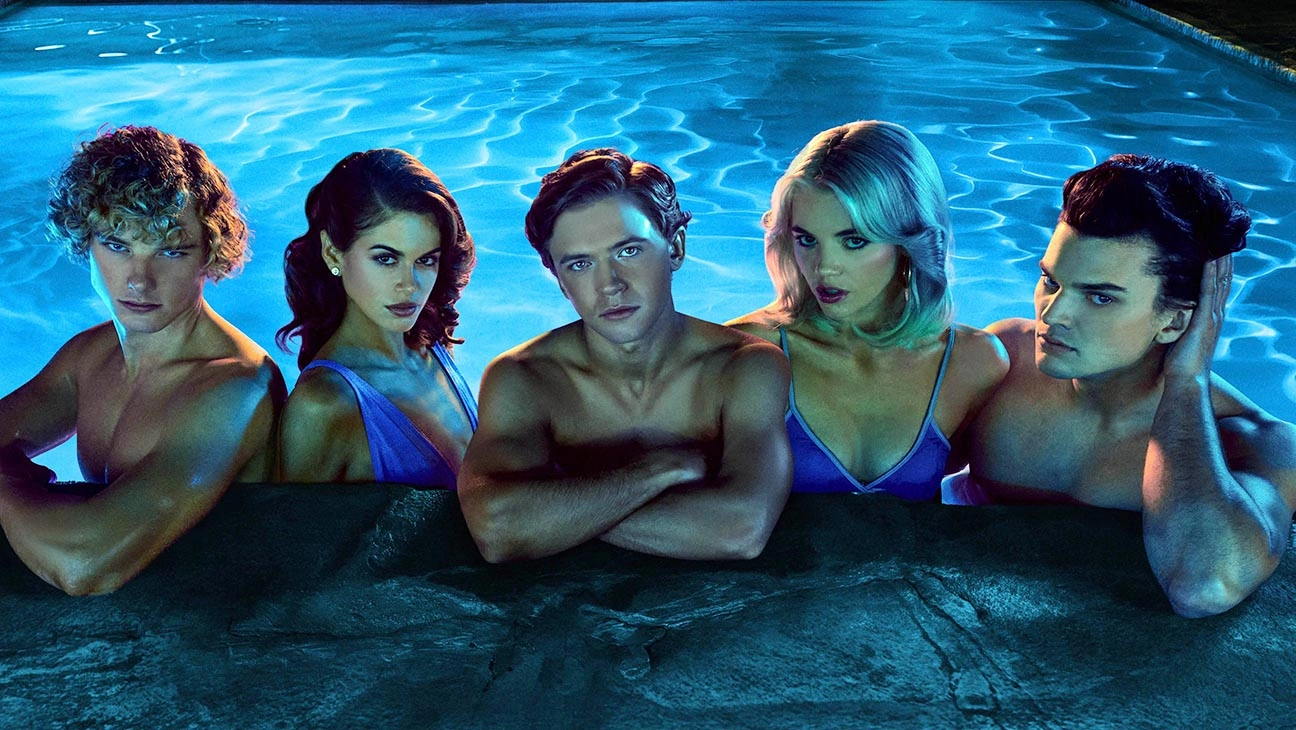

Bret complains that his generation had it harder because serial killers kept interrupting adolescence. He delivers this wisdom while driving an “old” Mercedes through the wealthy hills of Los Angeles, which tells us almost everything about The Shards before the Trawler claims another victim. Bret Easton Ellis and Ryan Murphy have built a nine-episode coming-of-age thriller around teenagers who treat cocaine etiquette as a life skill and emotional honesty as a suspicious new fad.
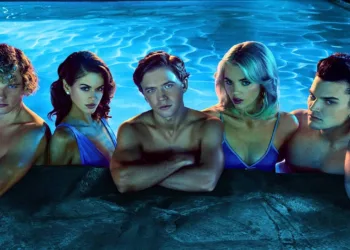
It is 1981, and Bret (Igby Rigney) is entering his final year at an elite school with his girlfriend Debbie (Hayes Warner), his adored friend Susan (Kaia Gerber), and Susan’s boyfriend Thom (Graham Campbell). Their parents are absent, drunk, working, vacationing, or some efficient combination of the four. The friends call themselves a family because somebody has to. Then students begin dying, and transfer student Robert Mallory (Homer Gere) arrives with a smile that suggests he has already read the last page.
Bret believes he saw Robert a year earlier at a screening of The Shining. Robert denies it. From that small lie, the season builds attraction, rivalry, paranoia, and a mystery that keeps changing masks. Murphy’s glossy excess fits Ellis’s emotional frost surprisingly well, until the series asks camp, horror, satire, and tragedy to share one chair. Television has survived crowded casts. Crowded tones are less polite.
Bret Performs Bret
Rigney understands that Bret is always acting, including during the scenes where he appears alone. His posture stays measured when he lies to Debbie, his voice remains cool when he discusses men he desires, and his face barely shifts when Robert enters Susan’s orbit. The control is the point. Bret has created a version of himself that can date the right girl, admire the right movies, write the right screenplay, and remain untouched by every appetite threatening to expose him.
The voiceover makes this performance explicit, sometimes painfully so. Bret narrates motives that Rigney has already made clear through a glance or a pause, leaving the actor to compete with his own explanation. Yet the narration also traps the season inside Bret’s vanity.
His remark about serial killers sounds ridiculous because it is ridiculous, but the show hesitates over how loudly we should laugh. That uncertainty follows him through each episode. Is Bret a wounded teenager turning experience into fiction, or a smug author polishing his alibi before the blood has dried?
Also Read




Rigney becomes strongest when the scripts stop answering for him. Episode 8 lets suspicion move across his eyes as Robert’s stories, Susan’s shifting loyalties, and Bret’s own memory begin to blur. He can make stillness feel busy. A tiny delay before Bret replies to a question carries the sense that he is drafting three versions of the truth and choosing the one with the best lighting.
Gere plays Robert from the opposite direction. He smiles as if everyone around him has missed a joke, then lets a line such as “Someone has to” puncture Bret’s screenplay ambitions with casual precision. Robert is most effective as the person who sees through Bret’s presentation. The trouble arrives when the Trawler plot asks him to seem physically dangerous. The scripts preserve his mystery by withholding behavior, motive, and edge, so his menace often has to be supplied by music and Bret’s staring. A smirk can carry a scene. It cannot carry an arrest warrant.
The Family Without Parents
Susan, Debbie, Thom, and Bret drink, smoke, study, party, and sleep together in homes where adults rarely enter the frame. Their claim that they raised one another sounds touching until their idea of childcare becomes another round of cocktails. The series gets sharp comic mileage from the gap between their practiced sophistication and their teenage panic. Susan scolding Debbie for openly doing cocaine at Hamburger Hamlet is a perfect social rule from this world: addiction is tolerable, bad table manners are not.
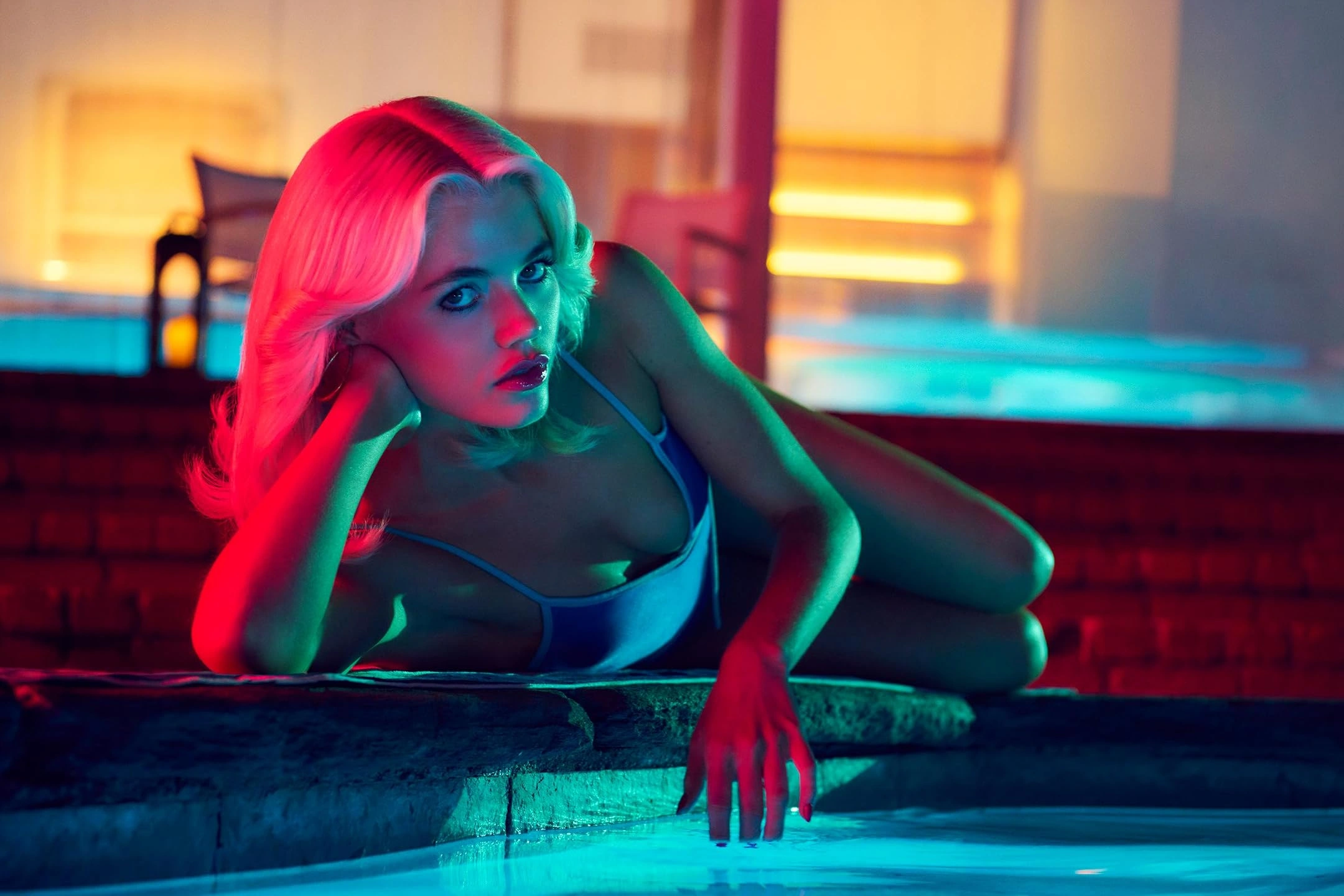
Gerber gives Susan the ease of someone accustomed to winning before the contest begins. She is class president, an excellent student, socially untouchable, and desired by Bret, Thom, and Robert in different ways. Her attraction to Robert disrupts the group because Bret has built his future around Susan staying exactly where he placed her. Thom receives less interior life, functioning mainly as part of the photograph Bret wants to preserve. He is the boyfriend, the athlete, the proof that the group still looks correct from across the room.
Debbie has the messier household and the livelier material. Her father Terry (Wes Bentley) is an acclaimed producer whose affairs with men remain hidden behind money and status. Her mother Liz (Evan Rachel Wood) is a former actress numbing herself through alcohol while the family performs normality. Bentley gives Terry a warm professional charm that makes his neglect feel routine, which is far uglier than open villainy. Wood lets Liz’s bitterness arrive sideways, through a slurred comment or a look held after everyone else has moved on.
Bret’s fascination with Terry supplies one of the season’s darkest ideas. Terry represents an adult life where secrecy can be maintained through wealth, marriage, and industry influence. Bret sees the cost and still envies the arrangement. The murderer outside the house is terrifying. The future sitting at the dinner table may be worse.
Welcome to 1981, Repeatedly
Murphy directs the early hours like a memory contaminated by heat, drugs, and hindsight. Los Angeles sits under a soft haze, while expensive homes and quiet roads make every threat look tastefully framed. A brown van appears in wide shots before characters notice it, turning background space into a source of tension. Those glimpses do finer horror work than several later scenes of explicit violence. The van does not demand attention. It waits for you to realize you have been sharing the frame.
The production and costume design attack 1981 with the enthusiasm of a department store window. Giorgio perfume, Bain de Soleil, Maxell advertising, the arrival of MTV, sculpted hair, tinted interiors, and polished cars appear with such frequency that the period sometimes feels less observed than announced. The soundtrack follows suit, dropping Duran Duran’s “Planet Earth,” The Go-Go’s “We Got the Beat,” and Ultravox’s “Vienna” with dependable force. The songs give scenes instant propulsion, though the season occasionally uses them like historical captions set to drums.
The slower passages suit the material better. Bret drives without purpose, visits cinemas, comments on films, and watches tiny fractures appear in his friendships. Murphy gives these stretches room, then inserts horror through composition: a vehicle at the edge of a shot, an empty road held a second too long, Robert standing where Bret did not expect him. Suspense grows because the edit refuses to point and shout. Then Episode 5 discovers a dance contest.
Debbie decides she must become “Groover of the Week” on a television program, Anthony Ramos plays the flustered host, a rival named Cha Cha arrives, and the whole group participates in an overt Grease riff. Even Bret dances, presumably because the episode has hostages.
Camp can work inside this series when it exposes the characters’ vanity, yet this detour suspends the murder plot, Bret’s obsession, and the group’s collapse for a subplot with no dramatic pressure. Episodes 6 through 8 recover the haze and suspicion, but the hour leaves a bruise. Nothing says mortal danger like compulsory choreography.
The Trawler Loses the Thread
The emotional mystery is stronger than the criminal one. Robert threatens Bret because he may steal Susan, reveal Bret’s desire, expose his dishonesty, or pull apart the substitute family holding senior year together. Each fear grows from a specific relationship. The Trawler, by comparison, commits grotesque murders, including forcing living creatures into victims, yet the investigation drifts farther from the characters as the season moves forward.
Direction contributes to the split. Several confrontations are staged with an arch rhythm that invites laughter when the scene needs dread. The violence grows graphic, but suspense does not automatically rise with the body count. Early episodes understand this. A distant van and a withheld cut make the city feel unsafe. Later hours lean on revelation, spectacle, and fresh questions, as though mystery were measured by inventory.
The series also gestures toward the AIDS crisis waiting beyond 1981. Bret hides his sexuality, Terry protects his career through a false domestic image, and death shadows a group treating sex as recreation and secrecy as survival. The pieces are present, yet the season rarely makes the Trawler’s violence and that historical threat speak to each other. They remain adjacent forms of dread, sharing atmosphere without sharing dramatic logic.
Its autofictional joke fares better. Every episode carries a disclaimer denying resemblance to real people, then spends an hour with a young writer named Bret working toward Less Than Zero. The contradiction fits a series where each character maintains a public version and a private one. It may be the cleanest gag in the whole production, partly because nobody pauses to explain it in voiceover.
By the finale, existing questions are still waiting while a new mystery enters looking for accommodation. The season once made an unnoticed van feel like a promise. Its last turn feels closer to a reservation for Season 2.
The Shards premiered on August 5, 2026, and is available to stream on FX and Hulu. Set in 1980s Los Angeles, the suspenseful drama follows an elite group of prep school students whose lives are disrupted by a mysterious new arrival and a terrifying string of local murders.
Where to Watch The Shards Online


Full Credits
Title: The Shards
Distributor: FX, Hulu
Release date: August 5, 2026
Rating: TV-MA
Running time: 45-60 minutes
Director: Ryan Murphy, Max Winkler, Michael Uppendahl, Max Minghella
Writers: Ryan Murphy, Bret Easton Ellis, Juli Weiner, Charles Rogers
Producers and Executive Producers: Ryan Murphy, Nina Jacobson, Brad Simpson, Bret Easton Ellis, Eric Kovtun, Scott Robertson, Nissa Diederich, Tanase Popa, Nick Hall, Michael Uppendahl, Max Winkler, Kathleen McCaffrey
Cast: Igby Rigney, Homer Gere, Kaia Gerber, Hayes Warner, Graham Campbell, Wes Bentley, Evan Rachel Wood, Jordan Roth
Director of Photography (Cinematographer): Eric Koretz
Composer: Morgan Kibby, David Klotz, Brett McLaughlin, Troye Sivan, Hayes Warner
The Review
The Shards
The Shards turns 1981 Los Angeles into a narcotic haze of expensive cars, absent parents, bad secrets, and excellent needle drops. Igby Rigney holds its unstable center, while Homer Gere gives Robert the sly menace the scripts frequently misplace. The early suspense and Episode 8 prove Ellis and Ryan Murphy can make beautiful trouble together. Then Episode 5 arrives dressed for a different series, and the Trawler mystery gradually loses its grip. Seductive, frustrating television. At least the mess knows how to accessorize.
PROS
- Igby Rigney’s controlled lead performance
- Homer Gere’s sly, slippery presence
- Hazy 1981 Los Angeles atmosphere
- Strong period music and production design
- Effective early suspense
CONS
- Grating, overused narration
- Episode 5’s disruptive dance detour
- Uneven balance between camp and horror
- Underdeveloped Trawler mystery
- Finale adds questions instead of answers