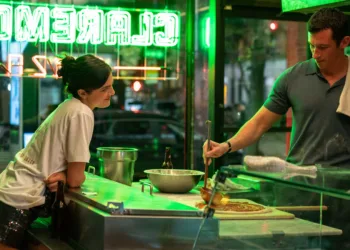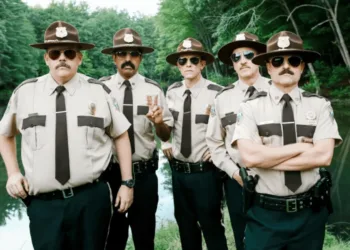



















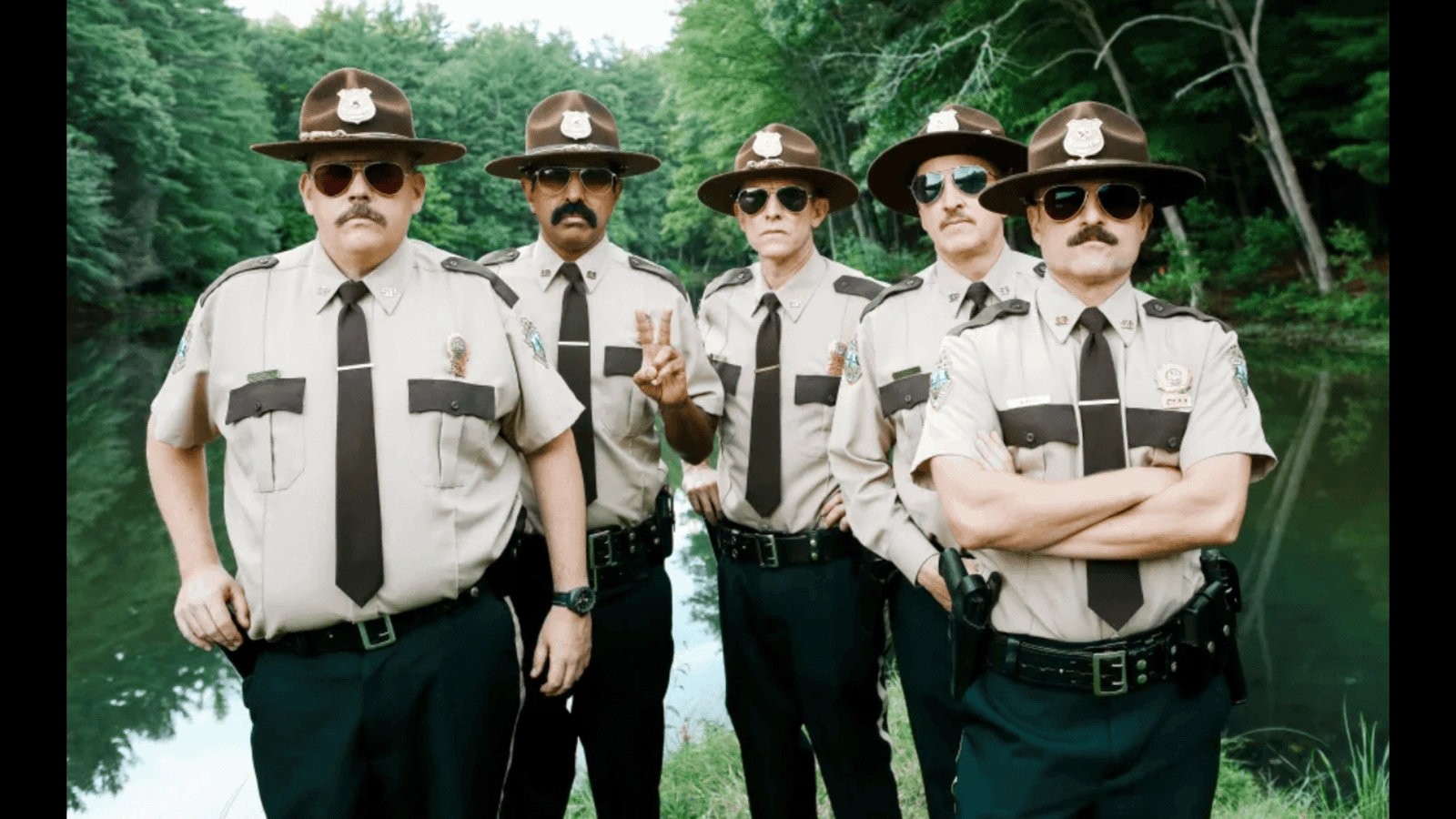

Farva rescuing Sarita from an exploding Mini is the first sensible act he has committed across three films, which may explain why everyone treats the resulting engagement as evidence of neurological damage. Sarita falls for him immediately. Thorny, her brother and Farva’s longtime victim, reacts as though Vermont has legalized a new category of crime.
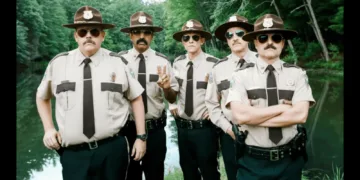
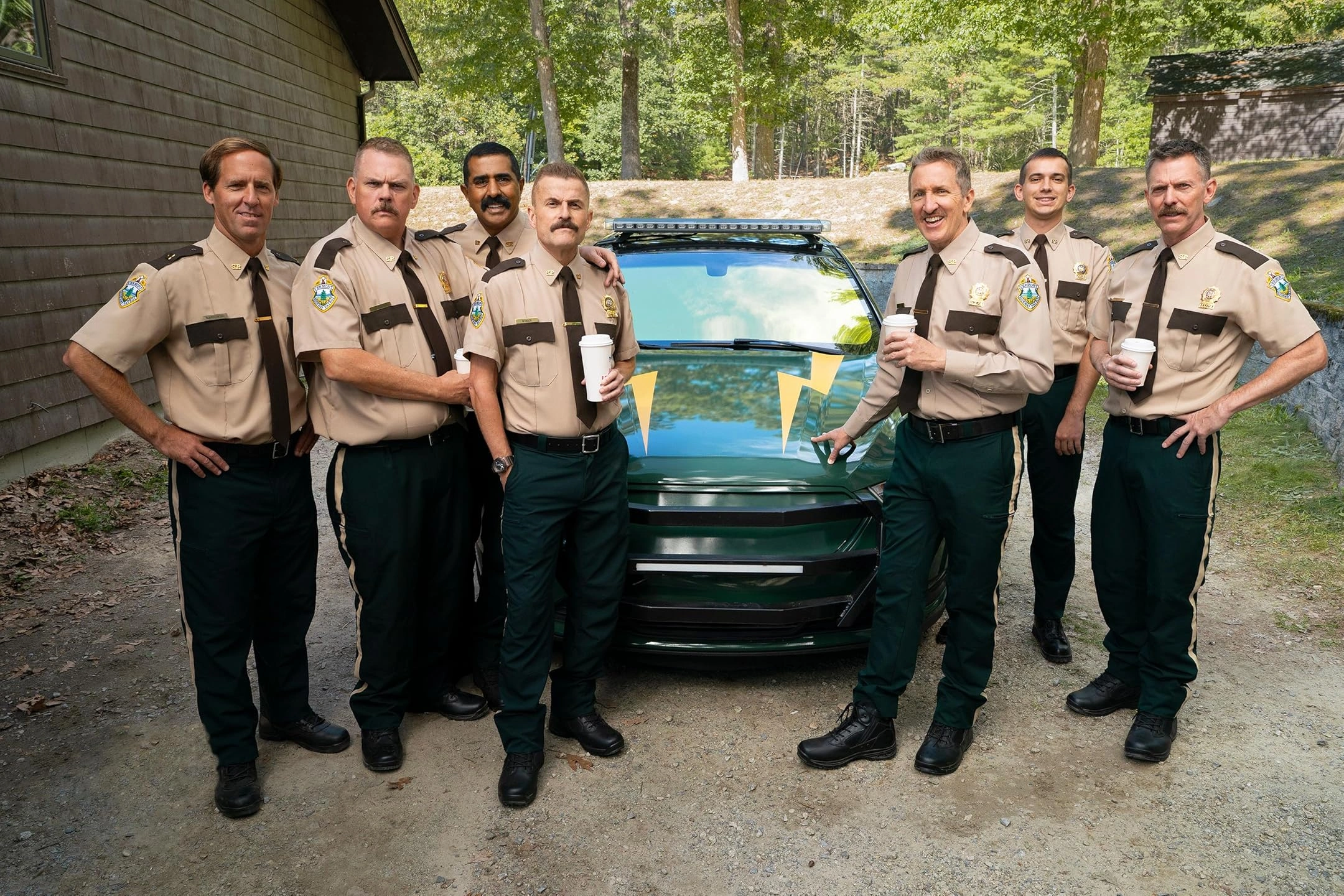
That premise gives Super Troopers 3 its clearest reason to exist. Broken Lizard’s 2001 original turned state authority into a clubhouse for bored men with mustaches, patrol cars, and too much confidence. The 2018 sequel revived the clubhouse. This third film finally places a private consequence inside it: Farva may become family. Jay Chandrasekhar, directing again and returning as Thorny, builds the best material around that violation of domestic order.
The police plot is less fortunate. Vandalized maple syrup trucks, Canadian Crystal, wedding planners with suspicious connections, and a Canadian electric vehicle form a mystery that rarely feels mysterious. The case supplies movement while the wedding supplies comedy. One is machinery. The other is a reason to watch.
Marriage as Hostile Takeover
Kevin Heffernan has spent the series treating Farva’s vulgarity as a complete moral philosophy. The man does not make choices so much as declare war on nearby oxygen. Giving him sincere romantic purpose changes the temperature. Farva is thrilled by Sarita, eager to impress her parents, and delighted by the prospect of calling Thorny his brother. His happiness becomes a weapon without requiring him to understand that it is one.
Thorny agrees to serve as best man so he can destroy the wedding from inside. Call this kinship panic: the terror produced when a tolerable public nuisance crosses into permanent private life. Thorny’s behavior is childish, yet his fear remains rational for an uncomfortable amount of time. Anyone who has watched Farva force a joke past dignity can understand the objection.
Hannah Simone keeps Sarita from becoming a blank explanation for male rivalry. She plays the instant romance straight, gives Sarita an amused confidence around Farva’s excesses, and refuses the easy wink that would turn the relationship into a hidden prank. The script gives her fewer chances to confront Thorny than it should. Her engagement drives the story, but the men keep claiming ownership of its meaning.
Also Read





That imbalance does not ruin the farce, partly because Heffernan commits to every humiliation. At the bachelor party, Farva eats lobster while knowing he is allergic, turning stubbornness into an EpiPen battle. The gag works because the pain begins with character. The film is weaker whenever bodily escalation arrives without that foundation.
Sherwanis and Social Panic
The visit to Vermont’s only Indian clothing shop gives the troupe one of its sharpest ensemble sequences. The troopers try on sherwanis, admire themselves with catastrophic confidence, and convert wedding preparation into another competition. The store’s name, Turban Outfitters, earns a quick laugh before repetition starts billing the audience twice for the same purchase.
Chandrasekhar treats the wedding’s musical numbers with surprising affection. The choreography is broad, the costumes are bright, and the men perform with the serious vanity of people who think cultural participation becomes mastery after one rehearsal. Thorny is frequently the humiliated party inside his own family celebration. That choice matters. The customs are staged as pleasurable and theatrical; his loss of control provides the joke.
Sakina Jaffrey and Iqbal Theba, playing Thorny and Sarita’s parents, sharpen the material by refusing the response Thorny expects. He assumes they will reject Farva. They meet the vulgarian with curiosity, appetite, and a talent for embarrassing their son. Thorny’s old B+ becomes a family disgrace. Farva presents a Gandhi DVD as though he has solved Indian culture. Thorny’s vegetarian father tastes beef and declares it delicious. These jokes court offense, then redirect the impact toward vanity, stereotype, and Thorny’s failed certainty.
The film is less precise when provocation becomes the whole architecture. A snakebite leads Thorny’s mother to suck venom from Farva’s neck, followed by visible erections across the room. It is committed nonsense, which is still nonsense (commitment has never possessed cleansing properties).
Nat Faxon’s new captain, Markowski, offers a cleaner target. He distributes self-help literature and speaks in the strained vocabulary of a manager who has learned inclusion as choreography. His attempts at sensitivity expose what might be called etiquette narcissism: the belief that performing awareness makes one the moral center of every room. Faxon’s pauses are better than several written punchlines.
Men Outside Their Expiration Date
The returning troopers are older, heavier, and still emotionally governed by the prospect of making a colleague look stupid. The film notices this and then retreats from the discovery. Coy Burns, played by Andrew Dismukes, arrives as a competent rookie with a TikTok fixation. His presence should make the veterans appear ancient. Instead, he slips into their rituals quickly enough to suggest that immaturity has become departmental policy.
Mac’s obsession with completing a dangerous vehicle jump turns adolescent fantasy into unfinished paperwork. Rabbit resents losing his position as the youngest man in the room. Paul Soter’s character spirals after his breakup with Ursula and tries to decode slang that may be sexual, meaningless, or both. Each thread touches the anxiety of aging without letting that anxiety alter anyone.
I initially thought this refusal was the film’s central weakness. It may be its most honest idea. Broken Lizard’s comedy depends on arrested development, so genuine growth would threaten the machine. The men cannot learn too much because knowledge would close the clubhouse. Their friendship survives through repetition, prank logic, and the shared conviction that consequences belong to someone outside the frame.
Brian Cox’s retired Captain O’Hagan embodies the same refusal from the other direction. He has left the job but keeps sitting at headquarters, heckling Markowski from the peanut gallery and discussing a girlfriend who may not exist. Cox still sounds capable of ordering an execution while surrounded by people planning a fart joke. That gap remains funny because he never asks the film to respect him.
Canada, Crystal, and the Long Ride Home
The obligatory crime story involves attacked syrup trucks, anti-corporate hostility toward “Big Syrup,” a drug called Canadian Crystal, and former weed dealers working as wedding planners. The suspects are limited, the clues are broad, and the investigation behaves like a hallway built to connect the jokes.
Canada receives the usual mockery through syrup, smuggling, politeness, and electric vehicles. Steve Lemme’s hostility toward any car that is not gas-powered and American suits Mac’s fossilized adolescence. The routine keeps returning after its comic fuel is gone, then becomes structurally important during the finale. This is sketch inflation: a five-minute idea promoted to plot because nobody had the heart to fire it.
The wedding shootout tries to merge every loose thread. A trooper is trapped in syrup. Another reaches into an elephant. The drug case resolves with the sort of obviousness that makes the preceding investigation feel ceremonial. Practical props and physical commitment give the sequence energy, yet the film mistakes accumulation for momentum.
Still, the Farva and Thorny conflict survives the noise. Farva’s desire to join the family remains sincere, Thorny’s sabotage remains petty, and their rivalry finds a new form without sanding down either man. The original film found comic freedom in institutional incompetence. This one finds a smaller, stranger freedom in the possibility that the worst man at work might show up at every future holiday.
Super Troopers 3 releases in theaters on August 7, 2026, distributed by Searchlight Pictures. The comedy follows the iconic state troopers as they try to sabotage a chaotic engagement while dismantling a new drug ring.
Where to Watch Super Troopers 3 (2026) Online
Full Credits
Title: Super Troopers 3
Distributor: Searchlight Pictures
Release date: August 7, 2026
Rating: R
Running time: 104 minutes
Director: Jay Chandrasekhar
Writers: Jay Chandrasekhar, Kevin Heffernan, Steve Lemme, Paul Soter, Erik Stolhanske
Producers and Executive Producers: Richard Perello
Cast: Jay Chandrasekhar, Kevin Heffernan, Steve Lemme, Paul Soter, Erik Stolhanske, Brian Cox, Marisa Coughlan, Nat Faxon, Chace Crawford, Hannah Simone
Director of Photography (Cinematographer): Joe Collins
Editors: Spencer Houck
Composer: Leo Birenberg, Zach Robinson
The Review
Super Troopers 3
Super Troopers 3 survives through what might be called comic institutional decay: the officers have aged, the jokes have not, and Vermont apparently remains willing to fund the experiment. Farva’s engagement to Sarita creates the film’s sharpest friction, especially when Thorny’s reasonable horror mutates into childish sabotage. The Indian wedding sequences carry affection, spectacle, and genuine ensemble energy. The Canadian Crystal investigation feels like paperwork stapled to the fun. Broken Lizard can still generate laughter from its shared chemistry, yet the patrol car is beginning to resemble a retirement vehicle.
PROS
- Farva and Thorny’s rivalry
- Spirited wedding sequences
- Kevin Heffernan’s full commitment
- Nat Faxon’s sensitivity-training satire
- Enduring ensemble chemistry
CONS
- Thin Canadian Crystal mystery
- Overextended electric-car routine
- Uneven cultural humor
- Recycled franchise callbacks
- Bloated action finale