














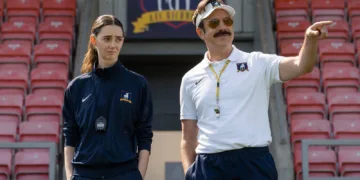










The law in One Night Only is monstrous, but the movie keeps dressing it for brunch. Three years after the United States has outlawed premarital sex, unmarried citizens receive a twelve-hour exemption from 7 p.m. to 7 a.m., their marital status displayed through tattoo-like biosensors and their compliance tracked by police. Will Gluck films this annual release valve like a citywide block party. King Princess sings “Love Is in the Air,” brands flood subway walls with condom ads, and New York glows with the soft heat of a summer date movie.
That brightness is the film’s first evasion. Travis Braun’s premise places bodily autonomy beneath state control, then Gluck uses the arrangement as an accelerator for two attractive strangers who keep meeting across Manhattan.
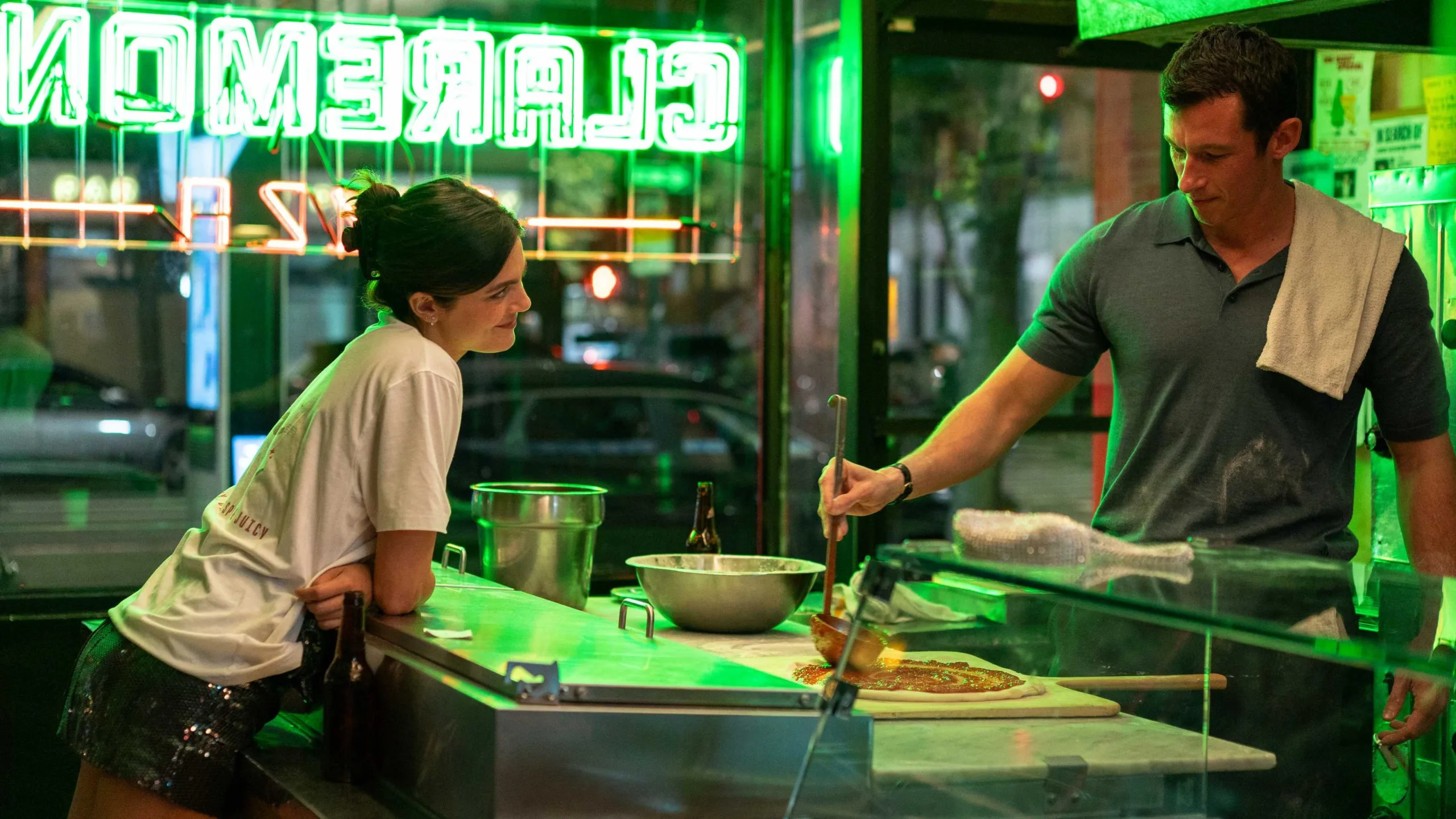
Monica Barbaro plays Allie, an aspiring singer stuck recording pharmaceutical jingles. Callum Turner is Owen, a pizzeria owner whose long-term girlfriend has chosen Mandate Night to request an open relationship. Their chemistry gives the film a pulse. The surrounding society remains a painted backdrop, charmingly lit and morally vacant.
Love on a Timer
Owen enters the night believing he has already solved romance. He has prepared an evening with Malika, played by Maya Hawke, only to learn over dinner that she plans to sleep with their neighbor. Hawke resists turning Malika into a villain. Her embarrassment and faint tenderness suggest a relationship that has been decaying beyond the edges of the screenplay. Owen’s shock lands because Turner plays it without theatrical indignation. He simply looks displaced.
Allie begins from the opposite position. She has tired of the annual parade of disposable encounters and wants something that feels chosen rather than scheduled. Their first meeting appears ready to deliver the polished spark Gluck handled in Anyone But You. Then Owen vomits sushi in the street. The gag punctures the fantasy, forcing the pair to rebuild attraction across accidental reunions.
The structure resembles an all-night urban chase. Allie leaves with Ezra Stone, a rock star whose image proves stronger than his reality. Another prospective partner is on parole for repeated mandate violations and ends up fleeing a bedroom naked while police close in. Owen turns to dating apps and hurried introductions, each shaped by the panic of a clock that promises freedom for twelve hours and punishment after sunrise.
Also Read






The repeated collisions work because Barbaro and Turner recognize attraction before the screenplay permits their characters to name it. Their pauses last longer after each meeting. Irritation becomes curiosity, then relief. Yet coincidence performs too much of the emotional labor. The film keeps placing them together, then treats placement as intimacy.
The citywide condom shortage sends them to a bodega where the final one costs $200. A broken ATM extends the ordeal, and a postcard from An Affair to Remember announces that New York is for lovers. The reference reaches for grand romantic lineage. The scene offers another shared errand beneath neon. A deadline that should generate desperation barely raises the temperature.
Stars Doing the Heavy Lifting
Barbaro gives Allie a personality the writing only sketches. Her pharmaceutical recording sessions are Gluck’s cleanest comic invention, especially when she belts out songs about plaque psoriasis and intimate medical products with the conviction of a stadium performer. The joke works because she never winks. She sings corporate embarrassment as emotional truth.
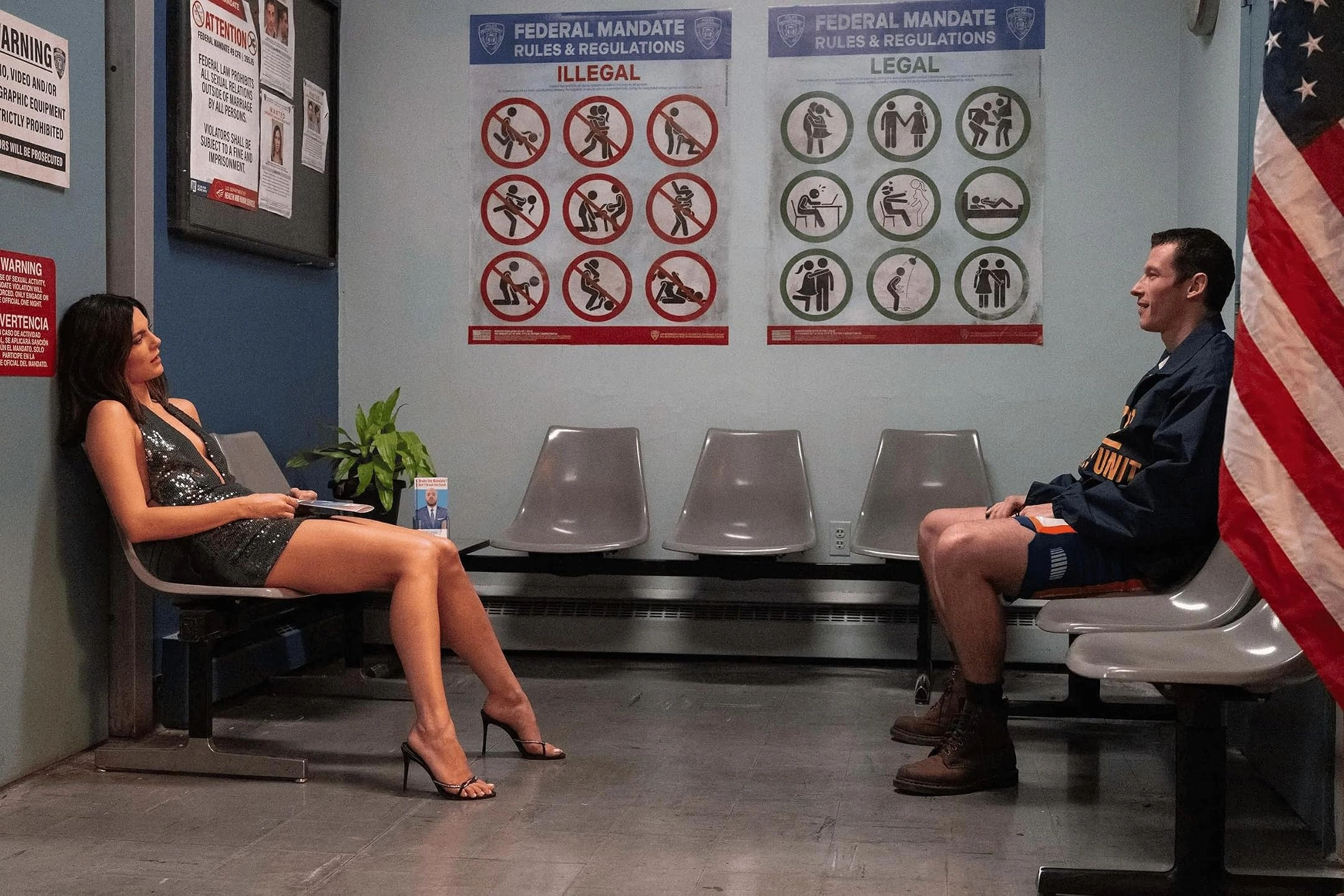
The rooftop chase pushes that commitment further. Half-dressed, pursued by police, and hiding a condom in her mouth, Allie becomes the kind of studio-comedy heroine who survives humiliation by increasing its velocity. Barbaro refuses vanity, which lets the sequence recover some of the loose physical pleasure associated with Gluck’s earlier work. Small silences after failed encounters also suggest exhaustion with Mandate Night. The film rarely gives her language for that fatigue, so Barbaro supplies it through posture and timing.
Allie’s career remains a gag without a dramatic destination. Her dream sequences are explained as products of a creative mind, an excuse that sounds like the screenplay filing its own paperwork. She wants a lasting connection, but the film offers little history behind that desire. Allie is vivid from moment to moment and curiously blank across time.
Turner faces the harsher problem. Owen is kind, handsome, sincere, and available. He owns a pizzeria, which gives him an occupation and a room full of red sauce, yet few traits emerge beyond decency. Turner’s quiet rhythm complements Barbaro’s sharper comic energy. He listens well, carries disappointment without self-pity, and makes Owen easy to like. The role still leaves him occupying the story like a safe choice in human form.
Their chemistry is real. Their bond is assumed. The film can show why two movie stars look good crossing a hot Manhattan street together. It cannot explain why these two people should reorganize their lives around each other.
A Mandate Without Politics
The government’s control is visible everywhere. Biosensors turn marital status into public data. Police monitor condom use. A red-tied president defends the law through family-values language. A Fox-style news channel celebrates the exemption with the giddy tone of a sales event. Graffiti tells the mandate to go to hell, repeal signs sit in windows, and the Statue of Liberty appears in a chastity belt.
These details create recognition without analysis. The film knows the symbols of authoritarianism and displays them like familiar furniture. No resistance movement enters the plot. Arrested dissidents vanish after their jokes. Owen and Allie never ask what this law has done to the country beyond complicating their evening.
The passivity becomes clearest around the queer characters. Allie’s roommate, played by Quintessa Swindell, calls Mandate Night a holiday for straight people and notes that queer communities have spent centuries working around laws designed against them. It is the sharpest line in the film because it identifies the mandate as a continuation of existing power rather than a strange future invention. Then the character exits the central action and ends up babysitting.
King Princess appears as Allie’s heterosexual friend, meets a dream man in a bathroom line, and disappears. Same-sex couples occupy background space. Queer resilience becomes a visual credential while heterosexual romance remains the only story granted movement, danger, and reward. The film wants credit for seeing exclusion without surrendering narrative room to the excluded.
Sex workers receive even less generosity, appearing as thieves who fleece men in the woods. Activists become comic eccentrics. A man on parole for repeated sex is useful until the police arrive. The system produces criminals, then the film treats criminalization as personality.
Abstinence as Romance
The screenplay’s moral pattern grows clearer as the night continues. Casual sex ends in humiliation. Open relationships produce guilt. Desire without emotional certainty becomes a trap. Allie and Owen establish their virtue by refusing the annual frenzy around them.
Placed inside an ordinary romantic comedy, that choice might read as a defense of patience. Here, patience has been legislated under threat of arrest. The film still frames abstention as evidence that the leads possess greater emotional maturity than the people trying to use their single legal night. State coercion and personal restraint become visually indistinguishable.
Gluck’s Easy A understood that social control becomes dramatic only when a character seizes the narrative used against her. Olive Penderghast turns rumor into performance, then stages a protest in the middle of a basketball game. Allie and Owen obey almost every rule placed before them. Their rebellion is private, polite, and compatible with the law.
That choice might have exposed the smallness of privileged resistance. The film provides no sign that such an argument is intentional. Its middle-class characters keep working, dating, buying coffee, and accepting surveillance as civic weather. Love becomes a shelter from politics rather than a reason to confront it.
Without revealing the final turn, the film imagines happiness within the mandate and leaves the mandate standing. A romance built under fascism does not automatically endorse fascism. A romance that treats fascism as quirky production design has already made a choice.
The Sponsored Dystopia
Gluck knows how to manufacture studio pleasure. Yaron Orbach’s cinematography turns the city into an airy lovers’ playground, full of warm storefronts, rooftops, pizzerias, and crowded sidewalks. The camera moves with an ease that keeps the night buoyant. Molly Ringwald and LeVar Burton attack Owen’s family material with comic confidence, including the sight of the older couple wrapped in protective material. Charlie Gillespie embraces Ezra Stone’s fraudulent rock-star vanity, and Andrew Burnap commits fully to the naked escape from police.
The same polish hides the film’s most embarrassing contradiction. Durex, KY Jelly, CitiBike, Dunkin’, dating apps, and pharmaceutical companies occupy the frame while the script gestures toward the commodification of intimacy. During an emotional scene, Owen arrives carrying two Dunkin’ coffees framed with the reverence of supporting actors. Satire and sponsorship merge so completely that the movie cannot tell which one is speaking.
Friends with Benefits and Easy A used self-awareness to expose the performances people build around sex, reputation, and romance. One Night Only preserves the knowing title cards, pop references, and conspiratorial tone, then empties them of friction. Its characters live under surveillance, its corporations monetize scarcity, and its queer citizens are pushed aside. The camera keeps smiling. That smile is the film’s governing ideology.
One Night Only was released in theaters by Universal Pictures on August 5, 2026. The romantic comedy follows two single New Yorkers scrambling to find a partner on the single night of the year when pre-marital sex is legal.
Where to Watch One Night Only (2026) Online
Full Credits
Title: One Night Only
Distributor: Universal Pictures
Release date: August 5, 2026
Rating: R
Running time: 102 minutes
Director: Will Gluck
Writers: Travis Braun
Producers and Executive Producers: Will Gluck
Cast: Monica Barbaro, Callum Turner, Maya Hawke, Julia Fox, King Princess, Ben Marshall, Ziwe, Molly Ringwald
Director of Photography (Cinematographer): Yaron Orbach
Editors: Tia Nolan
The Review
One Night Only
One Night Only has the surface pleasures of a studio rom-com: Monica Barbaro’s comic nerve, Callum Turner’s gentleness, and a polished New York night built for accidental encounters. Its political premise keeps exposing the emptiness beneath that charm. A government ban on premarital sex becomes set dressing, queer characters are reduced to exits and background gestures, and romance is framed as accommodation to coercion. The leads can sell attraction, but the film never earns love or the system’s unchallenged survival.
PROS
- Monica Barbaro’s fearless comedy
- Appealing lead chemistry
- Catchy pharmaceutical jingles
- Polished New York photography
- Energetic supporting performances
CONS
- Politically passive screenplay
- Thin central characters
- Queer roles pushed aside
- Weak countdown tension
- Product placement blunts satire