








Grief becomes legislation in Donkey Princess. After his wife dies from plague, King Arthur responds by outlawing love across his realm, transforming private sorrow into public policy. It is an absurd decree, yet Cristóbal León and Joaquín Cociña give it the cold logic of authoritarianism: the King cannot control death, so he controls everyone still alive.
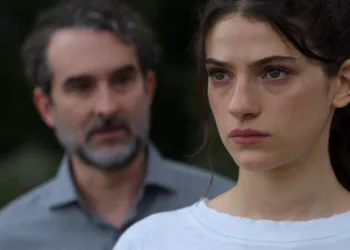
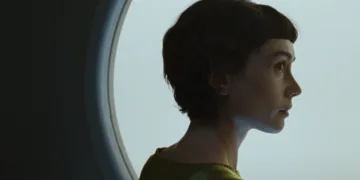
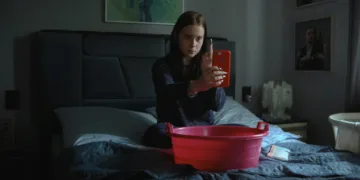
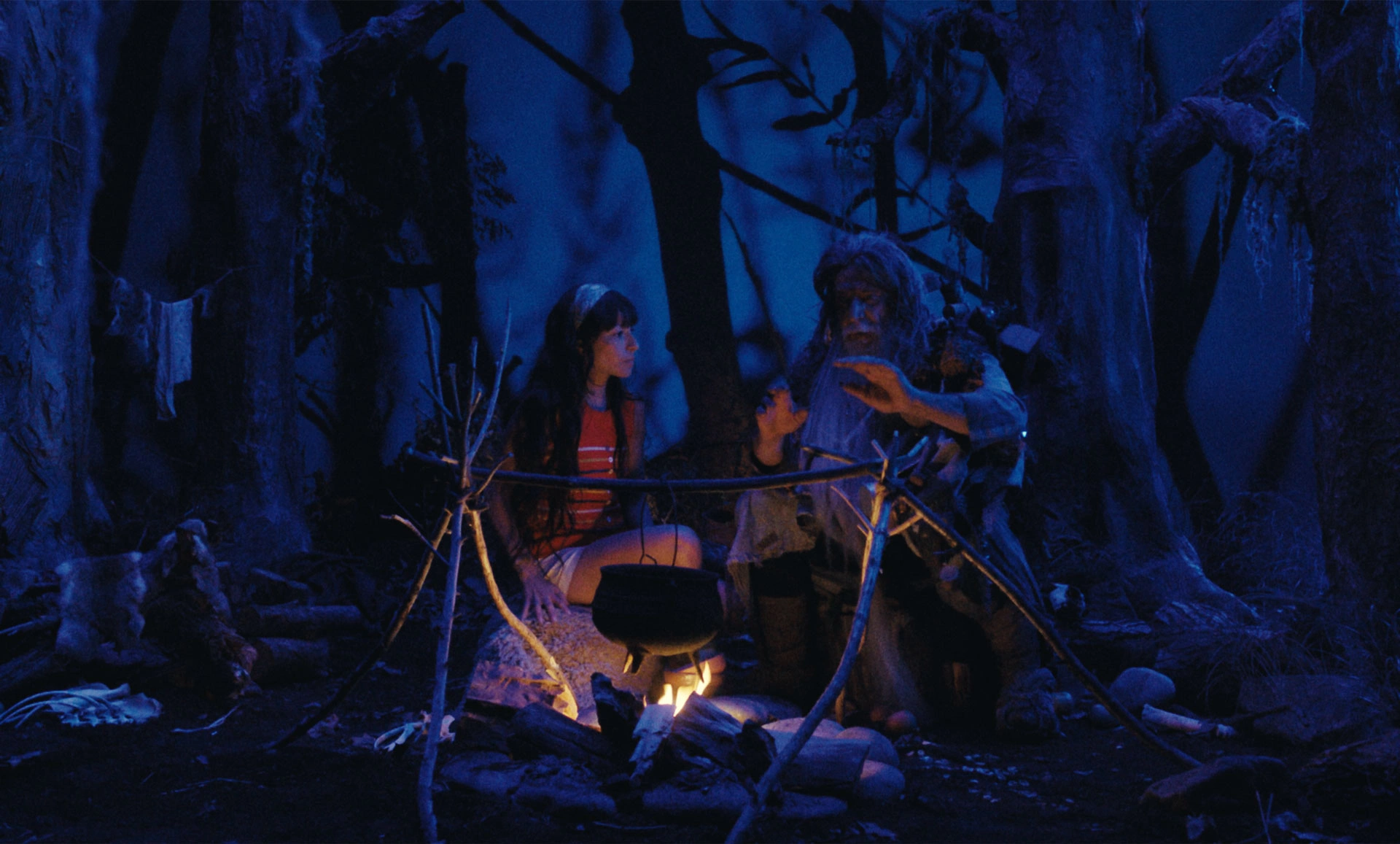
His daughter Diana lives inside that logic. Antonia Giesen plays her with an alert stillness, particularly around Francisco Melo’s King, whose protection has curdled into possession. Their kingdom looks equally unstable. Toadstool-shaped towers, bare-branch forests, fiberglass mountains and stray animated birds make the royal landscape resemble a theatrical set that could collapse if somebody leans against the wrong wall.
Then Andrew Bargsted’s Lalo appears at Diana’s birthday celebration. Their attraction gives the King another uncontrollable force to suppress. His decision to banish Lalo to an orange wasteland of thorns and vultures turns paternal jealousy into geography. The landscape itself becomes punitive.
Before leaving, Lalo gives Diana a bracelet capable of carrying her into another kingdom and another time. She presses its button when royal authority has made ordinary escape impossible.
The Same Shadow, Different Light
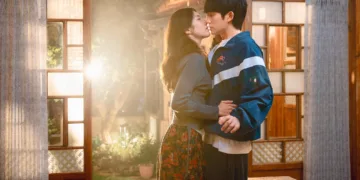
Diana nearly gets hit by traffic when the bracelet deposits her into something resembling contemporary Chile. The transition has the violence of waking from a dream too quickly. Medieval clothes become a winter coat. Car traffic flickers around her through stylized animation. Apartment blocks replace painted castles.

Also Read





Lalo is here too, now her husband and co-worker in a pest-control business dealing with a bat infestation. A health emergency has produced curfews. The setting has changed, yet restriction has followed her. So has her father.
He is no longer an absolute monarch. Age and illness have stripped away much of his physical authority, but the emotional geometry remains remarkably similar. Diana still moves around him. The King has lost his throne without surrendering his gravitational pull.
This is where León and Cociña’s shifting visual grammar becomes philosophically sharp. Political domination in the fairy-tale kingdom is visible because it wears a crown. Inside a recognizable modern household, obligation becomes harder to identify. Authority survives by changing costume.
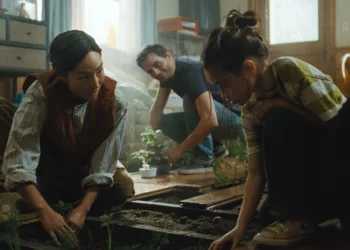
Other realities complicate Diana’s wish further. One turns her into a television actress wearing a donkey suit. Another places her on a beach beside a different husband while Lalo plays nearby with another partner and child. Each life offers some variation on romance, domesticity or professional identity. None produces the clean escape promised by fairy tales. Freedom, the film suggests, has a nasty habit of inheriting old furniture.
Handmade Instability
Few filmmakers make artificiality feel this physical. León and Cociña refuse the polished seam between animation and live action that hybrid cinema usually seeks. Their seams are visible, sometimes aggressively so.
Natalia Geisse’s production design gives the opening kingdom the texture of an abandoned storybook display. The sickly turquoise walls and crude mountains announce their construction rather than hiding it. Small 2D creatures flutter through three-dimensional spaces. Lalo’s exile moves toward silhouette animation, recalling early screen fantasy while making his punishment look like something cut from black paper.
The contemporary city changes the technique again. Animated vehicles surround Giesen’s live-action body, leaving Diana visually stranded between forms before she understands the rules of her new existence. Later realities borrow from romantic drama, science fiction, television production and horror without settling comfortably inside any of them.
Jean-Benoît Dunckel’s score helps hold those fractured spaces together. Its presence gives the dimensional jumps a strange continuity, like one melody heard through several neighboring walls.
The directors’ approach to lighting is equally revealing. Their fairy-tale spaces rarely provide comfortable depth. Figures appear boxed against fabricated scenery or trapped inside compositions crowded by branches, painted surfaces and theatrical architecture. Diana can cross centuries, yet the frame keeps finding new ways to confine her.
The King Without a Crown
The bracelet initially seems to give Diana the power missing from her childhood. Press a button, reject the current reality, try again. Yet repetition slowly exposes the trap inside that freedom. Diana can select another world without controlling what she carries into it.
Her early desire centers on Lalo. Escape means being with him because romance appears to be the opposite of her father’s prohibition. The later realities weaken that equation. A marriage can become another arrangement to endure. Seeing Lalo living happily with somebody else forces Diana to encounter a possibility that fairy tales rarely grant their princesses: the desired prince may have been an exit sign rather than a destination.
The film is less disciplined during its final movement. Once the pattern becomes clear, another shift of circumstance occasionally confirms an idea already established. Melancholy starts circling itself, and the coming emotional destination becomes easier to see. Then the film turns vicious.
A late piece of body horror uses practical effects and harsh, crunchy sound with startling force. The handmade quality that previously made castles charming and forests uncanny suddenly makes flesh horribly tangible. There is no protective digital sheen between the viewer and the damaged body. León and Cociña place physical corruption inside the same tactile aesthetic that produced their fairy-tale scenery, making beauty and decay feel manufactured by the same pair of hands.
By then, Diana’s real conflict has moved far from the question of which kingdom might make her happy. Her father’s power has survived royal robes, illness, temporal displacement and changing genres. What remains is the harder problem: learning to recognize authority after it stops looking like authority.
Donkey Princess premiered on August 7, 2026, at the Locarno Film Festival. Set in a fantastical kingdom where love is forbidden, the story follows a princess who uses a magical bracelet to cross worlds and search for her banished love.
Full Credits
Title: Donkey Princess
Distributor: Bendita Film Sales
Release date: August 7, 2026
Running time: 90 minutes
Director: Cristóbal León, Joaquín Cociña
Writers: Cristóbal León, Joaquín Cociña, Alejandra Moffat
Producers and Executive Producers: Leon & Cociña Films, Globo Rojo Films, Autentika Films, Metonymie, Montelona Films, Viking Film
Cast: Antonia Giesen, Andrew Bargsted, Francisco Melo
Director of Photography (Cinematographer): Benjamín Echazarreta
Editors: Soledad Salfate, María Salazar, Cristóbal León, Joaquín Cociña
Composer: Jean-Benoît Dunckel
The Review
Donkey Princess
Donkey Princess treats every new reality as another room Diana has been locked inside. The scenery changes from crooked fairy-tale castles to urban streets and sunlit beaches, yet her father’s shadow keeps finding the frame. Cristóbal León and Joaquín Cociña make that repetition visually purposeful, particularly when handmade animation bleeds into live action and authority survives after royalty disappears. The final movement circles its destination for too long, weakening some of the tragedy. Then the practical-effects horror arrives, ugly and tactile, and the film remembers exactly where its teeth are.
PROS
- Extraordinary hybrid visual design
- Diana’s evolving struggle for autonomy
- Form reinforces patriarchal control
- Disturbing practical body horror
- Strong genre mutations
CONS
- Repetitive final movement
- Early storytelling can feel scrambled
- Some realities receive limited development