


























Julian of Norwich left behind almost nothing except words. A name that may not have been her birth name, a small room attached to a church, and a record of visions that survived the collapse of the world around her. That absence becomes the space where Caroline Golum’s Revelations of Divine Love breathes. The film does not attempt to recover a complete life because history offers no complete life to recover. Instead, it sits with the fragments.
The year is 1373. Julian (Tessa Strain) lies near death after a mysterious illness, receiving the final rites of the church as her body fades. In that fragile space between life and death, she experiences visions of Christ’s Passion. The visions do not arrive as simple comfort. They arrive with blood, fear, beauty, and questions.
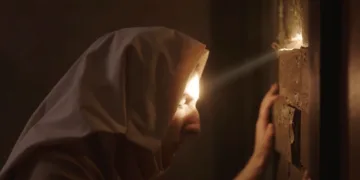
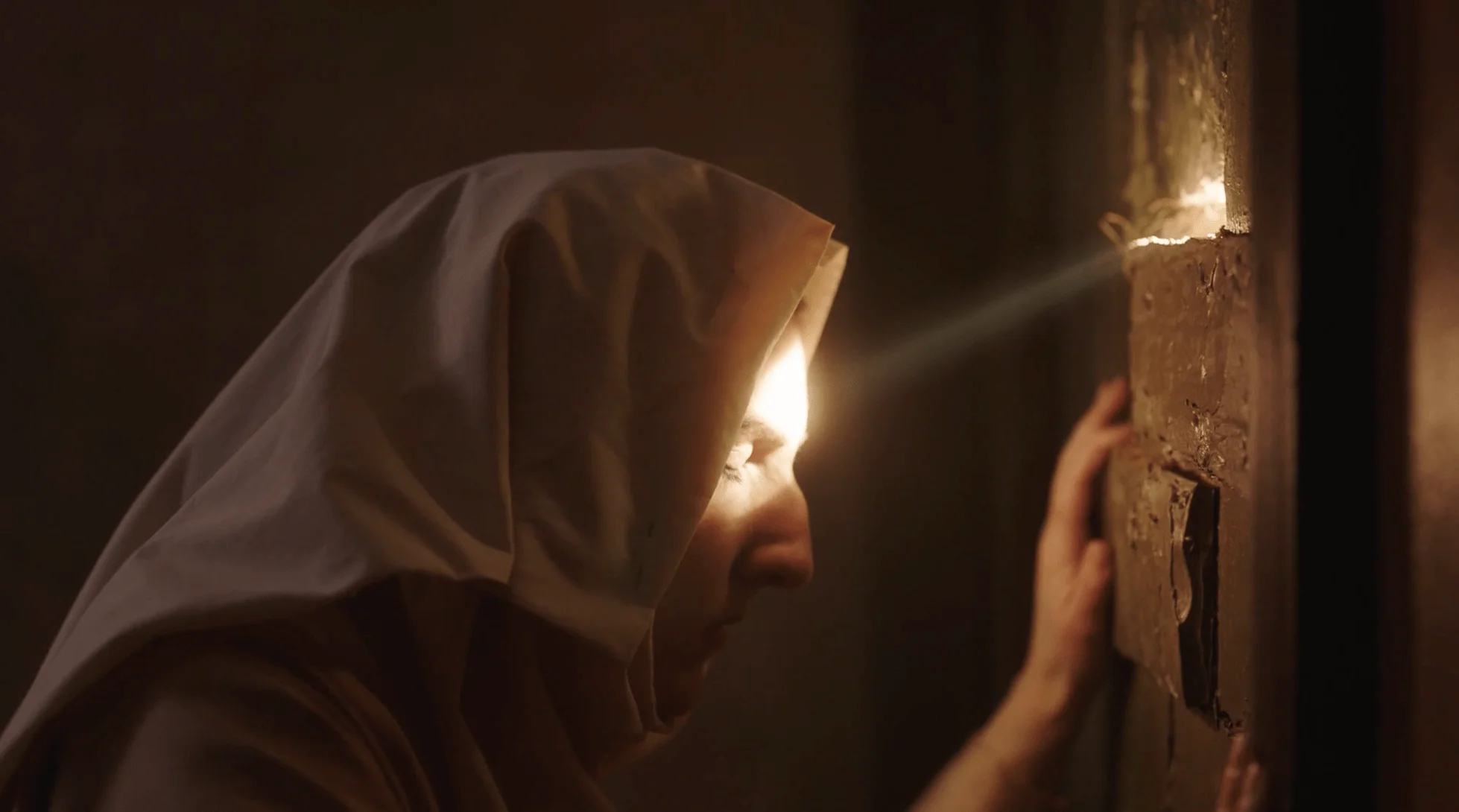
When Julian survives, she chooses a life of enclosure as an anchoress, living inside a small cell attached to St. Julian’s Church while dedicating herself to prayer, reflection, and writing. Golum’s film understands that Julian’s isolation contains a strange contradiction. The walls close around her, yet they become the place where her voice escapes into centuries.
The Weight of a Small Life
The film’s greatest strength comes from its patience with Julian’s existence. There are no grand battles or traditional historical spectacle. Medieval England appears through the voices that reach Julian’s window. People arrive carrying grief, anger, guilt, and desperation.
The plague moves through the countryside. Poverty and exploitation shape the lives of ordinary people. The outside world presses against Julian’s quiet space. Her cell becomes a listening room for a wounded society.
Golum imagines conversations between Julian and those who seek her counsel, creating a portrait of a woman who is physically removed from the world while remaining deeply connected to it. A young woman mourns the loss of her children during the plague. A laborer speaks about injustice and suffering. These encounters expand Julian’s writings beyond private devotion, presenting them as the record of someone observing human pain with open eyes.
Also Read






The film finds something haunting in this arrangement. Julian cannot walk into the streets and change what she sees. She cannot stop disease or repair a broken social order. She can only listen, pray, and write. Sometimes history belongs to those who held power. Sometimes it survives because someone trapped behind a wall kept a candle burning.
A Medieval World Made By Hand
Golum creates a medieval landscape that refuses the polished realism often associated with historical cinema. The sets, miniatures, painted backgrounds, and costumes carry the visible marks of human hands. The church, Julian’s room, and the surrounding village feel like pages from an illuminated manuscript brought into motion. This artificiality becomes the film’s most honest choice. The production does not pretend to recreate a world no camera ever witnessed. It creates a memory of that world.
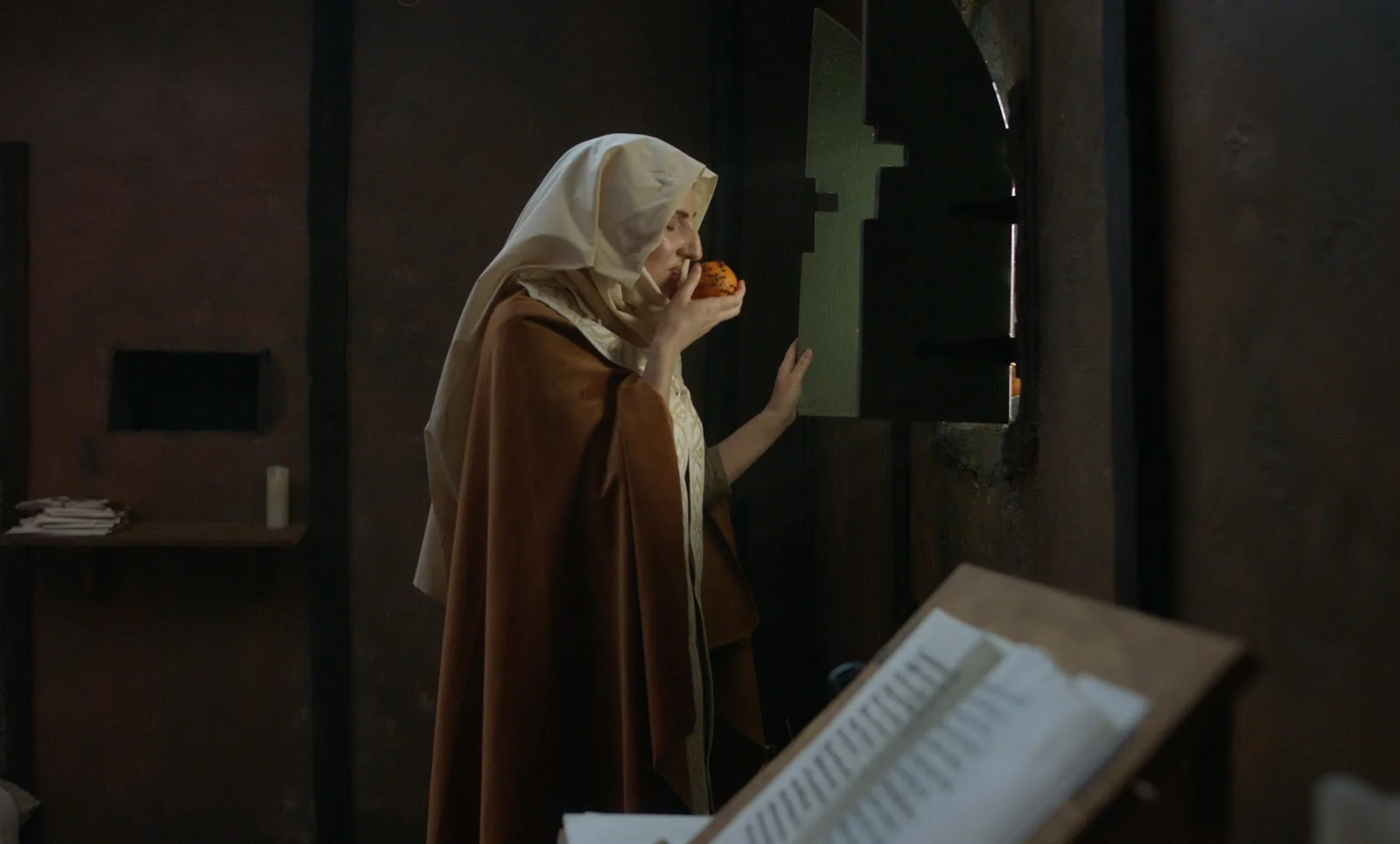
Gabe Elder’s cinematography bathes the film in colors inspired by stained glass. Blue, crimson, and gold transform ordinary spaces into places of spiritual intensity. The candlelight surrounding Julian’s writing desk feels almost like a second presence, a quiet companion watching over her work. Nell Simon’s costumes reinforce the physical humility of the period, with rough fabrics and simple designs that make Julian’s spiritual life feel grounded.
The visions themselves move into stranger territory. Christ’s wounds become vivid images of suffering and devotion. Shadows gather around Julian during moments of terror. The supernatural sequences carry the feeling of a sacred painting becoming restless. Faith here is not presented as something comfortable. It is overwhelming.
The Woman Behind the Vision
Tessa Strain carries the film with a performance built from stillness. Julian could easily become a distant symbol, a figure preserved in religious history rather than a living person. Strain avoids that distance. Her Julian is thoughtful, frightened, curious, and constantly searching for meaning inside experiences she cannot fully explain.
The camera often frames her like a figure from medieval art, surrounded by the heavy folds of her clothing and the quiet architecture of her cell. Yet Strain gives those images a human presence. Her face carries the exhaustion of someone who has seen something impossible and must spend the rest of her life trying to understand it.
Revelations of Divine Love also carries a quiet statement about authorship. Julian’s room was a place of confinement, but it was also the place where a woman’s thoughts could survive. Without her writing, she would have disappeared completely.
The film’s final feeling comes from that strange exchange between silence and permanence. A woman who spent decades separated from the world created a voice that outlived kingdoms, plagues, and centuries. Her room vanished. Her words remained.
Revelations of Divine Love premiered in select theaters on March 27, 2026, through independent distributors like Cinema Firmament. Inspired by 14th-century mystic Julian of Norwich, the film chronicles her profound religious visions, survival through plague and civil unrest, and journey to becoming the first woman to write a book in English.
Full Credits
Title: Revelations of Divine Love
Distributor: Cinema Firmament, Nice Dissolve
Release date: March 27, 2026
Running time: 1 hour 13 minutes
Director: Caroline Golum
Writers: Caroline Golum, Laurence Bond
Producers and Executive Producers: Kate Stahl, Pierce Varous
Cast: Tessa Strain, Theodore Bouloukos, Kersti Bryan, Valéry Lessard, Samantha Steinmetz, Mary Jo Mecca, Michael McKenzie
Director of Photography (Cinematographer): Gabe C. Elder
Editors: Zach Clark
Composer: Zachary Koeber
The Review
Revelations of Divine Love
Revelations of Divine Love finds a haunting beauty inside a life defined by silence. Caroline Golum transforms Julian of Norwich’s confinement into a meditation on memory, faith, and the fragile survival of a human voice across centuries. Its deliberate pace and theatrical construction will test some viewers, yet the handmade world and Tessa Strain’s luminous performance create a rare spiritual portrait.
PROS
- Tessa Strain’s profound lead performance
- Handmade medieval visual design
- Powerful religious imagery
- Thoughtful historical perspective
CONS
- Deliberate, slow pacing
- Limited narrative movement
- Uneven supporting performances